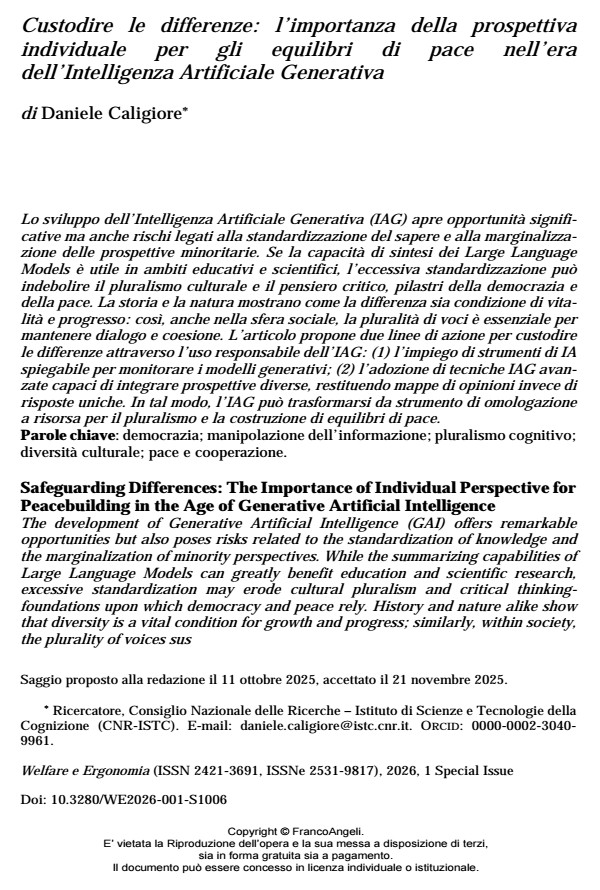
Custodire le differenze: l’importanza della prospettiva individuale per gli equilibri di pace nell’era dell’Intelligenza Artificiale Generativa
Titolo Rivista WELFARE E ERGONOMIA
Autori/Curatori Daniele Caligiore
Anno di pubblicazione 2026 Fascicolo 2026/1 Suppl.
Lingua Italiano Numero pagine 9 P. 105-113 Dimensione file 49 KB
DOI 10.3280/WE2026-001-S1006
Il DOI è il codice a barre della proprietà intellettuale: per saperne di più
clicca qui
Qui sotto puoi vedere in anteprima la prima pagina di questo articolo.
Se questo articolo ti interessa, lo puoi acquistare (e scaricare in formato pdf) seguendo le facili indicazioni per acquistare il download credit. Acquista Download Credits per scaricare questo Articolo in formato PDF
FrancoAngeli è membro della Publishers International Linking Association, Inc (PILA), associazione indipendente e non profit per facilitare (attraverso i servizi tecnologici implementati da CrossRef.org) l’accesso degli studiosi ai contenuti digitali nelle pubblicazioni professionali e scientifiche.
Lo sviluppo dell’Intelligenza Artificiale Generativa (IAG) apre opportunità significative ma anche rischi legati alla standardizzazione del sapere e alla marginalizzazione delle prospettive minoritarie. Se la capacità di sintesi dei Large Language Models è utile in ambiti educativi e scientifici, l’eccessiva standardizzazione può indebolire il pluralismo culturale e il pensiero critico, pilastri della democrazia e della pace. La storia e la natura mostrano come la differenza sia condizione di vitalità e progresso: così, anche nella sfera sociale, la pluralità di voci è essenziale per mantenere dialogo e coesione. L’articolo propone due linee di azione per custodire le differenze attraverso l’uso responsabile dell’IAG: (1) l’impiego di strumenti di IA spiegabile per monitorare i modelli generativi; (2) l’adozione di tecniche IAG avanzate capaci di integrare prospettive diverse, restituendo mappe di opinioni invece di risposte uniche. In tal modo, l’IAG può trasformarsi da strumento di omologazione a risorsa per il pluralismo e la costruzione di equilibri di pace.
Parole chiave:democrazia; manipolazione dell’informazione; pluralismo cognitivo; diversità culturale; pace e cooperazione.
- Bharathi Mohan G., Prasanna Kumar R., Vishal Krishh P., Keerthinathan A., Lavanya G., Meghana M.K.U., ... and Doss S. (2024). An analysis of large language models: their im-pact and potential applications. Knowledge and Information Systems, 66: 5047-5070.
- Caligiore D. (2024). Curarsi con l’Intelligenza Artificiale. Bologna: il Mulino.
- Caligiore D. (2022). IA istruzioni per l’uso. Bologna: il Mulino.
- Caligiore D. e Carli S. (2025). Simulating the Brain a Four-Step Method using Ordinary Dif-ferential Equations and Python. Springer.
- Castelfranchi C. and Falcone R. (2000). Trust is much more than subjective probability: Men-tal components and sources of trust. In: Proceedings of the 33rd Annual Hawaii Interna-tional Conference on System Sciences, IEEE, 10.
- Gallegos I.O., Rossi R.A., Barrow J., Tanjim M.M., Kim S., Dernoncourt F., ... and Ahmed N.K. (2024). Bias and fairness in large language models: A survey. Computational Lin-guistics, 50: 1097-1179.
- Harari Y.N. (2024). Nexus: A brief history of information networks from the Stone Age to AI Signal. New Youk: Random House.
- Kirk H.R., Vidgen B., Röttger P., and Hale S.A. (2024). The benefits, risks and bounds of personalizing the alignment of large language models to individuals. Nature Machine In-telligence, 6: 383-392.
- Knab P., Marton S., Schlegel U., and Bartelt C. (2025). Which lime should I trust? Concepts, challenges, and solutions. arXiv: 2503.24365.
- Linardatos P., Papastefanopoulos V., and Kotsiantis S. (2020). Explainable ai: A review of machine learning interpretability methods. Entropy, 23: 18.
- Mosca E., Szigeti F., Tragianni S., Gallagher D., and Groh G. (2022). SHAP-based explana-tion methods: a review for NLP interpretability. In: Proceedings of the 29th international conference on computational linguistics, 4593-4603.
- O’Neill M. and Connor M. (2023). Amplifying limitations, harms and risks of large language models. arXiv: 2307.04821.
- Procko T.T. and Ochoa O. (2024). Graph retrieval-augmented generation for large language models: A survey. In: 2024 Conference on AI, Science, Engineering, and Technology (AIxSET), 166-169.
- Saqr K. (2025). Narratives of Divide: The Polarizing Power of Large Language Models in a Turbulent World (2025).
- Singh A., Ehtesham A., Kumar S. and Khoei T.T. (2025). Agentic retrieval-augmented gen-eration: A survey on agentic rag. arXiv: 2501.09136.
- Zhao H., Chen H., Yang F., Liu N., Deng H., Cai H., ... and Du M. (2024). Explainability for large language models: A survey. ACM Transactions on Intelligent Systems and Technol-ogy, 15: 1-38. DOI: 10.1145/3639372
Daniele Caligiore, Custodire le differenze: l’importanza della prospettiva individuale per gli equilibri di pace nell’era dell’Intelligenza Artificiale Generativa in "WELFARE E ERGONOMIA" 1 Suppl./2026, pp 105-113, DOI: 10.3280/WE2026-001-S1006