Il contributo della Scienza Aperta per la promozione di una cultura di pace
Titolo Rivista WELFARE E ERGONOMIA
Autori/Curatori Luciana Taddei, Claudia Pennacchiotti
Anno di pubblicazione 2026 Fascicolo 2026/1 Suppl.
Lingua Italiano Numero pagine 19 P. 115-133 Dimensione file 136 KB
DOI 10.3280/WE2026-001-S1007
Il DOI è il codice a barre della proprietà intellettuale: per saperne di più
clicca qui
Qui sotto puoi vedere in anteprima la prima pagina di questo articolo.
Se questo articolo ti interessa, lo puoi acquistare (e scaricare in formato pdf) seguendo le facili indicazioni per acquistare il download credit. Acquista Download Credits per scaricare questo Articolo in formato PDF
FrancoAngeli è membro della Publishers International Linking Association, Inc (PILA), associazione indipendente e non profit per facilitare (attraverso i servizi tecnologici implementati da CrossRef.org) l’accesso degli studiosi ai contenuti digitali nelle pubblicazioni professionali e scientifiche.
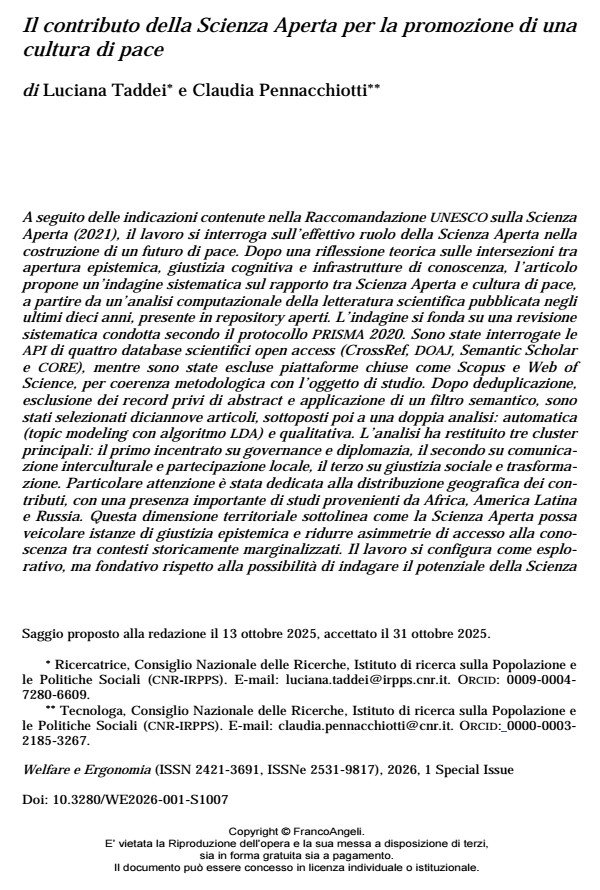
A seguito delle indicazioni contenute nella Raccomandazione UNESCO sulla Scienza Aperta (2021), il lavoro si interroga sull’effettivo ruolo della Scienza Aperta nella costruzione di un futuro di pace. Dopo una riflessione teorica sulle intersezioni tra apertura epistemica, giustizia cognitiva e infrastrutture di conoscenza, l’articolo propone un’indagine sistematica sul rapporto tra Scienza Aperta e cultura di pace, a partire da un’analisi computazionale della letteratura scientifica pubblicata negli ultimi dieci anni, presente in repository aperti. L’indagine si fonda su una revisione sistematica condotta secondo il protocollo PRISMA 2020. Sono state interrogate le API di quattro database scientifici open access (CrossRef, DOAJ, Semantic Scholar e CORE), mentre sono state escluse piattaforme chiuse come Scopus e Web of Science, per coerenza metodologica con l’oggetto di studio. Dopo deduplicazione, esclusione dei record privi di abstract e applicazione di un filtro semantico, sono stati selezionati diciannove articoli, sottoposti poi a una doppia analisi: automatica (topic modeling con algoritmo LDA) e qualitativa. L’analisi ha restituito tre cluster principali: il primo incentrato su governance e diplomazia, il secondo su comunicazione interculturale e partecipazione locale, il terzo su giustizia sociale e trasformazione. Particolare attenzione è stata dedicata alla distribuzione geografica dei contributi, con una presenza importante di studi provenienti da Africa, America Latina e Russia. Questa dimensione territoriale sottolinea come la Scienza Aperta possa veicolare istanze di giustizia epistemica e ridurre asimmetrie di accesso alla conoscenza tra contesti storicamente marginalizzati. Il lavoro si configura come esplorativo, ma fondativo rispetto alla possibilità di indagare il potenziale della Scienza Aperta come infrastruttura di ricerca sociale per la promozione di una cultura di pace.
Parole chiave:cultura di pace; revisione sistematica; topic modeling; epistemologie del Sud.
- Azoulay A. (UNESCO), Ghebreyesus T.A. (WHO), Bachelet M. (OHCHR) and Gianotti F. (CERN). (2020, 27 ottobre). Joint Appeal for Open Science. Nazioni Unite.
- Beck S., Bergenholtz C., Bogers M., Brasseur T.M., Conradsen M.L., Di Marco D., … and Xu S. M. (2020). The Open Innovation in Science research field: a collaborative conceptualisation approach. Industry and Innovation, 29(2): 136-185. DOI: 10.1080/13662716.2020.1792274
- Bezuidenhout L.M., Leonelli S., Kelly A.H. and Rappert B. (201). Beyond the digital divide: Towards a situated approach to open data, Science and Public Policy, 44(4): 464-475.
- Borgman C.L., Scharnhorst A. and Golshan M.S. (2019). Digital data archives as knowledge infrastructures: Mediating data sharing and reuse. Journal of the Association for Information Science and Technology, 70(8): 888-904.
- CESSDA (2023). The CESSDA Consortium. -- https://www.cessda.eu/About/Consortium.
- CODATA (2020). Open Science for a Global Transformation.
- Cooke A., Smith D. and Booth A. (2012). Beyond PICO: The SPIDER tool for qualitative evidence synthesis. Qualitative Health Research, 22(10): 1435-1443. DOI: 10.1177/1049732312452938
- David P.A. (2008). The Historical Origins of ‘Open Science’: An Essay on Patronage, Reputation and Common Agency Contracting in the Scientific Revolution. Capitalism and Society, 3(2). DOI: 10.2202/1932-0213.1040
- Edwards P.N., Jackson S.J., Chalmers M.K., Bowker G.C., Borgman C.L., Ribes D., Burton M. and Calvert S. (2013). Knowledge Infrastructures: Intellectual Frameworks and Research Challenges. Ann Arbor: Deep Blue. -- http://hdl.handle.net/2027.42/97552.
- Fricker M. (2007). Epistemic injustice: Power and the ethics of knowing. Oxford University Press.
- Galtung J., Fischer D. and Fischer D. (2013). Johan Galtung: Pioneer of peace research. Vol. 5. New York: Springer.
- Greco P. (2008). La cittadinanza scientifica. Micron, 9: 6-7.
- Kocar S. and Kaczmirek L. (2023). A meta-analysis of worldwide recruitment rates in 23 probability-based online panels, between 2007 and 2019. International Journal of Social Research Methodology, 27(5): 589-604.
- ISC (2020). From the International Science Council submission to the UNESCO review of Open Science ‘Open Science for the 21st Century: Draft ISC Working Paper.
- Leonelli S. (2023). Philosophy of Open Science. Cambridge University Press.
- Marker H.J. and Fink A.S. (2017). CESSDA – a History of Research Data Management for Social Science Data. In: J. B. Thestrup and F. Kruse, editors, Research Data Management - A European Perspective. Berlin, Boston: De Gruyter Saur, 25-42. DOI: 10.1515/9783110365634-003.
- Merton R.K. (1979). The normative structure of science. The sociology of science: Theoretical and empirical investigations, 267-278.
- Methley A.M., Campbell S., Chew-Graham C., McNally R. and Cheraghi-Sohi S. (2014). PICO, PICOS and SPIDER: A comparison study of specificity and sensitivity in three search tools for qualitative systematic reviews. BMC Health Services Research, 14, 579.
- Nora S. and Minc A. (1978). L’informatisation de la société. Ed. du Seuil (trad. it. Convivere con il calcolatore, Bompiani, 1979).
- Schumann N. and Mauer R. (2013). The GESIS Data Archive for the Social Sciences: A Widely Recognised Data Archive on its Way. International Journal of Digital Curation, 8(2): 215-222.
- UK Data Service (2023). About us. -- https://ukdataservice.ac.uk/about/.
- UNESCO (2021). UNESCO Recommendation on Open Science. Paris: UNESCO.
- Valente A. e Luzi D. (2004). Partecipare la scienza. Roma: Biblink.
- Valente A., editor (2002). Trasmissione d’élite, o accesso alle conoscenze? Percorsi e contesti della documentazione e comunicazione scientifica. Milano: FrancoAngeli.
- Van Den Eynden V. and Corti L. (2017). Advancing research data publishing practices for the social sciences: From archive activity to empowering researchers. International Journal on Digital Libraries, 18(2): 113-121.
- Wehn U., Ajates R., Mandeville C., Somerwill L., Kragh G. and Haklay M. (2024). Opening science to society: how to progress societal engagement into (open) science policies. R. Soc. Open Sci, 11(5), 231309.
- Wilkinson M.D., Dumontier M., Aalbersberg Ij.J., Appleton G., Axton M., Baak A., Blomberg N., Boiten J.-W., Da Silva Santos L.B., Bourne P.E., Bouwman J., Brookes A.J., Clark T., Crosas M., Dillo I., Dumon O., Edmunds S., Evelo C.T., Finkers R., … and Mon B. (2016). The FAIR Guiding Principles for scientific data management and stewardship. Scientific Data, 3(1), 160018.
- Ziman J. (2000). Real science: What it is, and what it means.
- Ziman J.M. (1994). Prometheus bound. Cambridge University Press.
Luciana Taddei, Claudia Pennacchiotti, Il contributo della Scienza Aperta per la promozione di una cultura di pace in "WELFARE E ERGONOMIA" 1 Suppl./2026, pp 115-133, DOI: 10.3280/WE2026-001-S1007