Aperta come infrastruttura di ricerca sociale per la promozione di una cultura di pace. Parole chiave: cultura di pace; revisione sistematica; topic modeling; epistemologie del Sud
Journal title WELFARE E ERGONOMIA
Author/s Luciana Taddei, Claudia Pennacchiotti
Publishing Year 2026 Issue 2026/1 Suppl.
Language Italian Pages 19 P. 115-133 File size 136 KB
DOI 10.3280/WE2026-001-S1007
DOI is like a bar code for intellectual property: to have more infomation
click here
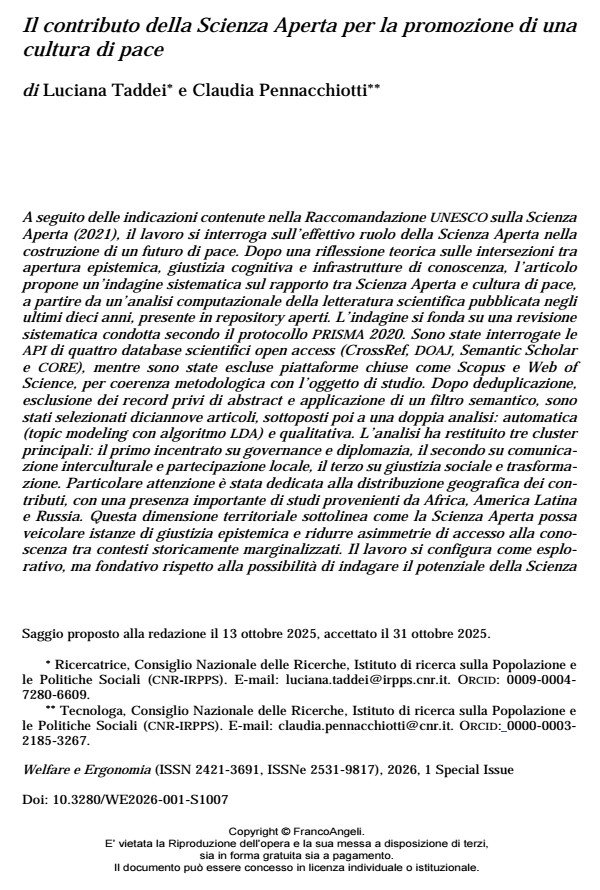
Below, you can see the article first page
If you want to buy this article in PDF format, you can do it, following the instructions to buy download credits
FrancoAngeli is member of Publishers International Linking Association, Inc (PILA), a not-for-profit association which run the CrossRef service enabling links to and from online scholarly content.
Following the guidelines set out in the UNESCO Recommendation on Open Science (2021), this study explores the actual role of Open Science in building a future of peace. After a theoretical reflection on the intersections between epistemic openness, cognitive justice, and knowledge infrastructures, the article presents a systematic investigation into the relationship between Open Science and a culture of peace, based on a computational analysis of the scientific literature published over the past ten years in open repositories. The investigation is based on a systematic review conducted according to the PRISMA 2020 protocol. The APIs of four open access scientific databases (CrossRef, DOAJ, Semantic Scholar, and CORE) were queried, while closed platforms such as Scopus and Web of Science were excluded for methodological consistency with the object of study. After deduplication, exclusion of records without abstracts, and the application of a semantic filter, nineteen 19 articles were selected and subjected to a dual analysis: automated (topic modeling with the LDA algorithm) and qualitative. The analysis identified three main clusters: the first focused on governance and diplomacy, the second on intercultural communication and local participation, and the third on social justice and transformation. Particular attention was given to the geographical distribution of contributions, with a significant presence of studies from Africa, Latin America, and Russia. This territorial dimension highlights how Open Science can serve as a vehicle for epistemic justice and reduce asymmetries in access to knowledge in historically marginalized contexts. While exploratory in nature, this work lays the foundation for investigating the potential of Open Science as a social research infrastructure for the promotion of a culture of peace.
Keywords: culture of oeace; systematic review; topic modeling; southern epistemologies.
- Azoulay A. (UNESCO), Ghebreyesus T.A. (WHO), Bachelet M. (OHCHR) and Gianotti F. (CERN). (2020, 27 ottobre). Joint Appeal for Open Science. Nazioni Unite.
- Beck S., Bergenholtz C., Bogers M., Brasseur T.M., Conradsen M.L., Di Marco D., … and Xu S. M. (2020). The Open Innovation in Science research field: a collaborative conceptualisation approach. Industry and Innovation, 29(2): 136-185. DOI: 10.1080/13662716.2020.1792274
- Bezuidenhout L.M., Leonelli S., Kelly A.H. and Rappert B. (201). Beyond the digital divide: Towards a situated approach to open data, Science and Public Policy, 44(4): 464-475.
- Borgman C.L., Scharnhorst A. and Golshan M.S. (2019). Digital data archives as knowledge infrastructures: Mediating data sharing and reuse. Journal of the Association for Information Science and Technology, 70(8): 888-904.
- CESSDA (2023). The CESSDA Consortium. -- https://www.cessda.eu/About/Consortium.
- CODATA (2020). Open Science for a Global Transformation.
- Cooke A., Smith D. and Booth A. (2012). Beyond PICO: The SPIDER tool for qualitative evidence synthesis. Qualitative Health Research, 22(10): 1435-1443. DOI: 10.1177/1049732312452938
- David P.A. (2008). The Historical Origins of ‘Open Science’: An Essay on Patronage, Reputation and Common Agency Contracting in the Scientific Revolution. Capitalism and Society, 3(2). DOI: 10.2202/1932-0213.1040
- Edwards P.N., Jackson S.J., Chalmers M.K., Bowker G.C., Borgman C.L., Ribes D., Burton M. and Calvert S. (2013). Knowledge Infrastructures: Intellectual Frameworks and Research Challenges. Ann Arbor: Deep Blue. -- http://hdl.handle.net/2027.42/97552.
- Fricker M. (2007). Epistemic injustice: Power and the ethics of knowing. Oxford University Press.
- Galtung J., Fischer D. and Fischer D. (2013). Johan Galtung: Pioneer of peace research. Vol. 5. New York: Springer.
- Greco P. (2008). La cittadinanza scientifica. Micron, 9: 6-7.
- Kocar S. and Kaczmirek L. (2023). A meta-analysis of worldwide recruitment rates in 23 probability-based online panels, between 2007 and 2019. International Journal of Social Research Methodology, 27(5): 589-604.
- ISC (2020). From the International Science Council submission to the UNESCO review of Open Science ‘Open Science for the 21st Century: Draft ISC Working Paper.
- Leonelli S. (2023). Philosophy of Open Science. Cambridge University Press.
- Marker H.J. and Fink A.S. (2017). CESSDA – a History of Research Data Management for Social Science Data. In: J. B. Thestrup and F. Kruse, editors, Research Data Management - A European Perspective. Berlin, Boston: De Gruyter Saur, 25-42. DOI: 10.1515/9783110365634-003.
- Merton R.K. (1979). The normative structure of science. The sociology of science: Theoretical and empirical investigations, 267-278.
- Methley A.M., Campbell S., Chew-Graham C., McNally R. and Cheraghi-Sohi S. (2014). PICO, PICOS and SPIDER: A comparison study of specificity and sensitivity in three search tools for qualitative systematic reviews. BMC Health Services Research, 14, 579.
- Nora S. and Minc A. (1978). L’informatisation de la société. Ed. du Seuil (trad. it. Convivere con il calcolatore, Bompiani, 1979).
- Schumann N. and Mauer R. (2013). The GESIS Data Archive for the Social Sciences: A Widely Recognised Data Archive on its Way. International Journal of Digital Curation, 8(2): 215-222.
- UK Data Service (2023). About us. -- https://ukdataservice.ac.uk/about/.
- UNESCO (2021). UNESCO Recommendation on Open Science. Paris: UNESCO.
- Valente A. e Luzi D. (2004). Partecipare la scienza. Roma: Biblink.
- Valente A., editor (2002). Trasmissione d’élite, o accesso alle conoscenze? Percorsi e contesti della documentazione e comunicazione scientifica. Milano: FrancoAngeli.
- Van Den Eynden V. and Corti L. (2017). Advancing research data publishing practices for the social sciences: From archive activity to empowering researchers. International Journal on Digital Libraries, 18(2): 113-121.
- Wehn U., Ajates R., Mandeville C., Somerwill L., Kragh G. and Haklay M. (2024). Opening science to society: how to progress societal engagement into (open) science policies. R. Soc. Open Sci, 11(5), 231309.
- Wilkinson M.D., Dumontier M., Aalbersberg Ij.J., Appleton G., Axton M., Baak A., Blomberg N., Boiten J.-W., Da Silva Santos L.B., Bourne P.E., Bouwman J., Brookes A.J., Clark T., Crosas M., Dillo I., Dumon O., Edmunds S., Evelo C.T., Finkers R., … and Mon B. (2016). The FAIR Guiding Principles for scientific data management and stewardship. Scientific Data, 3(1), 160018.
- Ziman J. (2000). Real science: What it is, and what it means.
- Ziman J.M. (1994). Prometheus bound. Cambridge University Press.
Luciana Taddei, Claudia Pennacchiotti, Il contributo della Scienza Aperta per la promozione di una cultura di pace in "WELFARE E ERGONOMIA" 1 Suppl./2026, pp 115-133, DOI: 10.3280/WE2026-001-S1007