Park, The City e la questione urbana. La sociologia delle città a Chicago
Titolo Rivista SOCIOLOGIA URBANA E RURALE
Autori/Curatori Raffaele Rauty
Anno di pubblicazione 2026 Fascicolo 2026/140
Lingua Italiano Numero pagine 19 P. 27-45 Dimensione file 170 KB
DOI 10.3280/SUR2026-140002
Il DOI è il codice a barre della proprietà intellettuale: per saperne di più
clicca qui
Qui sotto puoi vedere in anteprima la prima pagina di questo articolo.
Se questo articolo ti interessa, lo puoi acquistare (e scaricare in formato pdf) seguendo le facili indicazioni per acquistare il download credit. Acquista Download Credits per scaricare questo Articolo in formato PDF
FrancoAngeli è membro della Publishers International Linking Association, Inc (PILA), associazione indipendente e non profit per facilitare (attraverso i servizi tecnologici implementati da CrossRef.org) l’accesso degli studiosi ai contenuti digitali nelle pubblicazioni professionali e scientifiche.
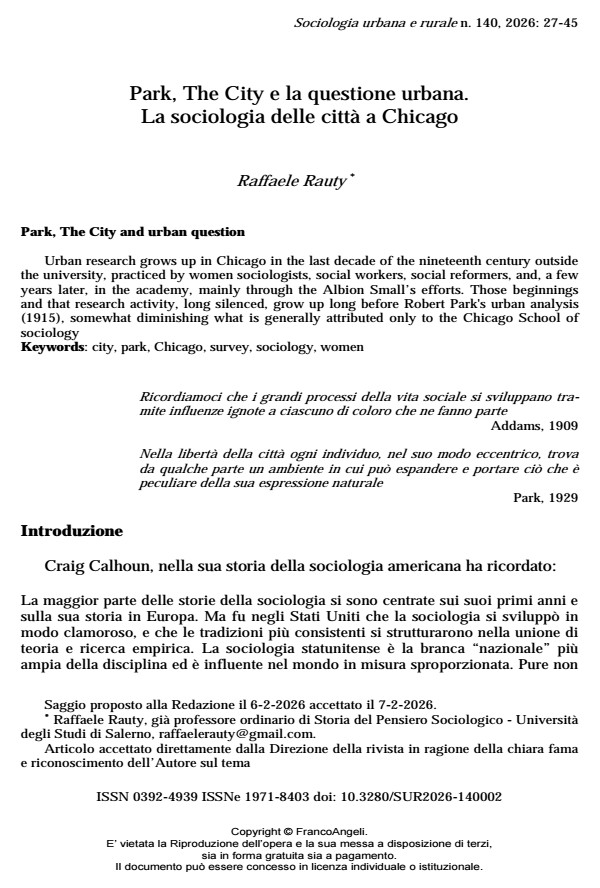
Urban research grows up in Chicago in the last decade of the nineteenth century outside the university, practiced by women sociologists, social workers, social reformers, and, a few years later, in the academy, mainly through the Albion Small’s efforts. Those beginnings and that research activity, long silenced, grow up long before Robert Park's urban analysis (1915), somewhat diminishing what is generally attributed only to the Chicago School of sociology
Parole chiave:city, park, Chicago, survey, sociology, women
- Abbott A. (1999). Department & Discipline. Chicago Sociology at One Hundred. Chicago: The University of Chicago Press.
- Abbott E. (1910). Women in Industry. A Study in American Economic History. New York: D. Appleton and Company.
- Abbott G. (1917). The Immigrant and the Community. New York: The Century Co.
- Addams J. (1909). The Spirit of Youth and the City Streets. New York: The Macmillan Company.
- Anderson N. (1923). The Hobo. Sociology of the Homeless Man. Chicago: The University of Chicago Press.
- Anderson N. (1940). Men on the Move. Chicago: The University of Chicago Press.
- Anderson N. (1983). A Stranger at the Gate. Reflections on the Chicago School of Sociology, Urban Life, 11, 4: 396-406. DOI: 10.1171/0098303983011004002
- Athens L. (2020). The Renunciation of Robert Park: Myths about his Sociological Work. The American Sociologist, 51: 76-91.
- Berthoff R. (1960). The American Social Order: A Conservative Hypothesis. American Historical Review, 65, 1: 495-514. DOI: 10.2307/1849618
- Berthoff R. (1971). An Unsettled People. New York: Harper and Row.
- Boas F. (1912). Changes in the Bodily Forms of Descendants of Immigrants. New York: Columbia University Press.
- Booth C. (1892-7). Life and Labour of the People in London (2° ed. 9 voll.). London: Macmillan.
- Bulmer M. (1984). The Chicago School of Sociology. Institutionalization, Diversity, and the Rise of Sociological Research. Chicago: The University of Chicago Press.
- Burgess E.W. (1925). Can Neighborhood Work Have a Scientific Basis? In Park R.E., Burgess E.W., McKenzie R.D. The City. Chicago: The University of Chicago Press.
- Burgess E.W., Bogue D.J. (1994). Research in Urban Society: A Long View. In Burgess E.W., Bogue D.J. (eds.). Contributions to Urban Sociology. Chicago: The University of Chicago Press.
- Calhoun C. (ed.) (2007). Sociology in America. A Story. Chicago: The University of Chicago Press.
- Carter P. A. (1975). The Twenties in America. Arlington Heights, Ariz: Harlan Davidson (2° ed. 1968).
- Cavan R.S. (1983). The Chicago School of Sociology, 1918-1933. Urban Life, 11: 407-420. DOI: 10.1177/0098303983011004003
- Cersosimo G., Rauty R. (2023). Introduzione. La genesi femminile dell’analisi sociale. In Cersosimo G., Rauty R. (a cura di). Una presenza dimenticata. Donne e analisi sociale negli Stati Uniti tra XIX e XX secolo. Napoli: Liguori Editore.
- Chudacoff H. P. (1975). The Evolution of American Urban Society. New Jersey: Prentice Hall.
- Coser L.A. (1971). Masters of Sociological Thought: Ideas in Historical and Social Context. New York: Harcourt, Brace Jovanovich
- Cressey P.F. (1938). Population Succession in Chicago, 1898-1930. American Journal of Sociology, 44, 1: 59-69. DOI: 10.1086/217916
- Cressey P.G. (1932). The Taxi-Dance Hall. Chicago: University of Chicago Press.
- Dedmon F. (1983). Fabulous Chicago: A Great City’s History and People. New York: Macmillan.
- DiMaggio P. (1986). Cultural Entrepreneurship in Nineteenth Century Boston: The Creation of an Organizational Base for High Culture in America. In Collins R., Curran J., Garnham N., Scannell P., Schlesinger P., Sparks C. (eds.). Media, Culture & Society. A Critical Reader. London: Sage Publications.
- Diner S.J. (1980). A City and its Universities. Public Policy in Chicago,1892-1919. Chapel Hill: University of North Carolina Press.
- Du Bois W.E.B. (1906). The Laboratory in Sociology at Atlanta University. Annals of the American Academy of Political and Social Science, 21: 160-163.
- Dunn A.W. (1895). An Analysis of the Social Structure of a Western Town: After the Method of Small and Vincent. Chicago: University of Chicago Press.
- Eisenschmidt A. (2018). The Story of an Intersection, or How Early Chicago Became an Urban Laboratory. Architectural Theory Review, 22, 2: 233-248. DOI: 10.1080/13264826.2018.1461663
- Faris R.E. (1967). Chicago Sociology 1920-1932. Chicago: The University of Chicago Press.
- Fleming H.E. (1905). Some Phases of the Production and Consumption of Literature in Chicago. Ph.D., University of Chicago.
- Gillette J.M. (1901). The Culture Agencies of a Typical Manufacturing Group. South Chicago. Ph.D., University of Chicago.
- Harvey L. (1987). Myths of the Chicago School of Sociology. Aldershot: Avebury.
- Hawley A.H. (1968). Introduction. In Hawley A.H. (ed.). Roderick McKenzie On Human Ecology. Chicago: The University of Chicago Press.
- Hayner N.S. (1927). Hotel Homes. Sociology and Social Research, XII, 2: 124-131.
- Hayner N.S. (1928). Hotel Life and Personality. American Journal of Sociology, 33, 5: 784-795. DOI: 10.1086/21454
- Hayner N.S. (1936). Hotel Life. Chapel Hill: University of Carolina Press.
- Hays S.P. (1999). The Response to Industrialism. 1885-1914. Chicago: The University of Chicago Press (1° ed. 1955).
- Higham J. (1955). Strangers in the Land. Patterns of American Nativism. New York: Rutgers University Press.
- Hinkle R.C. (1994). Developments in American Sociological Theory (1915-1950). New York: State University of New York Press.
- Janowitz M. (1966). Introduction. In Janowitz M. (ed.). W.I. Thomas On Social Organization and Social Personality. Chicago: The University of Chicago Press.
- Janowitz M. (1973). Bibliography. In Janowitz M. (ed.). Ernest W. Burgess On Community, Family and Delinquency. Chicago: The University of Chicago Press.
- Kellor F.A. (1908). The Protection of Immigrant Women. The Atlantic Monthly, 101, 27: 246-254.
- Kellor F.A. (1915). Out of Work; a Study of Unemployment. New York: G.P. Putnam’s Sons.
- Kurtz L.R. (1984). Evaluating Chicago Sociology. A Guide to Literature, with Annotated Bibliography. Chicago: The University of Chicago Press.
- Lazarsfeld P.F. (1962). The Sociology of Empirical Social Research. American Sociological Review, 27, 6: 757-767.
- Leuchtenburg W.E. (1958). The Perils of Prosperity. 1914-1932. Chicago: The University of Chicago Press.
- Levine D. (1995). Visions of the Sociological Tradition. Chicago: The University of Chicago Press.
- MacLean A.M. (1899). Two Weeks in the Department Store. American Journal of Sociology, IV, 6: 721-741. Ed. it. Due settimane nei grandi magazzini, Calimera: Kurumuy. - a cura di Rauty R.
- Matthews F.H. (1977). Quest for an American Sociology: Robert E. Park and the Chicago School. Montreal: McGill-Queen’s University Press.
- Mayer H.M., Wade R.C. (1969). Chicago: Growth of a Metropolis. Chicago: The University of Chicago Press.
- Mayhew H. (1861). London Labour and the London Poor. 3 voll. London: Griffin, Bohn and Company (1° ed. 1851).
- McKenzie R.D. (1923). The Neighborhood: A Study of Local Life in City of Columbus, Ohio. Chicago: The University of Chicago Press.
- McKenzie R.D. (1933a). The Rise of Metropolitan Community. In President’s Research Committee (ed.). Recent Social Trends in the United States. New York: McGraw Hill Book Company.
- McKenzie R.D. (1933b). The Metropolitan Community. New York: McGraw-Hill Book Company.
- Mohl R.A. (1972). Poverty, Urbanization and Social Order in Preindustrial American City 1780-1840. Social Science Quarterly, 52, 4: 934-948.
- Nakano K. (2011). How the Other Half was Made: Perceptions of Poverty in Progressive Era Chicago. The Japanese Journal of American Studies, 22: 63-87.
- Palmer V.M. (1928). Field Studies in Sociology. Chicago: The University of Chicago Press.
- Park R.E. (1904). Masse und Publikum. Bern: Lack & Grunau (Ed. ingl. The Crowd and the Public Chicago: The University of Chicago Press - a cura di Elsner H. jr., Elsner C. Ed. it. La folla e il pubblico, Roma: Armando, 1996 - a cura di Rauty R.
- Park R.E. (1915). The City: Suggestions for the Investigation of Human Behavior in the Urban Environment. American Journal of Sociology, XX: 577-612.
- Park R.E. (1923). Editor’s Preface. In Anderson N. The Hobo. The Sociology of the Homeless Man. Chicago: The University of Chicago Press.
- Park R.E. (1925). The City: Suggestions for the Investigation of Human Behavior in the Urban Environment. In Park R.E., Burgess E.W., McKenzie R.D. The City. Chicago: The University of Chicago Press.
- Park R.E. (1929). The City as a Social Laboratory. In Smith T.V., White L.D. (eds.). Chicago. An Experiment in Social Science Research. Chicago: The University of Chicago Press.
- Park R.E. (1950). Race and Culture. Essays in the Sociology of Contemporary Man. New York: The Free Press.
- Park R.E. (1952). Human Communities. The City and Human Ecology. Cherrington Hughes E., Johnson C.S., Masuoka J. M., Redfield R., Wirth L. (eds.). Glencoe, Ill: The Free Press.
- Park R.E. (1955). Society. Collective Behavior. News and Opinion. Sociology and Modern Society, Hughes E.C., Johnson C.S., Masuoka J. M., Redfield R., Wirth L., (eds.). Glencoe, Ill.: The Free Press.
- Park R.E. (1972). Curriculum. In Park R.E. The Crowd and the Public. Chicago: The University of Chicago Press. Ed. it. La folla e il pubblico, Roma: Armando, 1996 - a cura di Rauty R.
- Persons S. (1987). Ethnic Studies at Chicago 1905-1945. Urbana: University of Illinois Press.
- Platt J. (1998). Chicago Methods: Reputation and Reality. Ashgate: Aldershot, Hants and Brookfield.
- Rauty R. (2014). Ernest Watson Burgess, l’uomo di Chicago. Sociologia e Ricerca Sociale, 103: 18-39. DOI: 10.3280/SR2014-10300
- Reckless W. (1933). Vice in Chicago. Chicago: The University of Chicago Press.
- Rhoades M.C. (1906). A Case Study of the Delinquent Boys in the Juvenile Court in Chicago. Ph.D., University of Chicago.
- Riley T.J. (1904). A Study in the Higher Life of Chicago. Ph.D., University of Chicago.
- Schlereth T.J. (1979). America 1817-1919. A View of Chicago. Chicago: University of Chicago Press.
- Shils E. (1997). The Order of Learning. Essays on the Contemporary University. New Brunswick: Transaction Publishers - edited and with an introduction by Altbach P.G.
- Small A.W. (1893). Annual Register. Chicago: University of Chicago.
- Small A.W., Vincent G.E. (1894). An Introduction to the Study of Society. New York: American Book Co.
- Taylor J.C. (1979). The Fine Arts in America (The Chicago History of American Civilization). Chicago: University of Chicago Press.
- Thernstrom S. (1973). Poverty and Progress; Social Mobility in a Nineteenth Century City. New York: Atheneum.
- Thomas L. (2023). Chicago Skyscrapers 1871-1934. How Technology, Politics, Finance and Race Reshaped the City. Urbana: University of Illinois Press.
- Thomas W.I. (1921). Old World Traits Transplanted. New York: Harper & Brothers.
- Thrasher F.M. (1927). The Gang. A Study of 1313 Gangs in Chicago. Chicago: University of Chicago Press.
- Trachtenberg A. (1982). The Incorporation of America: Culture and Society in Gilded Age. New York: Hill & Wang.
- Turner R.H. (ed.) (1967). Robert E. Park On Social Control and Collective Behavior. Chicago: The University of Chicago Press.
- Turner R.H. (1967a). Introduction. In Turner R.H. (ed.). Robert E. Park On Social Control and Collective Behavior. Chicago: The University of Chicago Press.
- Warner S.B. (1972). The Urban Wilderness. A History of American City. New York: Harper & Row.
- Wirth L. (1927). The Ghetto. American Journal of Sociology, 33, 1: 57-71. DOI: 10.1086/214333
- Wirth L. (1928). The Ghetto. A Study in Isolation. Chicago: University of Chicago Press.
- Wirth L. (1938). Urbanism as a Way of Life. American Journal of Sociology, 44, 1: 1-24.
- Woods R.A. (1893). University Settlements as Laboratories in Social Science. Paper Read Before International Congress of Charities, Correction and Philanthropy, Chicago.
- Zorbaugh H.W. (1929). The Gold Coast and the Slum. Chicago: University of Chicago Press.
Raffaele Rauty, Park, The City e la questione urbana. La sociologia delle città a Chicago in "SOCIOLOGIA URBANA E RURALE" 140/2026, pp 27-45, DOI: 10.3280/SUR2026-140002