Embodied simulation and metaphors. On the role of the body in the interpretation of bodily-based metaphors
Journal title EPISTEMOLOGIA
Author/s Valentina Cuccio
Publishing Year 2015 Issue 2015/1
Language English Pages 15 P. 99-113 File size 95 KB
DOI 10.3280/EPIS2015-001007
DOI is like a bar code for intellectual property: to have more infomation
click here
Below, you can see the article first page
If you want to buy this article in PDF format, you can do it, following the instructions to buy download credits
FrancoAngeli is member of Publishers International Linking Association, Inc (PILA), a not-for-profit association which run the CrossRef service enabling links to and from online scholarly content.
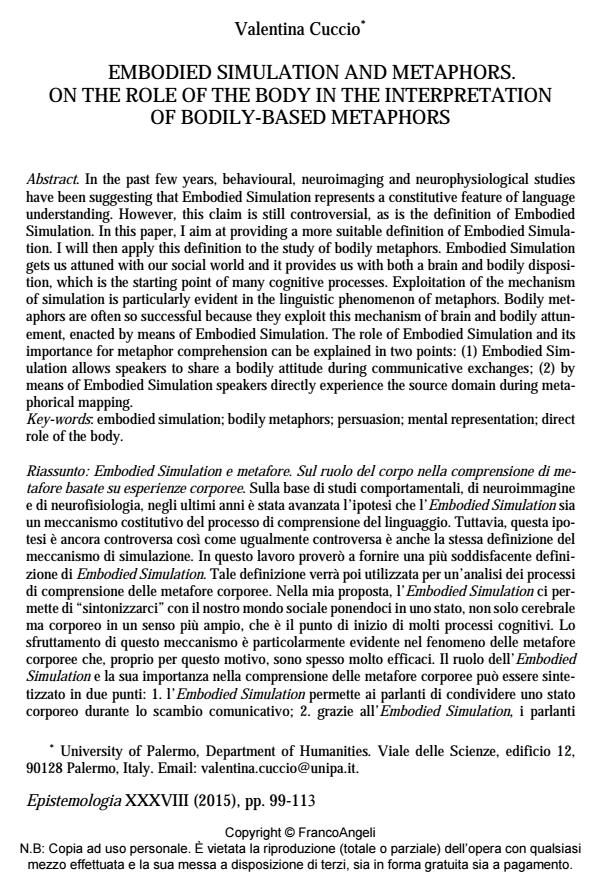
In the past few years, behavioural, neuroimaging and neurophysiological studies have been suggesting that Embodied Simulation represents a constitutive feature of language understanding. However, this claim is still controversial, as is the definition of Embodied Simulation. In this paper, I aim at providing a more suitable definition of Embodied Simulation. I will then apply this definition to the study of bodily metaphors. Embodied Simulation gets us attuned with our social world and it provides us with both a brain and bodily disposition, which is the starting point of many cognitive processes. Exploitation of the mechanism of simulation is particularly evident in the linguistic phenomenon of metaphors. Bodily metaphors are often so successful because they exploit this mechanism of brain and bodily attunement, enacted by means of Embodied Simulation. The role of Embodied Simulation and its importance for metaphor comprehension can be explained in two points: (1) Embodied Simulation allows speakers to share a bodily attitude during communicative exchanges; (2) by means of Embodied Simulation speakers directly experience the source domain during metaphorical mapping.
Keywords: Embodied simulation; bodily metaphors; persuasion; mental representation; direct role of the body
- Raposo A., Moss H.E., Stamatakis E.A., Tyler L.K. (2009). Modulation of motor and premotor cortices by actions, action words and action sentences, Neuropsychologia, 47(2), pp. 388-396. DOI: 10.1016/j.neuropsychologia.2008.09.017
- Ritchie D. (2010). “Everybody goes down”: Metaphors, Stories, and Simulations in Conversations, Metaphor and Symbol, 25, pp. 123-143.
- Rizzolatti G., Craighero L. (2004). The mirror-neuron system, Annu Rev Neurosci, 27, pp. 169-192. DOI: 10.1146/annurev.neuro.27.070203.144230
- Rizzolatti G., Sinigaglia C. (2007). Mirrors in the brain: how our minds share actions and emotions, Oxford, Oxford University Press.
- Sato M., Mengarelli M., Riggio L., Gallese V., Buccino G. (2008). Task related modulation of the motor system during language processing, Brain Lang, 105(2), pp. 83-90. DOI: 10.1016/j.bl.2007.10.001
- Sbriscia-Fioretti B., Berchio C., Freedberg D., Gallese V., Umiltà M.A. (2013). ERP modulation during observation of abstract paintings by Franz Kline, PLoS One, 8(10): e75241. DOI: 10.1371/journal.pone.0075241
- Semino E. (2010). Descriptions of Pain, Metaphors, and Embodied Simulation, Metaphor & Symbol, 25(4), pp. 205-226.
- Sperry R.W. (1950). Neural basis of the spontaneous optokinetic response produced by visual inversion, J Comp Physiol Psychol, 43(6), pp. 482-489.
- Steen G.J. (2011). The contemporary theory of metaphor – now new and improved!, Review of Cognitive Linguistics, 9(1), pp. 26-64.
- Strack F., Martin L.L., Stepper S. (1988). Inhibiting facilitating conditions of the human smile: a nonobtrusive test of the facial feedback hypothesis, J Pers Soc Psychol, 54(5), pp. 768-777.
- Tettamanti M., Buccino G., Saccuman M.C. Gallese V., Danna M., Scifo P., Fazio F.,
- Rizzolatti G., Cappa S.F., Perani D. (2005). Listening to action-related sentences activates fronto-parietal motor circuits, J Cogn Neurosci, 17(2), pp. 273-281. DOI: 10.1162/0898929053124965
- Thelen E., Smith L.B. (1994). A dynamic systems approach to the development of cognition and action, Cambridge (Mass.) / London, MIT Press.
- Tzuyin Lai V., Curran T. (2013). ERP evidence for conceptual mappings comparison processes during the comprehension of conventional novel metaphors, Brain Lang, 127(3), pp. 484-496. DOI: 10.1016/j.bl.2013.09.010
- Van Gelder T. (1995). What might cognition be, if not computation?, The Journal of Philosophy, 92(7), pp. 345-381.
- Yang J., Shu H. (2015). Involvement of the Motor System in Comprehension of Non-Literal Action Language: A Meta-Analysis Study, Brain Topogr. DOI: 10.1007/s10548-015-0427-5
- Goldman A., de Vignemont F. (2009). Is social cognition embodied?, Trends in Cognitive Sciences, 13(4), pp. 154-159.
- Hauk O., Johnsrude I. Pulvermüller F. (2004). Somatotopic representation of action words in human motor premotor cortex, Neuron, 41(2), pp. 301-307.
- Iacoboni M., Molnar-Szakacs I., Gallese V., Buccino G. , Mazziotta J.C., Rizzolatti G. (2005). Grasping the intentions of others with one’s own mirror neuron system, PLoSBiol, 3(3): e79. DOI: 10.1371/journal.pbio.0030079
- Jeannerod M. (2001). Neural simulation of action: a unifying mechanism for motor cognition, Neuroimage, 14 (1 Pt 2), pp. 103-109. DOI: 10.1006/nimg.2001.0832
- Jirak D., Menz M.M., Buccino G., Borghi A.M., Binkofski F. (2010). Grasping language – a short story on embodiment, Conscious Cogn, 19(3), pp. 711-720. DOI: 10.1016/j.concog.2010.06.020
- Kelso J.A.S. (1995). Dynamic patterns : the self-organization of brain and behavior, Cambridge (Mass.) / London, MIT Press.
- Kemmerer D., Castillo J.G., Talavage T., Patterson S., Wiley C. (2008). Neuroanatomical distribution of five semantic components of verbs: evidence from fMRI, Brain Lang, 107(1), pp. 16-43. DOI: 10.1016/j.bandl.2007.09.003
- Lacey S., Stilla R., Sathian K. (2012). Metaphorically feeling: comprehending textural metaphors activates somatosensory cortex, Brain Lang, 120(3), pp. 416-421. DOI: 10.1016/j.bl.2011.12.016
- Lakoff G. (1987). Women, fire, dangerous things : what categories reveal about the mind, Chicago / London, University of Chicago Press.
- Lakoff G., Johnson M. (1980). Metaphors we live by, Chicago / London, University of Chicago Press.
- Mahon B.Z., Caramazza A. (2008). A critical look at the embodied cognition hypothesis a new proposal for grounding conceptual content, J Physiol Paris, 102(1-3), pp. 59-70. DOI: 10.1016/j.jphysparis.2008.03.004
- Matlock T., Ramscar M., Boroditsky L. (2005). The experiential link between spatial and temporal language, Cognitive Science, 29, pp. 655-664.
- Niedenthal P.M., Barsalou L.W., Winkielman P., Krauth-Gruber S., Ric F. (2005).
- Embodiment in attitudes, social perception, emotion, Pers Soc Psychol Rev, 9(3), pp. 184-211. DOI: 10.1207/s15327957pspr0903_1
- Niziolek C.A., Nagarajan S.S., Houde J.F. (2013). What does motor efference copy represent? Evidence from speech production. J Neurosci, 33(41), pp. 16110-16116. DOI: 10.1523/JNEUROSCI.2137-13.2013
- Papeo L., Vallesi A., Isaja A., Rumiati R.I. (2009). Effects of TMS on different stages of motor and non-motor verb processing in the primary motor cortex, PLoS One, 4(2): e4508. DOI: 10.1371/journal.pone.0004508
- Port R.F., Van Gelder T. (1995). Mind as motion: explorations in the dynamics of cognition, Cambridge (Mass.) / London, MIT Press.
- Pulvermüller F. (1999). Words in the brain’s language, Behav Brain Sci, 22(2), pp. 253-279; discussion 280-336 Pulvermüller F. (2005). Brain mechanisms linking language action, Nat Rev Neurosci, 6(7), pp. 576-582. DOI: 10.1038/nrn1706
- Pulvermüller F. (2013). How neurons make meaning: brain mechanisms for embodied abstract-symbolic semantics, Trends Cogn Sci, 17(9), pp. 458-470. DOI: 10.1016/j.tics.2013.06.004
- Pulvermüller F., Moseley R.L., Egorova N., Shebani Z., Boulenger V. (2014). Motor cognition-motor semantics: action perception theory of cognition and communication, Neuropsychologia, 55, pp. 71-84. DOI: 10.1016/j.neuropsychologia.2013.12.002
- Alsmith A., de Vignemont F. (2012). Embodying the mind and representing the body, Review of Philosophy and Psychology, special issue, 3(1), pp. 1-13.
- Aziz-Zadeh L., Wilson S.M., Rizzolatti G., Iacoboni M. (2006). Congruent embodied representations for visually presented actions and linguistic phrases describing actions, Curr Biol, 16(18), pp. 1818-1823. DOI: 10.1016/j.cub.2006.07.060
- Barsalou L.W. (1999). Perceptual symbol systems, Behav Brain Sci, 22, pp. 577-609; discussion 10-60.
- Barsalou L.W. (2008). Grounded cognition, Annu Rev Psychol, 59, pp. 617-645. DOI: 10.1146/annurev.psych.59.103006.093639
- Barsalou L.W. (2010). Grounded cognition: past, present, and future, Top Cogn Sci, 2(4), pp. 716-724. DOI: 10.1111/j.1756-8765.2010.01115.x
- Boulenger V., Hauk O. Pulvermüller F. (2009). Grasping ideas with the motor system: semantic somatotopy in idiom comprehension, Cereb Cortex, 19(8), pp. 1905-1914. DOI: 10.1093/cercor/bhn217
- Boulenger V., Shtyrov Y. Pulvermüller F. (2012). When do you grasp the idea? MEG evidence for instantaneous idiom understing, Neuroimage, 59(4), pp. 3502-3513. DOI: 10.1016/j.neuroimage.2011.11.011
- Bowdle B.F., Gentner D. (2005). The career of metaphor, Psychol Rev, 112(1), pp. 193-216. DOI: 10.1037/0033-295X.112.1.193
- Buccino G., Lui F., Canessa N., Patteri I. Lagravinese G., Benuzzi F., Porro C.A., Rizzolatti G. (2004). Neural circuits involved in the recognition of actions performed by nonconspecifics: an FMRI study, J Cogn Neurosci, 16(1), pp. 114-126. DOI: 10.1162/089892904322755601
- Buccino G., Riggio L., Melli G., Binkofski F., Gallese V., Rizzolatti G. (2005). Listening to action-related sentences modulates the activity of the motor system: a combined TMS behavioral study, Brain Res Cogn Brain Res, 24(3), pp. 355-363. DOI: 10.1016/j.cogbrainres.2005.02.020
- Cacciari C., Bolognini N., Senna I., Pellicciari M.C., Miniussi C., Papagno C. (2011). Literal, fictive metaphorical motion sentences preserve the motion component of the verb: a TMS study, Brain Lang, 119(3), pp. 149-157. DOI: 10.1016/j.bl.2011.05.004
- Chemero A. (2009). Radical embodied cognitive science, Cambridge (Mass.) / London, MIT Press.
- Cidi M., Urgesi C. Ionta S. Aglioti S.M. (2008). Virtual lesion of ventral premotor cortex impairs visual perception of biomechanically possible but not impossible actions, Soc Neurosci, 3(3-4), pp. 388-400. DOI: 10.1080/17470910701676269
- Clark A. (1997). Being there: putting brain, body, and world together again, Cambridge, (Mass.) / London, MIT Press.
- Cuccio V. (2015). The notion of representation and the brain, Phenomenology and Mind, 7, pp. 247-258. Cuccio V. (submitted). Embodied simulation as bodily attitude. For a direct role of the body in language and cognition, Topoi. An International Review of Philosophy.
- Desai R.H., Binder J.R., Conant L.L., Mano Q.R., Seidenberg M.S. (2011). The neural career of sensory-motor metaphors, J Cogn Neurosci, 23(9), pp. 2376-2386. DOI: 10.1162/jocn.2010.21596
- Desai R.H., Conant L.L., Binder J.R., Park H., Seidenberg M.S. (2013). A piece of the action: modulation of sensory-motor regions by action idioms metaphors, Neuroimage, 83, pp. 862-869. DOI: 10.1016/j.neuroimage.2013.07.044
- di Pellegrino G., Fadiga L. Fogassi L., Gallese V., Rizzolatti G. (1992). Understing motor events: a neurophysiological study, Exp Brain Res, 91(1), pp. 176-180.
- Fadiga L., Fogassi L., Pavesi G., Rizzolatti G. (1995). Motor facilitation during action observation: a magnetic stimulation study, J Neurophysiol, 73(6), pp. 2608-2611.
- Fischer M.H., Zwaan R.A. (2008). Embodied language: a review of the role of the motor system in language comprehension, Q J Exp Psychol (Hove), 61(6), pp. 825-850.
- Fodor J.A. (1975). Language of thought, [S.l.]: T Y Crowell.
- Fodor J.A. (2008). LOT 2: the language of thought revisited, Oxford, Clarendon Press.
- Foroni F., Semin G.R. (2009). Language that puts you in touch with your bodily feelings: the multimodal responsiveness of affective expressions, Psychol Sci, 20(8), pp. 974-980. DOI: 10.1111/j.1467-9280.2009.02400.x
- Gallagher S. (2005). How the body shapes the mind, Oxford, Clarendon Press.
- Gallese V. (2003). The roots of empathy: the shared manifold hypothesis the neural basis of intersubjectivity, Psychopathology, 36(4), pp. 171-180.
- Gallese V. (2006). Intentional attunement: a neurophysiological perspective on social cognition its disruption in autism, BrainRes, 1079(1), pp. 15-24.
- Gallese V., Fadiga L., Fogassi L., Rizzolatti G. (1996). Action recognition in the premotor cortex, Brain, 119(2), pp. 593-609.
- Gallese V., Lakoff G. (2005). The Brain’s concepts: the role of the Sensory-motor system in conceptual knowledge, Cogn Neuropsychol, 22(3), pp. 455-479. DOI: 10.1080/02643290442000310
- Gallese V., Rochat M., Cossu G., Sinigaglia C. (2009). Motor cognition its role in the phylogeny ontogeny of action understing, Dev Psychol, 45(1), pp. 103-113. DOI: 10.1037/a0014436
- Gallese V., Sinigaglia C. (2011). What is so special about embodied simulation?, Trends Cogn Sci, 15(11), pp. 512-519. DOI: 10.1016/j.tics.2011.09.003
- Gentner D., Bowdle B. (2008). Metaphor as structure-mapping. In Gibbs R.W. Jr. (ed.). The Cambridge Handbook of Metaphor and Thought, Cambridge, Cambridge University Press, pp. 109-128.
- Gibbs R.W. (2003). Embodied experience linguistic meaning, Brain Lang, 84(1), pp. 1-15.
- Gibbs R.W. (2005). Embodiment cognitive science, Cambridge, Cambridge University Press.
- Gibbs R.W. (2013). Walking the walk while thinking about the talk: embodied interpretation of metaphorical narratives, J Psycholinguist Res, 42(4), pp. 363-378. DOI: 10.1007/s10936-012-9222-6
- Gibbs R.W., Matlock T. (2008). Metaphor, imagination, and simulation: Psycholinguistic evidence. In Gibbs R. (ed.), Cambridge handbook of metaphor and thought, New York, Cambridge University Press, pp. 161-176.
- Gibbs R.W., Perlman M. (2010). Language understanding is grounded in experiential simulations: a response to Weiskopf, Stud Hist Philos Sci, 41(3), pp. 305-308.
- Giora R. (2003). On our mind: Salience, context, and figurative language, New York, Oxford University Press Glenberg A.M., Kaschak M.P. (2002). Grounding language in action, Psychon Bull Rev, 9(3), pp. 558-565.
- Glenberg A.M., Sato M., Cattaneo L., Riggio L., Palumbo D., Buccino G. (2008). Processing abstract language modulates motor system activity, Q J Exp Psychol (Hove), 61(6), pp. 905-919. DOI: 10.1080/17470210701625550
- Glenberg A.M., Witt J.K., Metcalfe J. (2013). From the Revolution to Embodiment: 25 Years of Cognitive Psychology, Perspectives on Psychological Science, 8, pp. 573-585.
- Ucieleśniona duchowość w dyskursie polskich protestantów pentekostalnych. Analiza wybranych metafor Karolina Bogacz-Kańka, in Studia Religiologica /2025 pp.39
DOI: 10.4467/20844077SR.24.012.21502 - Metaphors and Analogies in Sciences and Humanities Valentina Cuccio, Mario Graziano, pp.87 (ISBN:978-3-030-90687-0)
- Bodies, Ontology, and Bioarchaeology Ann M. Palkovich, pp.127 (ISBN:978-3-031-56022-4)
- Review of Littlemore (2019): Metaphors in the Mind. Sources of Variation in Embodied Metaphor Valentina Cuccio, in Metaphor and the Social World /2021 pp.367
DOI: 10.1075/msw.00024.cuc - Metonymic foci of event schemata in English denominal verbs with human body parts Patricia Manjavacas Sneesby, in Review of Cognitive Linguistics /2026
DOI: 10.1075/rcl.00262.man - What makes a Figure Anna Piata, Aristea-Maria Metaxa, pp.194 (ISBN:9789027224248)
Valentina Cuccio, Embodied simulation and metaphors. On the role of the body in the interpretation of bodily-based metaphors in "EPISTEMOLOGIA" 1/2015, pp 99-113, DOI: 10.3280/EPIS2015-001007