Aiutare ad aiutare. Stress, burn-out e manutenzione del sistema curante
Journal title PRISMA Economia - Società - Lavoro
Author/s Mario Perini
Publishing Year 2017 Issue 2016/1
Language Italian Pages 13 P. 47-59 File size 165 KB
DOI 10.3280/PRI2016-001005
DOI is like a bar code for intellectual property: to have more infomation
click here
Below, you can see the article first page
If you want to buy this article in PDF format, you can do it, following the instructions to buy download credits
FrancoAngeli is member of Publishers International Linking Association, Inc (PILA), a not-for-profit association which run the CrossRef service enabling links to and from online scholarly content.
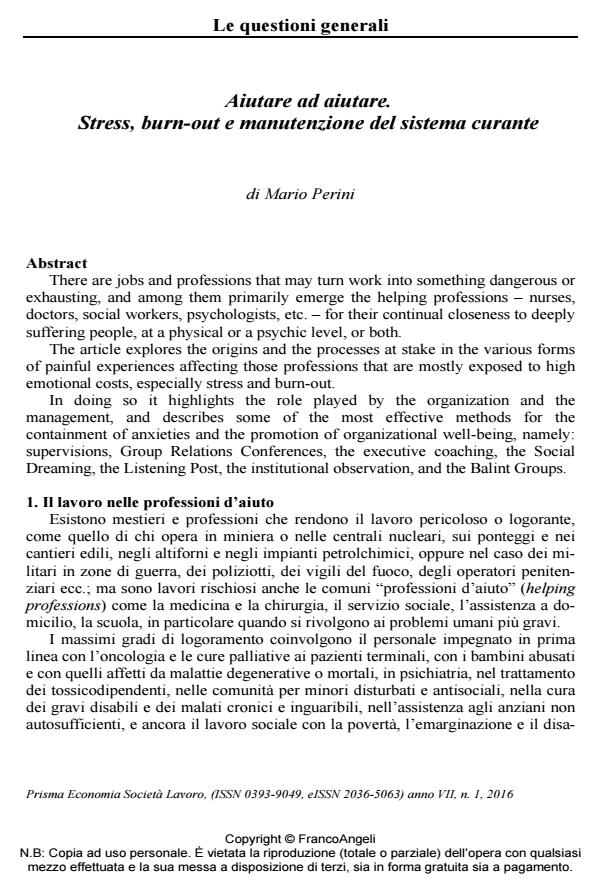
There are jobs and professions that may turn work into something dangerous or exhausting, and among them primarily emerge the helping professions - nurses, doctors, social workers, psychologists, etc. - for their continual closeness to deeply suffering people, at a physical or a psychic level, or both. The article explores the origins and the processes at stake in the various forms of painful experiences affecting those professions that are mostly exposed to high emotional costs, especially stress and burn-out. In doing so it highlights the role played by the organization and the management, and describes some of the most effective methods for the containment of anxieties and the promotion of organizational well-being, namely: supervisions, Group Relations Conferences, the executive coaching, the Social Dreaming, the Listening Post, the institutional observation, and the Balint Groups.
- Obholzer, A., Roberts V.Z. (eds), (1994) The Unconscious at Work. Individual and organizational stress in the human services, Routledge, London. (Tr. it. L’Inconscio al Lavoro. Stress Individuale e Organizzativo nei Servizi alla Persona, Etas Libri, Milano, 1998)
- Perini M., (2013) Lavorare con l’ansia. Costi emotivi nelle moderne organizzazioni, FrancoAngeli, Milano.
- Perini M., (2014) “Conference” in P.G. Quaglino (a cura di), Formazione. I Metodi, R. Cortina, Milano
- Perini M., (2015) “I Gruppi Balint: Prendersi cura di chi cura”, BergGasse, vol. 19, n. 13, pp. 146-162
- Racamier P.C., (1993) Il genio delle origini. Psicoanalisi e psicosi, R. Cortina, Milano
- Racamier P.C., (1995) Corteo concettuale, Edizioni del CeRP, Trento
- Schneider P-B., (1991) Regards discrets et indiscrets sur le médecin, Masson, Paris. (Tr. it. Fare il medico: Vocazione, formazione e professione del medico oggi e domani, FrancoAngeli, Milano, 1994)
- Senior J., (2007) “Can’t get no satisfaction. In a culture where work can be a religion, burnout is its crisis of faith”, New York Magazine, Oct 24
- Simmel E., (1926) “The ‘Doctor-Game’, Illness and the Profession of Medicine”, Int. J. Psycho-Anal., n. 7, pp. 470-483.
- Volpi C., Ghirelli G., Cortesini A., (1993) “Il burnout nelle professioni di aiuto: modalità d'intervento ed esperienze di prevenzione”, in D. Francescano, L. Leone, M. Traversi (Eds.), Oltre La Psicoterapia, La Nuova Italia Scientifica, Roma
- Avallone F. (a cura di), (2003) La convivenza nelle organizzazioni. Delega, benessere, valutazione, Guerini e Ass., Milano
- Balint M., (1957) The Doctor, his Patient and the Illness, Tavistock Publ., London
- Bion W.R., (1961) Experiences in groups, Tavistock Publications, London
- Braidi, G., (2001) Il Corpo Curante, FrancoAngeli, Milano
- Braidi G., (2004) “Affari di famiglia”, G. Gerontologia, n. 52, pp.475-478
- Brunning H. (ed.), (2006) Executive Coaching: Systems-Psychodynamic Perspective, Karnac, London. (Tr.it. La manutenzione del capo: Executive Coaching, Ananke, Torino 2009).
- Burton J., Launer J. (eds.), (2003) Supervision and support in primary care, Radcliffe Medical Press, Oxford
- Cherniss C., (1980) Staff Burnout: job stress in the Human service, Sage, Beverly Hills (Tr. it La sindrome del burnout. Lo stress lavorativo degli operatori dei servizi sociosanitari, Centro Scientifico Torinese, Torino, 1983)
- Foresti G., Fubini F., Perini M., (2011) “Supervisione e consulenza psicoanalitiche: promuovere il contenimento e il sostegno nelle istituzioni”, Funzionegamma, 27, ottobre. -- www.funzionegamma.edu
- Foresti G., Samà A., (2014) “Listening Post”, in P.G. Quaglino, (a cura di) Formazione. I Metodi, Cortina, Milano
- Freudenberger H.J., (1974) “Staff burn-out”, Journal of Social Issues, n. 30, pp. 159-165
- Freudenberger H.J., (1980) Burn-Out: The High Cost of High Achievement, Anchor Press. Garden City (NJ)
- Freud S., (1926-7) “Il problema dell’analisi condotta da non medici – Poscritto (1927)”, in Opere, vol. 10. Boringhieri, Torino, 1978
- Hinshelwood R.D., Skogstad W. (eds.), (2000) Observing Organizations: Anxiety, Defense, and Culture in Health Care, Routledge, London. (Tr. it. M. Perini e G. Micene, a cura di, Osservare le organizzazioni, Ananke, Torino, 2005)
- Knowles M., (1980) The Modern Practice of Adult Education. From Pedagogy to Andragogy, Englewood Cliffs, Prentice Hall/Cambridge. (Tr. it. Quando l’adulto impara. Pedagogia e andragogia, FrancoAngeli, Milano, 1999).
- Lawrence W.G. (ed.), (1998) Social Dreaming at Work, London, Karnac. (Tr. it Social Dreaming: La funzione sociale del sogno, Borla, Roma, 2001)
- Leiter M., Maslach C., (2000) Preventing burnout and building engagement: A complete program for organizational renewal, John Wiley & Sons, New York
- Maslach C., (1982) Burnout: The Cost of Caring, Prentice Hall Press, New York (Tr. it. La sindrome del burnout. Il prezzo dell’aiuto agli altri, Cittadella Editrice, Assisi, 1992).
- Maslach C., Leiter M.P., (1997) The truth about burnout: How organizations cause personal stress and what to do about it, Jossey-Bass, San Francisco, (Tr. it. Burnout e organizzazione. Modificare i fattori strutturali della demotivazione al lavoro, Erickson, Trento, 2000)
- Newton J., Long S., Sievers B. (eds.), (2005) Coaching in Depth: The Organizational Role Analysis Approach, Karnac, London
Mario Perini, Aiutare ad aiutare. Stress, burn-out e manutenzione del sistema curante in "PRISMA Economia - Società - Lavoro" 1/2016, pp 47-59, DOI: 10.3280/PRI2016-001005