Between body and soul, identity, being and becoming in adolescence.
Journal title PSICOANALISI
Author/s Alessandro Ruggieri
Publishing Year 2026 Issue 2025/2
Language Italian Pages 28 P. 49-76 File size 117 KB
DOI 10.3280/PSI2025-002005
DOI is like a bar code for intellectual property: to have more infomation
click here
Below, you can see the article first page
If you want to buy this article in PDF format, you can do it, following the instructions to buy download credits
FrancoAngeli is member of Publishers International Linking Association, Inc (PILA), a not-for-profit association which run the CrossRef service enabling links to and from online scholarly content.
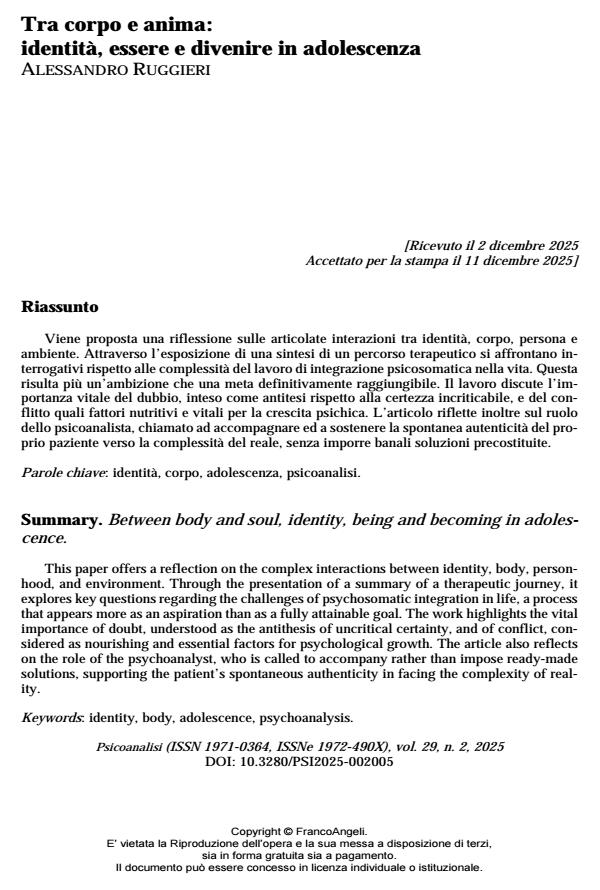
This paper offers a reflection on the complex interactions between identity, body, personhood, and environment. Through the presentation of a summary of a therapeutic journey, it explores key questions regarding the challenges of psychosomatic integration in life, a process that appears more as an aspiration than as a fully attainable goal. The work highlights the vital importance of doubt, understood as the antithesis of uncritical certainty, and of conflict, considered as nourishing and essential factors for psychological growth. The article also reflects on the role of the psychoanalyst, who is called to accompany rather than impose ready-made solutions, supporting the patient’s spontaneous authenticity in facing the complexity of reality.
Keywords: identity, body, adolescence, psychoanalysis.
- Argentieri S. (2025). L’identità di genere tra natura e cultura. In: La linea d’ombra: identità, conflitto, acting out nell’adolescenza. Firenze: Nicomp L.E.
- Argentieri S. (2025). La parola che cura. Uso e maluso della psicoanalisi oggi. Milano: La nave di Teseo.
- Barth D. (2024). Identificazioni e Besetzungen. Psicoanalisi, 28, 1: 61.
- Bell D. (2024). Ulteriori riflessioni sul disturbo di identità di genere. Psicoanalisi, 28, 1: 88-9.
- Bertolini M. (1998). È possibile proteggere i nostri figli dalla pedofilia. Lettera aperta a genitori, insegnanti, educatori. IMAGO, 1: 3-9.
- Butler J. (1990). Questione di genere: Il femminismo e la sovversione dell’identità (trad. it. S. Vecchio Roma: Laterza, 2004).
- Butler J. (2023). Berkeley professor explains gender theory | Judith Butler. YouTube, caricato da Big Think, 8 Giugno 2023, http://www.youtube.com/watch?v=UD9IOllUR4k.
- Gaddini R. (1980). Il significato e la genesi del sintomo somatico. Psicoterapia e scienze umane, 14, 2: 45-60.
- Freud A. (1936). L’Io e i meccanismi di difesa. Torino: Boringhieri.
- Freud S. (1923). L’Io e l’Es. In: OSF, vol. 9, Torino: Boringhieri.
- Freud S. (1913). Sull’inizio del trattamento. In: OSF, Vol. 7, Torino: Bollati Boringhieri, 1978, p. 340.
- Freud S. (1915). Metapsicologia. In: OSF, vol. 8, Torino: Bollati Boringhieri, 1978.
- Gaddini E. (1968). Sull’imitazione. In: Scritti (1953-1985), Milano: Raffaello Cortina Editore.
- Gaddini E. (1980). Note sul problema mente corpo. In: Scritti (1953-1985), Milano: Raffaello Cortina Editore.
- Gaddini R. (1980). Il significato e la genesi del sintomo somatico. Psicoterapia e scienze umane. 14, 2: 45-60.
- Grieve P. (2018). Una pelle propria. In: D. Campbell & R. Jaffé (A cura di), Il corpo che parla. Milano: Mimesis, pp. 209-224.
- Klein M. (1946). Note su alcuni meccanismi schizoidi. In Scritti 1921–1958, Torino: Boringhieri.
- Mahler M., Pine F., & Bergman A. (1975). The Psychological Birth of the Human Infant. New York: Basic Books.
- Nietzsche F. (2011). Così parlò Zarathustra (trad. it. S. Giametta, M. Montinari, A cura di Milano: Adelphi).
- Pellizzari G. (2020). Opus incertum. Editore Mimesis.
- Pontalis J.B. (1997). Questo tempo che non passa. Roma: Borla.
- Rutter M. (2005). How the environment affects mental health. British Journal of Psychiatry. 186, 1: 4-6.
- Ruggieri A. (2025). Diventare sé stesso tra finito ed infinito. In: La linea d’ombra: identità, conflitto, acting out nell’adolescenza. Firenze: Nicomp L.E.
- Ogden T. H. (2022). Prendere vita nella stanza d’analisi. Milano: Raffaello Cortina.
- Tolstoj L. (1869). Guerra e pace. Milano: Mondadori, 2005.
- Winnicott D.W. (1945). Lo sviluppo emozionale primario. In Scritti scelti: Dalla pediatria alla psicoanalisi. Firenze: Martinelli, 1975.
- Winnicott D.W. (1949). L’intelletto ed il suo rapporto con lo psiche-soma. In: Dalla pediatria alla psicoanalisi. Firenze: Giunti O.S.
- Winnicott D.W. (1950). L’aggressività ed il rapporto con lo sviluppo emozionale. In: Dalla pediatria alla psicoanalisi. Firenze: Giunti O.S.
- Winnicott D.W. (1945). Lo sviluppo emozionale primario. In: Psicoanalisi dello sviluppo. Roma: Armando.
- Winnicott D.W. (1960). L’ambiente e i processi di maturazione. Roma: Armando.
- Winnicott D.W. (1970). Morale ed educazione. Sviluppo affettivo e ambiente. Roma: Armando.
Alessandro Ruggieri, Tra corpo e anima: identità, essere e divenire in adolescenza in "PSICOANALISI" 2/2025, pp 49-76, DOI: 10.3280/PSI2025-002005