Indoor Environment as Everyday Ecosystem: The Added Value of a One Health Approach
Journal title SALUTE E SOCIETÀ
Author/s Stefania Fucci, Alberto Mantovani, Domenica Taruscio
Publishing Year 2026 Issue 2026/2
Language English Pages 13 P. 78-90 File size 304 KB
DOI 10.3280/SES2026-002008
DOI is like a bar code for intellectual property: to have more infomation
click here
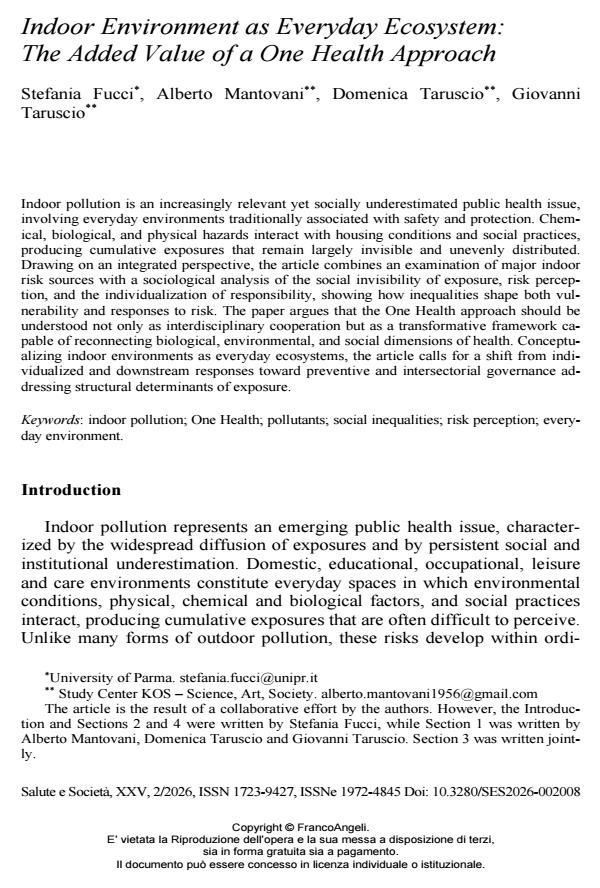
Below, you can see the article first page
If you want to buy this article in PDF format, you can do it, following the instructions to buy download credits
FrancoAngeli is member of Publishers International Linking Association, Inc (PILA), a not-for-profit association which run the CrossRef service enabling links to and from online scholarly content.
Indoor pollution is an increasingly relevant yet socially underestimated public health issue, involving everyday environments traditionally associated with safety and protection. Chemical, biological, and physical hazards interact with housing conditions and social practices, producing cumulative exposures that remain largely invisible and unevenly distributed. Drawing on an integrated perspective, the article combines an examination of major indoor risk sources with a sociological analysis of the social invisibility of exposure, risk perception, and the individualization of responsibility, showing how inequalities shape both vulnerability and responses to risk. The paper argues that the One Health approach should be understood not only as interdisciplinary cooperation but as a transformative framework capable of reconnecting biological, environmental, and social dimensions of health. Conceptualizing indoor environments as everyday ecosystems, the article calls for a shift from individualized and downstream responses toward preventive and intersectorial governance addressing structural determinants of exposure.
Keywords: indoor pollution; One Health; pollutants; social inequalities; risk perception; everyday environment.
- Agyeman J. (2005). Sustainable Communities and the Challenge of Environmental Justice. New York: New York University Press.
- Al-Shaarani A.A.Q.A., Pecoraro L. (2024). A review of pathogenic airborne fungi and bacteria: unveiling occurrence, sources, and profound human health implication. Frontiers in Microbiology, 15: 1428415.
- Baloch R.M., Maesano C.N., Christoffersen J., Banerjee S., Gabriel M., Csobod É., de Oliveira Fernandes E., Annesi-Maesano I. (2020). Indoor air pollution, physical and comfort parameters related to schoolchildren’s health: Data from the European SINPHONIE study. Science of the Total Environment, 739: 139870.
- Beck U. (1992). Risk Society: Towards a New Modernity. London: Sage Publications (trad. it.: La società del rischio. Verso una seconda modernità. Roma: Carocci, 2000).
- Bickerstaff W., Walker G. (2001). Public understandings of air pollution: the “localisation” of environmental risk. Global Environmental Change, 11: 133-145. DOI: 10.1016/S0959-3780(00)00063-
- Bozzola E., Agostiniani R., Pacifici Noja L., Park J., Lauriola P., Nicoletti T., Taruscio D., Taruscio G., Mantovani A. (2024). The impact of indoor air pollution on children’s health and well-being: the experts’ consensus. Italian Journal of Pediatrics, 50(1): 69.
- Bullard R.D. (2000). Dumping In Dixie: Race, Class, and Environmental Quality. New York: Routledge.
- Chatterjee, A., Pál, L., Lovas, S., McKee, M., Diószegi, J., Kovács, N., Szucs, S. (2026). Assessment of health risks from exposure to indoor volatile organic compounds in European educational buildings. Scientific Reports, 16: 6564.
- Clerbaux L.A., Albertini M.C., Amigó N., Beronius A., Bezemer G.F.G., Coecke S., Daskalopoulos E.P., Del Giudice G., Greco D., Grenga L., Mantovani A., Muñoz A., Omeragic E., Parissis N., Petrillo M., Saarimäki L.A., Soares H., Sullivan K., Landesmann B. (2022). Factors Modulating COVID-19: A Mechanistic Understanding Based on the Adverse Outcome Pathway Framework. Journal of Clinical Medicine, 11(15): 4464.
- Douglas M., Wildavsky A. (1982). Risk and Culture. An Essay of the Selection of Technological and Environmental Dangers. Berkeley: University of California Press.
- FAO, UNEP, WHO, WOAH (2022). One Health Joint Plan of Action (2022-2026): Working together for the health of humans, animals, plants and the environment. Roma: FAO.
- Fernandes A., Ubalde-López M., Yang T.C., McEachan R.R.C., Rashid R., Maitre L., Nieuwenhuijsen M.J., Vrijheid M. (2023). School-Based Interventions to Support Healthy Indoor and Outdoor Environments for Children: A Systematic Review. International Journal of Environmental Research and Public Health, 20(3): 1746.
- Fucic A. (2020). Endocrine Disruptors in Building Materials. In: Mantovani A., Fucic A., a cura di, Challenges in Endocrine Disruptor Toxicology and Risk Assessment. London: Royal Society of Chemistry.
- Fuentes-Ferragud E., Miralles P., López A., Ibáñez M., Piera J.M., Lopez-Labrador F.X., Camaró M., López-Ocaña L., Coscollà C. (2025). Comprehensive air quality assessment including non-targeted approaches in primary schools from Spain. Chemosphere, 372: 144022.
- Genisoglu M., Edebali O., Sofuoglu A., Turgut C., Sofuoglu S.C. (2025). Airborne and dust-bound PBDEs indoors and outdoors in Izmir, Türkiye: A multi-route exposure - risk assessment. Environmental Pollution, 384: 127032.
- Genova A. (2008). Le disuguaglianze nella salute. Politiche e governance in Italia e in Europa. Roma: Carocci.
- Hinchliffe S. (2015). More than one world, more than one health: Re-configuring interspecies health. Social Science & Medicine, 129: 28-35.
- Jendrossek S.N., Jurk L.A., Remmers K., Cetin Y.E., Sunder W., Kriegel M., Gastmeier P. (2023). The Influence of Ventilation Measures on the Airborne Risk of Infection in Schools: A Scoping Review. International Journal of Environmental Research and Public Health, 20(4): 3746.
- Lewis, A.C., Jenkins, D., Whitty, C.J. (2023). Hidden harms of indoor air pollution—five steps to expose them. Nature, 614(7947): 220-223.
- Lippai A., Leelossy Á., Magyar D. (2024). Indoor and Outdoor Air Microbial Contamination During Different Reconstruction Methods of Historic Buildings. Pathogens, 13(12): 1048.
- Navarrete-Meneses M.D.P., Salas-Labadía C., Gómez-Chávez F., Pérez-Vera P. (2024). Environmental Pollution and Risk of Childhood Cancer: A Scoping Review of Evidence from the Last Decade. International Journal of Molecular Sciences, 25(6): 3284.
- Nugus P. (2019). Re-structuring the negotiated order of the hospital. Sociology of Health and Illness, 41(2): 378-394. DOI: 10.1111/1467-9566.12838
- Pucci C., Abramidze T., Caimmi D., Gotua M., Jartti T., Kritikou M., Murray C.S., Papadopoulos N.G., Papatesta E.M., Rukhdze M., Simpson A., Tanno L., Xepapadaki P., Annesi-Maesano I. (2026). Assessing air pollution exposure in children at school: toward a source-specific exposure matrix. The International Journal of Tuberculosis and Lung Disease, 30(2): 48-55.
- Rivera, B.N., Bramer, L.M., Ghetu, C.C., Rohlman, D., Adams, K., Waters, K.M. and Anderson, K.A. (2025). Investigation of Influences on Indoor and Outdoor SVOC Exposure. International Journal of Environmental Research and Public Health, 22(4): 556.
- Sauvere M., Lejeune S., Chagnon F., Dartus M., Behal H., Deschildre A. (2025). Home exposure to moisture and mold is associated with poorer asthma control in children: The CHAMPIASTHMA study. Journal of Allergy and Clinical Immunology: Global, 4(2): 100415.
- United States Environmental Protection Agency (US EPA) (2026). Indoor Air Quality. https://www.epa.gov/indoor-air-quality-iaq
- Vardoulakis, S., Giagloglou, E., Steinle, S., Davis, A., Sleeuwenhoek, A., Galea, K.S., Dixon, K. and Crawford, J.O. (2020). Indoor exposure to selected air pollutants in the home environment: a systematic review. International Journal of Environmental Research and Public Health, 17(23): 8972.
- Waltner-Toews D. (2017). Zoonoses, One Health and complexity: wicked problems and constructive conflict. Philosophical Transaction of the Royal Society B, 372: 20160171.
- Wiesinger H., Bleuler C., Christen V., Favreau P., Hellweg S., Langer M., Pasquettaz R., Schönborn A., Wang Z. (2024). Legacy and Emerging Plasticizers and Stabilizers in PVC Floorings and Implications for Recycling. Environmental Science & Technology, 58(4): 1894-1907.
- World Health Organization (2009). WHO guidelines for indoor air quality: dampness and mould. WHO Regional Office for Europe. https://www.who.int/publications/i/item/9789289041683
- World Health Organization (2023). Fact Sheets: Radon. https://www.who.int/news-room/fact-sheets/detail/radon-and-health
- Xiong Y., Liu X., Li T. (2024). The urinary metabolites of volatile organic compounds and asthma in young children: NHANES 2011-2018. Heliyon, 10(3): e24199.
- Xiong, Q., Zhang, Z., Peng, J., Liang, J., Lian, D., Zhao, X., Wang, L., Lu, T., Li, Y. (2025). Epidemiological trends of lung cancer attributed to residential radon exposure at global, regional, and national level: a trend analysis study from 1990 to 2021. Frontiers in Public Health, 13: 1593415.
- Zhang W., Zhang X., Xie X., Liu T., Song F., Chen C., Wang C., Jiang L., Du H., Fan L., Han X., Sun Y., Li L., Tysklind M., Wang X. (2025). Sources, temporal-spatial characteristics, exposure assessment and children health risk of phthalate esters (PAEs) in household dust in China from 2000 to 2023: a review and pool analysis. Environmental Pollution, 383: 126903.
- Zinsstag J., Pelikan K., Berger Gonzalez M., Kaiser-Grolimund A., Crump L., Mauti S., Heitz Tokpa K., Bonfoh B., Mohammed S., Abtidon R., Tschopp R. (2023). Chapter 19: Value-added transdisciplinary One Health research and problem solving. In: Lawrence R.J., a cura di, Handbook of Transdisciplinarity: Global Perspectives. Cheltenham, UK: Edward Elgar Publishing.
- Zinsstag J., Schelling E., Waltner-Toews D., Tanner M. (2011). From “one medicine” to “one health” and systematic approaches to health and well-being. Preventive Veterinary Medicine, 101: 148-156.
Stefania Fucci, Alberto Mantovani, Domenica Taruscio, Indoor Environment as Everyday Ecosystem: The Added Value of a One Health Approach in "SALUTE E SOCIETÀ" 2/2026, pp 78-90, DOI: 10.3280/SES2026-002008