Ethnopsychiatry and migrant mental health: Cultures, traumas, and care policies
Journal title PRISMA Economia - Società - Lavoro
Author/s Massimo Melchiorre
Publishing Year 2026 Issue 2025/2
Language Italian Pages 6 P. 41-46 File size 66 KB
DOI 10.3280/PRI2025-002004
DOI is like a bar code for intellectual property: to have more infomation
click here
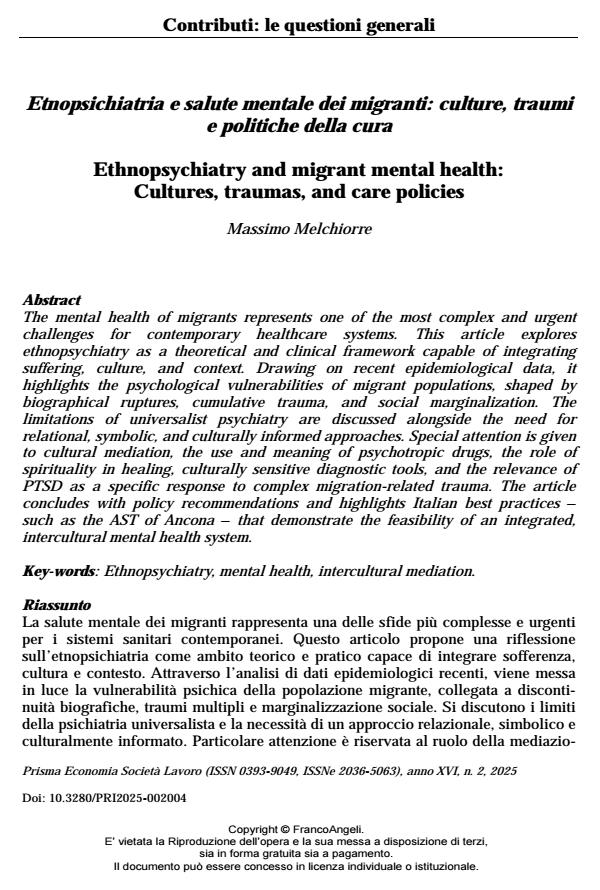
Below, you can see the article first page
If you want to buy this article in PDF format, you can do it, following the instructions to buy download credits
FrancoAngeli is member of Publishers International Linking Association, Inc (PILA), a not-for-profit association which run the CrossRef service enabling links to and from online scholarly content.
The mental health of migrants represents one of the most complex and urgent challenges for contemporary healthcare systems. This article explores ethnopsychiatry as a theoretical and clinical framework capable of integrating suffering, culture, and context. Drawing on recent epidemiological data, it highlights the psychological vulnerabilities of migrant populations, shaped by biographical ruptures, cumulative trauma, and social marginalization. The limitations of universalist psychiatry are discussed alongside the need for relational, symbolic, and culturally informed approaches. Special attention is given to cultural mediation, the use and meaning of psychotropic drugs, the role of spirituality in healing, culturally sensitive diagnostic tools, and the relevance of PTSD as a specific response to complex migration-related trauma. The article concludes with policy recommendations and highlights Italian best practices ‒ such as the AST of Ancona ‒ that demonstrate the feasibility of an integrated, intercultural mental health system.
Keywords: Ethnopsychiatry, mental health, intercultural mediation.
Massimo Melchiorre, Etnopsichiatria e salute mentale dei migranti: culture, traumi e politiche della cura in "PRISMA Economia - Società - Lavoro" 2/2025, pp 41-46, DOI: 10.3280/PRI2025-002004