Autism Spectrum Disorder: A narrative review on nursing strategies to improve the child and his family caring
Journal title PSICOLOGIA DELLA SALUTE
Author/s Benedetta Bianchi, Silvia Casella, Luca Guardamagna
Publishing Year 2026 Issue 2026/2
Language Italian Pages 21 P. 49-69 File size 201 KB
DOI 10.3280/PDS2026-002004
DOI is like a bar code for intellectual property: to have more infomation
click here
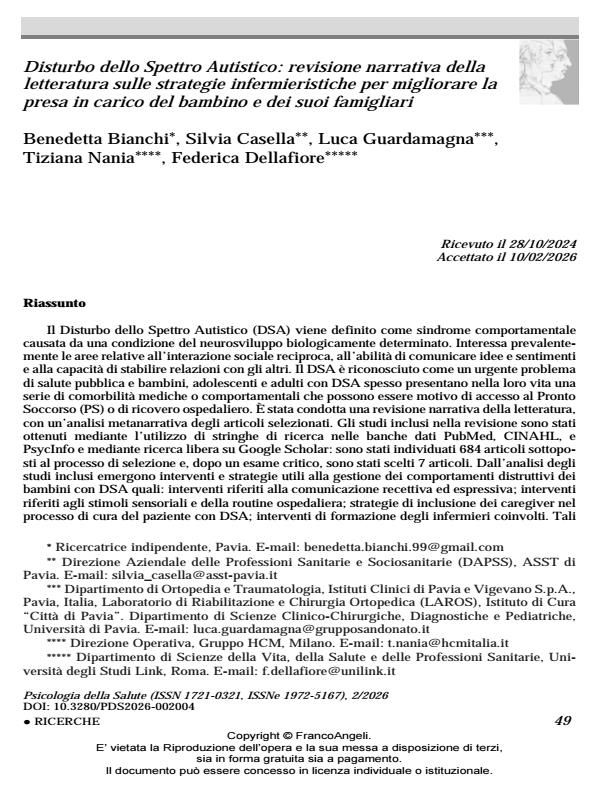
Below, you can see the article first page
If you want to buy this article in PDF format, you can do it, following the instructions to buy download credits
FrancoAngeli is member of Publishers International Linking Association, Inc (PILA), a not-for-profit association which run the CrossRef service enabling links to and from online scholarly content.
Autism Spectrum Disorder (ASD) is defined as a behavioral syndrome caused by a biologically determined developmental disorder. It mainly affects areas relating to mutual social interaction, the ability to communicate ideas and feelings and the ability to establish relationships with other people. ASD is recognized as an urgent public health problem and children, adolescents and adults with ASD often have a series of medical or behavioral comorbidities in their lives that can be a reason for access to the Emergency Department (ED) or hospitalization. A narrative review of the literature is conducted, with a metanarrative analysis of the selected articles. The studies included in the review were obtained using search strings in PubMed, CINAHL and PsycInfo databases and through free research on Google Scholar: 684 articles were identified and subjected to the selection process, and, after a critical examination, 7 articles have been chosen. From the analysis of the studies, interventions and strategies useful for managing the challenges behaviors of children with ASD emerge such as: interventions related to receptive and expressive communication; interventions related to sensory stimuli and hospital routine; strategies for including caregivers in the care process of the patient with ASD; training interventions for nurses. These interventions have proven effective in creating personalized care plans and in improving the hospital experience. The implementation of the proposed interventions allows the nurse to create a personalized care plan, and it allows the child with ASD and family members to have positive hospital experience.
Keywords: Autism, Care, Child, Emergency Department, Hospital, Nurse.
- American Psychiatric Association (2022). Diagnostic and Statistical Manual of Mental Disorders: DSM-5-TRTM. DSM-5-TRTM, 5(Text Revision).
- Baird, G., Cass, H. and Slonims, V. (2003). Diagnosis of autism. Clinical review, 327(7413): 488–93.
- Berney, T.P. (2000). Autism – an evolving concept. British Journal of Psychiatry, 176(1): 20–25.
- Broder-Fingert, S. et al. (2016). A Pilot Study of Autism-Specific Care Plans During Hospital Admission. Pediatrics, 137(2): S196–S204.
- Chebuhar, A. et al. (2013). Using Picture Schedules in Medical Settings for Patients with an Autism Spectrum Disorder. Journal of Pediatric Nursing, 28(2): 125–134.
- Drake, J., Johnson, N., Stoneck, Alice V. et al. (2012). Evaluation of a coping kit for children with challenging behaviors in a pediatric hospital. Pediatric Nursing, 38(4): 215–221.
- Duerden, E.G. et al. (2012). Risk Factors Associated with Self-Injurious Behaviors in Children and Adolescents with Autism Spectrum Disorders. Journal of Autism and Developmental Disorders, 42(11): 2460–2470.
- Gray, J.M. and Roback, M.G. (2021). Case Studies of Challenges in Emergency Care for Children with Autism Spectrum Disorder. Pediatric Emergency Care, 37(12): e1756–e1758.
- Iannuzzi, D.A. et al. (2015). Brief Report: Emergency Department Utilization by Individuals with Autism. Journal of Autism and Developmental Disorders, 45(4): 1096–1102.
- Jolly, A.A. (2015). Handle with Care: Top Ten Tips a Nurse Should Know Before Caring for a Hospitalized Child with Autism Spectrum Disorder. Pediatric Nursing, 41(1): 11–22.
- Kennedy, R. and Binns, F. (2014). Communicating and managing children and young people with autism and extensive burn injury. Wounds UK, 10(3): 60–65.
- Kopecky, K. et al. (2013). The Needs of Hospitalized Patients with Autism Spectrum Disorders: A Parent Survey. Clinical Pediatrics, 52(7): 652–660.
- Levi, G. et al. (2005). Linee Guida per l’Autismo: raccomandazioni tecniche-operative per i servizi di neuropsichiatria dell’età evolutiva’. Società italiana di neuropsichiatria dell’infanzia e dell’adolescenza. Available at: https://angsa.it/wp-content/uploads/2017/12/SINPIA-Linee-guida-Autismo-148.pdf.
- Mahoney, W. J., Villacrusis, M., Sompolski, M., Iwanski, B., Charman, A., Hammond, C. and Abraham, G. (2021). Nursing care for pediatric patients with autism spectrum disorders: A cross-sectional survey of perceptions and strategies. Journal for Specialists in Pediatric Nursing, 26(4): e12332.
- McGonigle, J. J., Migyanka, J. M. et al. (2014). Development and Evaluation of Educational Materials for Pre-hospital and Emergency Department Personnel on the Care of Patients with Autism Spectrum Disorder. Journal of Autism and Developmental Disorders, 44(5): 1252–1259.
- McGonigle, J. J., Venkat, A. et al. (2014). Management of Agitation in Individuals with Autism Spectrum Disorders in the Emergency Department. Child and Adolescent Psychiatric Clinics of North America, 23(1): 83–95.
- Mezaoui, H., Gunasekara, I. and Gontcharov, A. (2019). Enhancing PIO element detection in medical text using contextualized embedding. Proceedings of the 18th BioNLP Workshop and Shared Task, pp. 217–222.
- Milazzo, C. and Baldini, F. (2021). La vulnerabilità del bambino con autismo in Pronto Soccorso. Pedagogia e Psicologia, March, p. 8.
- Ministero della Salute (2022) Autismo, Salute Mentale. Available at: https://www.salute.gov.it/portale/saluteMentale/dettaglioContenutiSaluteMentale.jsp?lingua=italiano&id=5613&area=salute%20mentale&menu=vuoto (Accessed: 2 February 2022).
- Myers, S. M. and Johnson, C. P. (2007). Management of Children with Autism Spectrum Disorders. Pediatrics, 120(5): 1162–1182.
- Nicholas, D. B. et al. (2016). Experiences of emergency department care from the perspective of families in which a child has autism spectrum disorder. Social work in health care, 55(6), 409–426.
- Page, M. J. et al. (2021). The PRISMA 2020 statement: an updated guideline for reporting systematic reviews. BMJ, pp. 1–9.
- Scarpinato, N. et al. (2010). Caring for the Child with an Autism Spectrum Disorder in the Acute Care Setting. Journal for Specialists in Pediatric Nursing, 15(3): 244–254.
- Siniscalco, D. (2013). Current Findings and Research Prospective in Autism Spectrum Disorders. Autism: Open Access, S2, 1.
- Strunk, J. A. et al. (2014). Managing the health care needs of adolescents with autism spectrum disorder: The parents’ experience. Families, Systems, & Health, 32(3): 328–337.
- Szatmari, P. (2003). The causes of autism spectrum disorders: Multiple factors have been identified, but a unifying cascade of events is still elusive. Bmj, 326(7382): 173-174.
- Vaz, I. (2013). Visual symbols in healthcare settings for children with learning disabilities and autism spectrum disorder. British Journal of Nursing (Mark Allen Publishing), 22(3): 156–159.
- Zwaigenbaum, L. et al. (2016). Perspectives of Health Care Providers Regarding Emergency Department Care of Children and Youth with Autism Spectrum Disorder. Journal of Autism and Developmental Disorders, 46(5): 1725–1736.
Benedetta Bianchi, Silvia Casella, Luca Guardamagna, Disturbo dello Spettro Autistico: revisione narrativa della letteratura sulle strategie infermieristiche per migliorare la presa in carico del bambino e dei suoi famigliari in "PSICOLOGIA DELLA SALUTE" 2/2026, pp 49-69, DOI: 10.3280/PDS2026-002004