Interpreti e usi pubblici del folklorismo. Uno sguardo storiografico
Journal title ITALIA CONTEMPORANEA
Author/s Marco Fincardi
Publishing Year 2026 Issue 2026/311
Language Italian Pages 7 P. 129-135 File size 93 KB
DOI 10.3280/IC2026-311005
DOI is like a bar code for intellectual property: to have more infomation
click here
Below, you can see the article first page
If you want to buy this article in PDF format, you can do it, following the instructions to buy download credits
FrancoAngeli is member of Publishers International Linking Association, Inc (PILA), a not-for-profit association which run the CrossRef service enabling links to and from online scholarly content.
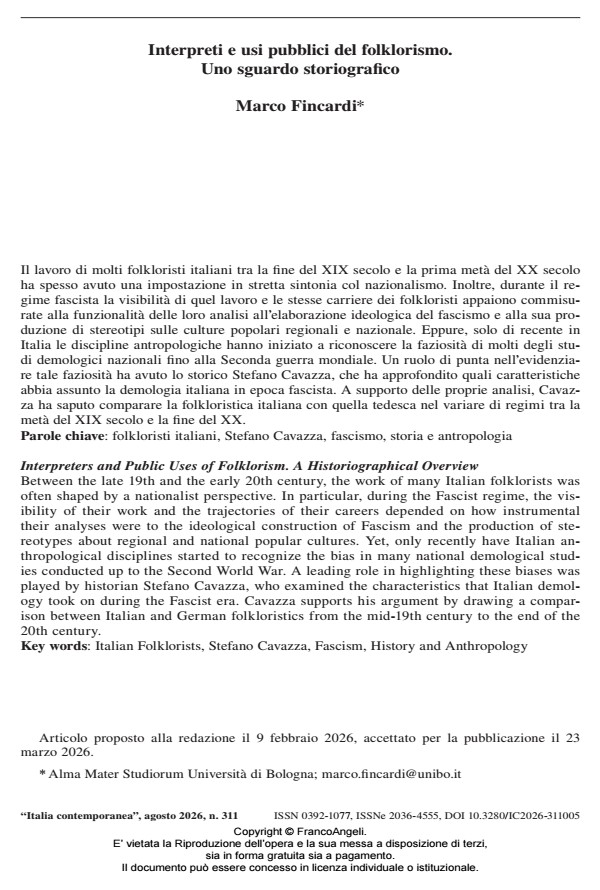
Between the late 19th and the early 20th century, the work of many Italian folklorists was often shaped by a nationalist perspective. In particular, during the Fascist regime, the visibility of their work and the trajectories of their careers depended on how instrumental their analyses were to the ideological construction of Fascism and the production of stereotypes about regional and national popular cultures. Yet, only recently have Italian anthropological disciplines started to recognize the bias in many national demological studies conducted up to the Second World War. A leading role in highlighting these biases was played by historian Stefano Cavazza, who examined the characteristics that Italian demology took on during the Fascist era. Cavazza supports his argument by drawing a comparison between Italian and German folkloristics from the mid-19th century to the end of the 20th century.
Keywords: Italian Folklorists, Stefano Cavazza, Fascism, History and Anthropology
Marco Fincardi, Interpreti e usi pubblici del folklorismo. Uno sguardo storiografico in "ITALIA CONTEMPORANEA" 311/2026, pp 129-135, DOI: 10.3280/IC2026-311005