The City that could have been. Urban theory through the women of the Chicago School
Journal title SOCIOLOGIA URBANA E RURALE
Author/s Monica Bernardi
Publishing Year 2026 Issue 2026/140
Language English Pages 29 P. 92-120 File size 237 KB
DOI 10.3280/SUR2026-140005
DOI is like a bar code for intellectual property: to have more infomation
click here
Below, you can see the article first page
If you want to buy this article in PDF format, you can do it, following the instructions to buy download credits
FrancoAngeli is member of Publishers International Linking Association, Inc (PILA), a not-for-profit association which run the CrossRef service enabling links to and from online scholarly content.
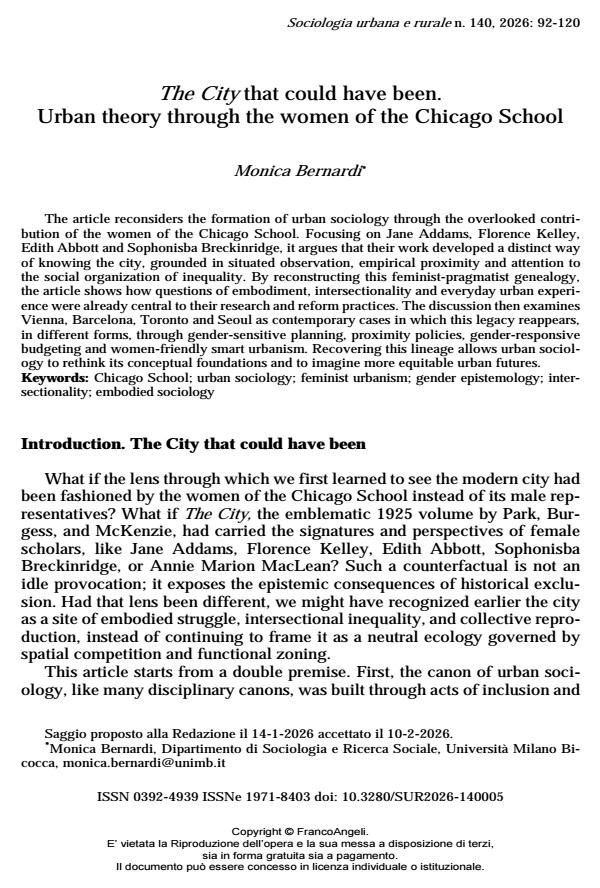
The article reconsiders the formation of urban sociology through the overlooked contribution of the women of the Chicago School. Focusing on Jane Addams, Florence Kelley, Edith Abbott and Sophonisba Breckinridge, it argues that their work developed a distinct way of knowing the city, grounded in situated observation, empirical proximity and attention to the social organization of inequality. By reconstructing this feminist-pragmatist genealogy, the article shows how questions of embodiment, intersectionality and everyday urban experience were already central to their research and reform practices. The discussion then examines Vienna, Barcelona, Toronto and Seoul as contemporary cases in which this legacy reappears, in different forms, through gender-sensitive planning, proximity policies, gender-responsive budgeting and women-friendly smart urbanism. Recovering this lineage allows urban sociology to rethink its conceptual foundations and to imagine more equitable urban futures.
Keywords: Chicago School; urban sociology; feminist urbanism; gender epistemology; intersectionality; embodied sociology
- Bargawi H., Cozzi G., Himmelweit S. (eds.) (2017). Economics and Austerity in Europe: Gendered Impacts and Sustainable Alternatives. London: Routledge.
- Addams J. (1910). Twenty Years at Hull-House: With autobiographical notes. New York: MacMillan.
- Ajuntament de Barcelona (2019). Manual d’urbanisme de la vida quotidiana. Urbanisme amb perspectiva de gènere. Ajuntament de Barcelona.
- Ajuntament de Barcelona (2024). 30 Barcelona Societat. Ajuntament de Barcelona.
- Andreola F., Muzzonigro A. (2021). Milan Gender Atlas / Milano Atlante di genere - Sex and the City (Milano Urban Center). Siracusa: Lettera Ventidue.
- Anguelovski I., Zografos C., Klause K.A., Connolly J.J.T. (2022). Urban Transformational Adaptation: Contestation and Struggles for Authority in the Pilot Barcelona Superblock of Poblenou. In Ruiz-Mallén I., March H., Satorras M. (eds.). Urban Resilience to the Climate Emergency: Unravelling the transformative potential of institutional and grassroots initiatives (pp. 65-91). Springer International Publishing. DOI: 10.1007/978-3-031-07301-4_
- Anneroth E., Ferlander S., Jukkala T. (2024). Public Spaces are Failing Girls and Women: How Feminist Planning can Learn from Social Innovation. The Journal of Public Space, 9(1), 109-114.
- Bacchetta P. (2015). Décoloniser le féminisme: Intersectionnalité, assemblages, co-formations, co-productions. Les cahiers du CEDREF. Centre d’enseignement, d’études et de recherches pour les études féministes, 20, Articolo 20.
- Bacciola G., Belluto M., Olcuire S. (2021). La città transfemminista. Movimenti, usi e pratiche intersezionali per altri immaginari urbani. Tracce urbane. Rivista italiana transdisciplinare di studi urbani, 9. DOI: 10.13133/2532-6562/1750
- Bauer U. (2009). Gender Mainstreaming in Vienna. How the Gender Perspective Can Raise the Quality of Life in a Big City. Kvinder, Køn & Forskning, 3-4.
- Burawoy M. (2005). For Public Sociology. American Sociological Review, 70(1), 4-28. DOI: 10.1177/000312240507000102
- Calderón-Argelich A., Anguelovski I., Connolly J.J.T., Baró F. (2023). Greening plans as (re)presentation of the city: Toward an inclusive and gender-sensitive approach to urban greenspaces. Urban Forestry & Urban Greening, 86(127984).
- Cersosimo G. (2024). Mary Jo Deegan (1946-2024): Sociologa femminista, pragmatista, interazionista. AG About Gender - International Journal of Gender Studies, 13(26). DOI: 10.15167/2279-5057/AG2024.13.26.241
- City of Toronto (2019). Creating a Gender Equity Strategy and Gender Equality Office for Toronto. REPORT FOR ACTION - EX8.7.
- Crenshaw K. (1989). Demarginalizing the Intersection of Race and Sex: A Black Feminist Critique of Antidiscrimination Doctrine, Feminist Theory and Antiracist Politics. University of Chicago Legal Forum, 1989(1).
- Cresswell T. (2006). On the Move: Mobility in the Modern Western World. London: Routledge.
- Deegan M.J. (1988). Jane Addams and the Men of the Chicago School, 1892-1918. New York: Routledge.
- Deegan M.J. (1991). Women in Sociology: A Bio-Bibliographical Sourcebook. London: Bloomsbury Academic.
- Duran J. (2014). Ellen Gates Starr and Julia Lathrop: Hull House and Philosophy. The Pluralist, 9(1): 1-13.
- EBRD (s.d.). Urban planning with superblocks: Barcelona, Spain - EBRD. Text available on the website: https://www.ebrdgreencities.com/policy-tool/urban-planning-with-superblocks-barcelona-spain-2/ (consulted the 03/12/20125)
- Falú A. (ed.). (2009). Mujeres en la ciudad. De violencias y derechos. Roma: Ediciones SUR.
- Falú A., Segovia O. (eds.). (2007). Ciudades para convivir: Sin violencias hacia las mujeres. Roma: Ediciones SUR.
- Grüning B. (a cura di). (2018). Marianne Weber. La donna e la cultura: Questione femminile e partecipazione pubblica. Roma: Armando Editore.
- Grüning B., Santoro M. (2021). Is there a canon in this class? International Review of Sociology, 1: 7-25. DOI: 10.1080/03906701.2021.1926674
- Gunnarsson Payne J., Tornhill S. (2023). The enemy’s enemy: Feminism at the crossroads of neoliberal co-optation and anti-gender conservatism. Journal of Political Ideologies, 28(1): 62-82. DOI: 10.1080/13569317.2021.1921937
- Haraway D. (1988). Situated Knowledges: The Science Question in Feminism and the Privilege of Partial Perspective. Feminist Studies, 14(3): 575-599. DOI: 10.2307/3178066
- Hayden D. (1980). What Would a Non-Sexist City Be Like? Speculations on Housing, Urban Design, and Human Work. Signs: Journal of Women in Culture and Society, 5(S3): S170-S187. DOI: 10.1086/495718
- Hayden D. (1984). Redesigning the American dream: The future of housing, work, and family life. New York: W.W. Norton.
- Horelli L. (2017). Engendering urban planning in different contexts - successes, constraints and consequences. European Planning Studies, 25(10): 1779-1796. DOI: 10.1080/09654313.2017.1339781
- Jacobs J. (1961). The Death and Life of Great American Cities. New York: Vintage Books.
- Kallus R., Churchman A. (2004). Women’s struggle for urban safety. The Canadian experience and its applicability to the Israeli context. Planning Theory & Practice, 5(2): 197-215. DOI: 10.1080/14649350410001691754
- Kern L. (2020). Feminist City. Claiming Space In A Man Made World. London: Verso.
- Khan Z. (2019). Gender-Responsive Budgeting. In Encyclopedia of Business and Professional Ethics. Cham: Springer.
- Kussy A., Palomera D., Silver D. (2023). The caring city? A critical reflection on Barcelona’s municipal experiments in care and the commons. Urban Studies, 60(11): 2036-2053. DOI: 10.1177/00420980221134191
- Lengermann P.M., Niebrugge G. (2006). The Women Founders: Sociology and Social Theory 1830-1930, A Text/Reader. Long Grove: Waveland Press.
- Lim Y., Edelenbos J., Gianoli A. (2023). Dynamics in the governance of smart cities: Insights from South Korean smart cities. International Journal of Urban Sciences, 27 (sup1): 183-205. DOI: 10.1080/12265934.2022.2063158
- Loukaitou-Sideris A., Fink C. (2009). Addressing Women’s Fear of Victimization in Transportation Settings: A Survey of U.S. Transit Agencies. Urban Affairs Review, 44(4): 554-587. DOI: 10.1177/1078087408322874
- Magrinyà F., Mercadé-Aloy J., Ruiz-Apilánez B., Magrinyà F., Mercadé-Aloy J., Ruiz-Apilánez B. (2023). Merging Green and Active Transportation Infrastructure towards an Equitable Accessibility to Green Areas: Barcelona Green Axes. Land, 12(4).
- Massey D.B. (1994). Space, Place, and Gender. Minneapolis: University of Minnesota Press.
- McCall L. (2005). The complexity of intersectionality. Signs: Journal of Women in Culture and Society, 30(3): 1771-1800. DOI: 10.1086/426800
- McDowell L. (1999). Gender, identity, and place: Understanding feminist geographies. Minneapolis: University of Minnesota Press.
- Meacham S. (1987). Toynbee Hall and social reform, 1880-1914: The search for community. New Haven: Yale University Press.
- Moreno C. (2021). Living in proximity, the 15-minute city | Barcelona Metròpolis | Barcelona City Council. Barcelona Metropolis. Text available on the website: https://www.barcelona.cat/metropolis/en/contents/living-proximity-the-15-minute-city (consulted by 05/05/2026)
- Moreno C., Allam Z., Chabaud D., Gall C., Pratlong F. (2021). Introducing the “15-Minute City”: Sustainability, Resilience and Place Identity in Future Post-Pandemic Cities. Smart Cities, 4(1): 1.
- Nussbaum M.C. (2000). Women and human development: The capabilities approach. Cambridge-New York: Cambridge University Press.
- Oakley A. (2005). The Ann Oakley reader: Gender, women and social science. Bristol: Bristol University Press.
- Period Think Tank, Sex and the City (a cura di). (2025). Atlante di genere di Bologna per una città femminista. Bologna Gender Atlas for a Feminist City. Bologna: Comune di Bologna.
- Plan International. (2018). Unsafe in the City: The Everyday Experiences of Girls and Young Women. The State of the World’s Girls 2018. Text available on the website: https://plan-international.org/uploads/2021/12/unsafeinthecity-en.pdf
- Rauty R. (2017). Il tempo di Jane Addams. Sviluppo dei settlements e costruzione dell’analisi sociale. Napoli: Orthotes.
- Roy A. (2011). Slumdog Cities: Rethinking Subaltern Urbanism. International Journal of Urban and Regional Research, 35(2): 223-238.
- Santagati M., Ferrari C., Noia E., Cornaggia C., Medina L. (2023). Donne all’origine della sociologia. Il contributo alla ricerca empirica in America, in Europa e in Italia. AG About Gender - International Journal of Gender Studies, 12(23). DOI: 10.15167/2279-5057/AG2023.12.23.2039
- Sassen S. (1991). The Global City: New York, London, Tokyo. Princeton: Princeton University Press.
- Sen A. (1999). Development as Freedom. Oxford: Oxford University Press.
- Seoulsolution. (2014). Women Friendly City Project. ???????? Seoul Solution. Text available on the website: https://seoulsolution.kr/en/content/women-friendly-city-project (consulted by 05/05/2026)
- Sheller M. (2018). Mobility Justice. The Politics of Movement in An Age of Extremes. London: Verso.
- Sklar K.K. (1997). Florence Kelley and the nation’s work: The rise of women’s political culture, 1830-1900. New Haven: Yale University Press.
- Social Planning Toronto. (2022). Advancing Gender Equity in the City of Toronto: Elevating the Voices of Women and Gender Diverse Residents. Social Planning Toronto.
- Statista (2024). South Korea smartphone penetration (share of population) 2019-2029. Statista. Text available on the website: https://www.statista.com/statistics/321408/smartphone-user-penetration-in-south-korea/ (consulted by 05/05/2026)
- Tronto J. (2020). Moral Boundaries: A Political Argument for an Ethic of Care. New York: Routledge.
- Tummers L., Wankiewicz H. (2020). Gender mainstreaming planning cultures: Why ‘engendering planning’ needs critical feminist theory. GENDER - Zeitschrift für Geschlecht, Kultur und Gesellschaft, 1-2020: 11-29.
- UN WOMEN. (2023). The Quito Declaration Global Commitment of Mayors to Accelerate Action: Safe Cities and Safe Public Spaces with and for Women and Girls. United Nations Entity for Gender Equality and the Empowerment of Women. Text available on the website: https://www.unwomen.org/sites/default/files/2025-06/the-quito-declaration-global-commitment-to-action-safe-public-spaces-2023-en.pdf (consulted by 05/05/2026)
- Waring J. (2025). Smartphone adoption by older Koreans surges. Mobile World Live. Text available on the website: https://www.mobileworldlive.com/asia-pacific/smartphone-adoption-by-older-koreans-surges/ (consulted by 05/05/2026)
- Yoo Y. (2021). Toward Sustainable Governance: Strategic Analysis of the Smart City Seoul Portal in Korea. Sustainability, 13(11).
Monica Bernardi, The City that could have been. Urban theory through the women of the Chicago School in "SOCIOLOGIA URBANA E RURALE" 140/2026, pp 92-120, DOI: 10.3280/SUR2026-140005