Territorial stigmatization in action. The case of the outskirts of Stockholm
Journal title SOCIOLOGIA URBANA E RURALE
Author/s Eleonora Clerici, Eva Andersson
Publishing Year 2026 Issue 2026/140
Language English Pages 17 P. 163-179 File size 146 KB
DOI 10.3280/SUR2026-140008
DOI is like a bar code for intellectual property: to have more infomation
click here
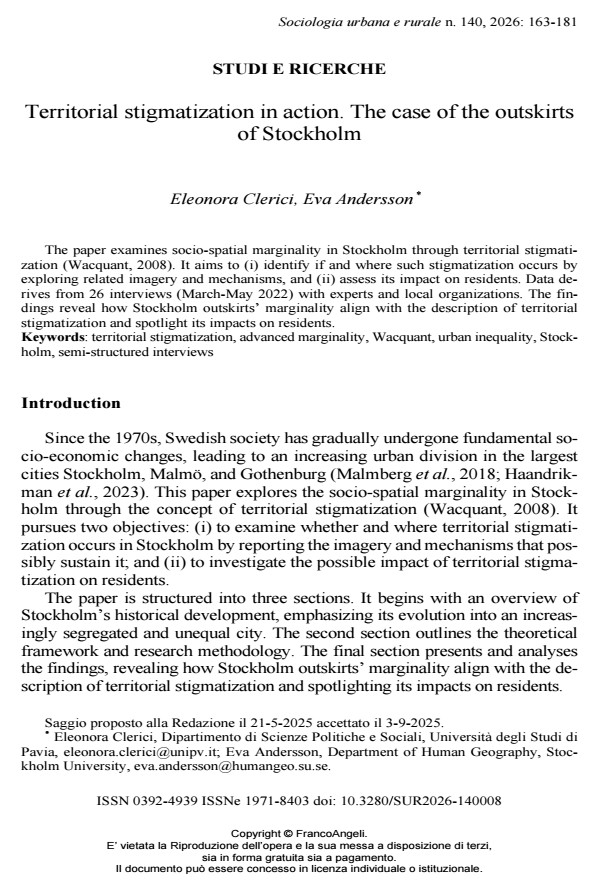
Below, you can see the article first page
If you want to buy this article in PDF format, you can do it, following the instructions to buy download credits
FrancoAngeli is member of Publishers International Linking Association, Inc (PILA), a not-for-profit association which run the CrossRef service enabling links to and from online scholarly content.
The paper examines socio-spatial marginality in Stockholm through territorial stigmatization (Wacquant, 2008). It aims to (i) identify if and where such stigmatization occurs by exploring related imagery and mechanisms, and (ii) assess its impact on residents. Data derives from 26 interviews (March-May 2022) with experts and local organizations. The findings reveal how Stockholm outskirts’ marginality align with the description of territorial stigmatization and spotlight its impacts on residents.
Keywords: territorial stigmatization, advanced marginality, Wacquant, urban inequality, Stockholm, semi-structured interviews
- Ålund A. (2014). Politics of Belonging: A Narrative on Activism in Sweden. NORA - Nordic Journal of Feminist and Gender Research, 22(4): 330-337. DOI: 10.1080/08038740.2014.965199
- Amnesty International (2018). Sweden: A cold welcome. Human rights of Roma and other ‘vulnerable EU citizens’ at risk. Index Number: EUR 42/9403/2018.
- Andersson R., Turner L.M. (2014). Segregation, gentrification, and residualisation: from public housing to market-driven housing allocation in inner city Stockholm. International Journal of Housing Policy, 14(1) : 3-29. DOI: 10.1080/14616718.2013.872949
- Backvall K. (2019). Constructing the suburb: Swedish discourses of spatial stigmatisation. Doctoral dissertation, Department of Social and Economic Geography, Uppsala university.
- Birk R.H., Arp Fallov M. (2021). Between a rock and a hard place: State-led territorial stigmatization, informal care practices and the interstitially of local community workers in Denmark. Community Development Journal, 56 (2) : 266-282.
- Blokland T. (2012). Blaming neither the undeserving poor nor the revanchist middle classes: A relational approach to marginalization. Urban Geography, 33(4): 488-507. DOI: 10.2747/0272-3638.33.4.48
- Bourdieu P. (1991). Language and symbolic power. Cambridge, MA: Harvard University Press.
- Christophers B. (2013). A Monstrous Hybrid: The Political Economy of Housing in Early Twenty-first Century Sweden. New Political Economy, 18(6): 885-911. DOI: 10.1080/13563467.2012.753521
- Clerici E. (2024). Social exclusion and inequality in European cities: Abyssal exclusion, advanced marginality, and the goodness of the European indicator AROPE. Doctoral dissertation, Sapienza University of Rome.
- Contessa D. (2024). Un margine che (non) vuole diventare centro: Dalle narrazioni ufficiali sull’immagine della città alle resistenze locali: Il caso della Bolognina. Sicurezza e Scienze Sociali, 2024(3): 60–73. DOI: 10.3280/SISS2024-003006
- Creswell J.W., Creswell J.D. (2018). Research Design. Qualitative, Quantitative, and Mixed Methods Approaches. SAGE Publications, Inc.
- Dahlstedt M. (2019). Problematising the urban periphery. Discourses on social exclusion and suburban youth in Sweden. In Keskinen S., Skaptadóttir U., Toivanen M. (Eds.). Undoing Homogeneity in the Nordic Region: Migration, Difference and the Politics of Solidarity. London: Routledge.
- Dikeç M. (2017). Urban rage: the revolt of the excluded. New Haven: Yale University Press.
- Djuve A.B., Friberg J., Tyldum G., Zhang H. (2015). When poverty meets affluence. Migrants from Romania on the streets of the Scandinavian capitals. Oslo: The Rockwool Foundation.
- Elgenius G., Rydgren J. (2019). Frames of nostalgia and belonging: the resurgence of ethno-nationalism in Sweden. European Societies, 21(4): 583-602. DOI: 10.1080/14616696.2018.1494297
- Elgenius G., Rydgren J. (2023). The Politics of Ethnic Nationalism, Nostalgia and Anti-Immigrant Framing: The trajectory of the Sweden Democrats 1989 -2022. In Samers M., Rydgren J. (eds.) Migration and Nationalism: Theoretical and Empirical Perspectives. London: Edward Elgar.
- Estrada F., Bäckman O., Nilsson A. (2022). Biased Enforcement Expansion? Sociodemographic Differences in Police Drug Testing for Suspected Narcotics Use 1993–2015. The British Journal of Criminology, 62(5): 1213-1232.
- Fjellborg A. (2022). Residential mobility and spatial sorting in Stockholm 1990-2014: the changing importance of housing tenure and income. International Journal of Housing Policy, 22(2): 198-224. DOI: 10.1080/19491247.2021.1893117
- Forlenza D., Cimagalli F. (2024). Processi di marginalizzazione: Il caso delle temporeras in Andalusia. Sicurezza e Scienze Sociali, 2024(3): 132-141. DOI: 10.3280/SISS2024-003011
- Forsberg S., Malmberg B., Andersson E. (2025). Spatial Processes of Habitus Formation Among Young Adults in Suburban Stockholm. International Journal of Urban and Regional Research, 49: 587-608. DOI: 10.1111/1468-2427.13320
- Garbin D., Millington G. (2012). Territorial Stigma and the Politics of Resistance in a Parisian Banlieue: La Courneuve and Beyond. Urban Studies, 49: 2067-2083. DOI: 10.1177/0042098011422572
- Goffman E. (1963) Stigma. Notes on the Management of Spoiled Identity. New York: Prentice-Hall.
- Grundström K., Molina I. (2016). From Folkhem to lifestyle housing in Sweden: segregation and urban form, 1930s–2010s. International Journal of Housing Policy, 16(3): 316-336. DOI: 10.1080/14616718.2015.1122695
- Haandrikman K., Costa R., Malmberg B., Rogne A.F., Sleutjes B. (2023). Socio-economic segregation in European cities. A comparative study of Brussels, Copenhagen, Amsterdam, Oslo and Stockholm. Urban Geography, 44: 1-36.
- Heber A. (2023). Stranger Danger: The Political Debate on Crimmigrants. Critical Criminology, 31: 859-878.
- Hedin K., Clark E., Lundholm E., Malmberg G. (2012). Neoliberalization of Housing in Sweden: Gentrification, Filtering, and Social Polarization. Annals of the Association of American Geographers, 102(2): 443-463.
- Interpeace (2014). Voices from Tensta, Report of a Pilot Project in Tensta, a suburb of Stockholm.
- Kawalerowicz J., Cederström A., Andersson E., Malmberg B. (2023). COVID-19 in the neighbourhood: the socio-spatial selectivity of severe COVID-19 cases in Sweden, March 2020-June 2021. GeoJournal.
- Kirkness P., Tije-Dra A. (2017). Negative Neighbourhood Reputation and Place Attachment, the Production and Contestation of Territorial Stigma. London: Routledge.
- Kirkness P. (2014) The Cite´s Strike Back: Restive Responses to Territorial Taint in the French Banlieues. Environment & Planning A 46, 1281–1296, https://doi.org/10.1068/a45636.
- Lamont M. (2018) Addressing Recognition Gaps: Destigmatization and the Reduction of Inequality. American Sociological Review, Vol. 83(3), 419–444, https://www.jstor.org/stable/48588666.
- Larsen T.S., Delica K.N. (2019). The production of territorial stigmatisation. City, 23:4-5, 540-563. DOI: 10.1080/13604813.2019.1682865
- Larsen T.S., Delica, K.N. (2021). Terriotorial destigmatization in an era of policy schizophrenia, Int. J. Urban Reg. Res., 45: 423-441. DOI: 10.1111/1468-2427.12994
- Levy J. (2022). Homeless in ‘The People’s Home’: Exploring the experiences of ‘vulnerable EU citizens’ in Stockholm, Sweden, Doctoral thesis.
- Löfdahl M., Järlehed J., Wojahn D., Milani T.M., Rosendal T., Nielsen H.L. (2023). Navigating whiteness from the margins: Finnish, Somali, and Arabic speakers’ experiences of racialization, (in)visibility, and (im)mobility in Gothenburg, Sweden. Multilingua, 43, 1: 119-150.
- Lokland I.A., Nilsson L. (2018). “Det svenska tillståndet”: en kvalitativ publikstudie om hur norska och danska nyhetskonsumenter uppfattar Sverige [The Swedish condition: a qualitative audience study on how Norwegian and Danish news consumers perceive Sweden], thesis Lund University.
- Losito G. (2007). L’analisi del contenuto nella ricerca sociale. Milano: FrancoAngeli.
- Malmberg B., Andersson E., Östh J. (2013). Segregation and Urban Unrest in Sweden. Urban Geography, 34(7): 1031-1046. DOI: 10.1080/02723638.2013.799370
- Malmberg B., Andersson E.K., Nielsen M.M., Haandrikman K. (2018). Residential Segregation of European and Non-European Migrants in Sweden: 1990–2012. Eur J Population 34:169-193.
- Mångkulturellt centrum (2014). The Afrophobia report.
- Meade R.R. (2021). Territorial stigmatization in theory and practice, and its implications for community development: an introduction to the themed section. Community Development Journal, 56(2): 191-202.
- Meli I. (2024). Analisi di un processo di stigmatizzazione: uno studio di comunità a Nuova Ostia. Sicurezza e Scienze Sociali, 2024(3): 31-42. DOI: 10.3280/SISS2024-003004
- NOA, Nationella operativa avdelningen., Underrättelseenheten. (2021). Lägesbild över utsatta områden. Regeringsuppdrag 2021.
- Östh J., Clark A.W., Malmberg B. (2015). Measuring the scale of segregation using k-nearest neighbour aggregates, Geographical Analysis, 47: 34-49. DOI: 10.1080/08038740.2014.965199
- Perlman J. (2006). The Metamorphosis of Marginality: Four Generations in the Favelas of Rio de Janeiro. Annals of the American Academy of Political and Social Science, 606: 154-177. DOI: 10.1177/0002716206288826
- Ramos E., Vianna Sento-Sé I. (2024). “Pacification” of favelas in Rio de Janeiro: The case of UPPs. Sicurezza e Scienze Sociali, 2024(3): 22-30. DOI: 10.3280/SISS2024-003003
- Rostami A., Sarnecki J. (2022). Det svenska tillståndet: En antologi om brottsutvecklingen i Sverige [The Swedish condition: An anthology on the development of crime in Sweden]. Studentlitteratur AB.
- Saarikkomäki E., Solhjell R., Wästerfors D. (2023). Dealing with police stops: how young people with ethnic minority backgrounds narrate their ways of managing over-policing in the Nordic countries. Policing and Society, 33(8): 937-952. DOI: 10.1080/10439463.2023.2216838.
- Schclarek Mulinari L. (2025) Criminalizing Style: Aesthetic Injustice and Racial Profiling in Sweden, The British Journal of Criminology.
- Schierup C.U., Ålund A., Kings L. (2014). Reading the Stockholm riots - a moment for social justice? RACE & CLASS, 55(3): 1-21. DOI: 10.1177/0306396813509191
- Schwarze T. (2022). Discursive practices of territorial stigmatization: how newspapers frame violence and crime in a Chicago community. Urban Geography, 43(9): 1415-1436. DOI: 10.1080/02723638.2021.1913015
- Sisson A. (2021). Territory and territorial stigmatisation: on the production, consequences and contestation of spatial disrepute. Progress in Human Geography, 45(4): 659-681. DOI: 10.1177/0309132520936760
- Sjöberg M. (2025). From a bad to good reputation: a case study illustrating the re-branding of a stigmatized neighbourhood in Sweden. Place Brand Public Dipl, 21: 223-231.
- Sjöberg S., Kings, L. (2022) Suburban commons: the rise of suburban social movements and new urban commons in marginalized neighbourhoods in Stockholm. Nordic Social Work Research, 12:2, 284-297, DOI: 10.1080/2156857X.2021.1982753
- Statistisk årsbok för Stockholm, 2025. (https://start.stockholm/globalassets/start/om-stockholms-stad/utredningar-statistik-och-fakta/statistik/arsbok/statistisk-arsbok-for-stockholm-2025.pdf)
- Stroud C. (2004). Rinkeby Swedish and Semilingualism in Language Ideological debates: A Bourdieuean Perspective. Journal of Sociolinguistics, 8: 196-214.
- Switzer R. (2024), “It’s not sweden anymore”: The far right’s mobilization of territorial stigmatization. Mobilization: an international quarterly, 28(4): 471-489.
- Tammaru T., Marcinczak S., van Ham M., Musterd S. (2016) Socio-Economic Segregation in European Capital Cities. East meets West. London: Routledge.
- Turner B., Whitehead C.M.E. (2002), Reducing Housing Subsidy: Swedish Housing Policy in an International Context. Urban Studies, 39(2): 201-217.
- Vogiazides L. (2020). Pathways and destinations: Spatial mobility and socioeconomic integration of international migrants in Sweden, Doctoral thesis.
- Wacquant L. (2008). Urban Outcasts. A Comparative Sociology of Advanced Marginality. London: Polity Press.
- Wacquant L. (2023). Bourdieu in the city. Challenging urban theory. London: Polity Press.
- Wacquant L., Slater T., Pereira V.B. (2014). Territorial Stigmatization in Action. Environment and Planning A: Economy and Space, 46(6): 1270-1280.
- Westra G.H. (2024). Segregation and well-being in Sweden: Geographies of well and ill-being. Population, Space and Place, 30, e2758. doi : 10.1002/psp.2758
- Wimark T., Andersson E.K., Malmberg B. (2020). Tenure type landscapes and housing market change: a geographical perspective on neo-liberalization in Sweden. Housing Studies, 35(2): 214-237. DOI: 10.1080/02673037.2019.1595535
Eleonora Clerici, Eva Andersson, Territorial stigmatization in action. The case of the outskirts of Stockholm in "SOCIOLOGIA URBANA E RURALE" 140/2026, pp 163-179, DOI: 10.3280/SUR2026-140008