The four-day workweek at Lamborghini: work-life balance, collective bargaining and workforce expectations
Journal title SOCIOLOGIA DEL LAVORO
Author/s Matteo Lupoli, Angelo Castellani
Publishing Year 2026 Issue 2026/174
Language Italian Pages 22 P. 30-51 File size 257 KB
DOI
DOI is like a bar code for intellectual property: to have more infomation
click here
Below, you can see the article first page
If you want to buy this article in PDF format, you can do it, following the instructions to buy download credits
FrancoAngeli is member of Publishers International Linking Association, Inc (PILA), a not-for-profit association which run the CrossRef service enabling links to and from online scholarly content.
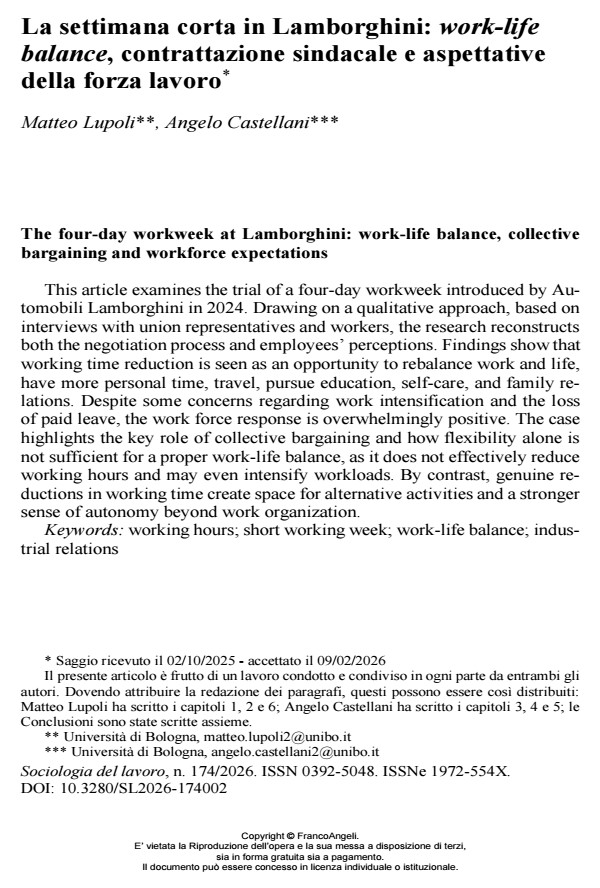
This article examines the trial of a four-day workweek introduced by Automobili Lamborghini in 2024. Drawing on a qualitative approach, based on interviews with union representatives and workers, the research reconstructs both the negotiation process and employees’ perceptions. Findings show that working time reduction is seen as an opportunity to rebalance work and life, have more personal time, travel, pursue education, self-care, and family relations. Despite some concerns regarding work intensification and the loss of paid leave, the work force response is overwhelmingly positive. The case highlights the key role of collective bargaining and how flexibility alone is not sufficient for a proper work-life balance, as it does not effectively reduce working hours and may even intensify workloads. By contrast, genuine reductions in working time create space for alternative activities and a stronger sense of autonomy beyond work organization.
Keywords: working hours; short working week; work-life balance; industrial relations
- Ashford, N. A., & Kallis, G. (2014). A Policy for Improving Employment and En-vironmental Conditions in Europe. The European Financial Review.
- Assirelli, G., Pais, I., & Lodigiani, R. (2025). Lasciare il lavoro, e poi? Transizioni occupazionali all’ombra della pandemia. Sociologia del lavoro: 171, 1, 2025, 75-102. DOI: 10.3280/SL2025-171004
- Bloch-London, C. (2001). Le norme in materia di orario di lavoro in Francia alla prova delle trattative: Il caso delle leggi Aubry. SOCIOLOGIA DEL LAVORO, 37–60. DOI: 10.3280/SL2001-081003
- Both-Nwabuwe JMC, Dijkstra MTM and Beersma B (2017) Sweeping the Floor or Putting a Man on the Moon: How to Define and Measure Meaningful Work. Front. Psychol. 8:1658.
- Campbell, T. T. (2023). The four-day work week: A chronological, systematic re-view of the academic literature. Management Review Quarterly, 74(3), 1791–1807.
- Caria, S., Garibaldo, F., & Rinaldini, M. (2024). La produzione nell’era digitale: Nuove sfide per organizzazione, lavoro e competenze. Lavoro e diritto, 3, 509–532. DOI: 10.1441/114418
- Carloni Rodriguez, R. e Dominguez Spandonari, E. (2023). Unravelling the 4-day week: a comprehensive study of its implementation and global impacts, with a focus on Italy. https://hdl.handle.net/10589/207013.
- Carreri, A., Gosetti, G., & Mattei, A. (2024). Il “caso” Lamborghini: Contrattazione continua e tempi di lavoro. Lavoro e diritto, 4, 663–690. DOI: 10.1441/115069
- Chalofsky, N. (2003). An emerging construct for meaningful work. Human Resource De-velopment International, 6(1), 69-83 DOI: 10.1080/1367886022000016785
- Coin, F. (2023). Le grandi dimissioni. Il nuovo rifiuto del lavoro e il tempo di ri-prenderci la vita, Torino: Einaudi.
- Coin, F. (2025). Per una teoria della disaffezione. Il lavoro dopo la pandemia, tra carenza di personale e turnover volontario. SOCIOLOGIA DEL LAVORO, 170, 206–220. DOI: 10.3280/SL2024-170012
- Coote, A., Harper, A., & Stirling, A. (2021). The case for a four-day week. Polity. D’aloia, G., & Pelusi, R. (2006). 12. Collective bargaining on working time in Italy,
- 1990-2005, in Keune, M., Galgóczi, B., Collective bargaining on working time: Recent European experiences. European Trade Union Institute for Research, Ed-ucation and Health and Safety (ETUI-REHS).
- De Spiegelaere, S., & Piasna, A. (2017). The why and how of working time reduction. ETUI. https://www.etui.org/publications/guides/the-why-and-how-of-working-time-reduction.
- Durante, F. (2022). Lavorare meno, vivere meglio. Futura Editrice.
- Fan, W., Schor, J., Kelly, O., & Gu, G. (2023). Does work time reduction improve workers’ well-being? Evidence from global four-day workweek trials.
- Fanelli, C., & Foggia, M. (2024). The Four-Day Workweek and the Future of Work in Canada. Global Labour Research Centre.
- Faustini, G. (2013). La riduzione dell’orario di lavoro, legale, contrattuale e di fatto. Note a margine di un dibattito. Moneta e Credito, V. 50, N. 200 (1997). DOI: 10.13133/2037-3651/11045
- Goerlich, C., & Vis, B. (2024). Different Ways of Promoting Working Time Reduc-tion: A Comparative Analysis of Actors, Motives, Forms, and Approaches in Ger-many, Ireland, and Spain. Journal of Comparative Policy Analysis: Research and Practice, 26(2), 159–177. DOI: 10.1080/13876988.2024.2332437
- Guest, D. E. (2002). Perspectives on the study of work-life balance. Social Science Information, 41(2), 255-279. DOI: 10.1177/0539018402041002005
- Jahal, T., Bardoel, E. A., & Hopkins, J. (2023). Could the 4-day week work? A scop-ing review. Asia Pacific Journal of Human Resources, 62(1), e12395. DOI: 10.1111/1744-7941.12395
- Greenhaus, J. H., Collins, K. M., & Shaw, J. D. (2003). The relation between work–family balance and quality of life. Journal of Vocational Behavior, 63(3), 510–531. DOI: 10.1016/S0001-8791(02)00042-8
- Kalleberg, A. L. (2009). Precarious Work, Insecure Workers: Employment Relations in Transition. American Sociological Review, 74(1), 1–22. DOI: 10.1177/000312240907400101
- Kelliher, C., & Anderson, D. (2009). Doing more with less? Flexible working prac-tices and the intensification of work. Human Relations, 63(1), 83–106. DOI: 10.1177/0018726709349199
- Kirby, E., & Krone, K. (2002). “The policy exists but you can’t really use it”: commu-nication and the structuration of work-family policies. Journal of Applied Commu-nication Research, 30(1), 50–77. DOI: 10.1080/00909880216577
- Laaser, K., & Karlsson, J. C. (2022). Towards a sociology of meaningful work. Work, Employment and Society, 36(5), 798-815.
- Lambert, S. J. (2009). Making a difference for hourly employees. In A. C. Crouter & A. Booth (Eds.), Work-life policies (pp. 169-195). Washington, DC: Urban Institute Press.
- Maran, G. (2020). Il tempo non è denaro: Perché la settimana di 4 giorni è urgente e necessaria. Altrimedia edizioni.
- Martela F and Pessi AB (2018) Significant Work Is About Self-Realization and Broader Purpose: Defining the Key Dimensions of Meaningful Work. Front. Psychol. 9:363.
- Munn, S. L. (2013). Unveiling the work–life system: the influence of work–life bal-ance on meaningful work. Advances in Developing Human Resources, 15(4), 401-417.
- Pullinger, M. (2014). Working time reduction policy in a sustainable economy: Cri-teria and options for its design. Ecological Economics, 103, 11–19.
- Spanò, A. (2019). Giovani e lavoro: cambiamenti dei significati del lavoro in tempo di crisi in "SOCIOLOGIA DEL LAVORO" 154/2019, pp 203-222, DOI: 10.3280/SL2019-154011
- Spencer, D. A. (2022). A FOUR-DAY Working Week: Its Role in a Politics of Work. The Political Quarterly, 93(3), 401–407. DOI: 10.1111/1467-923X.13173
- Stronge, W., & Harper, A. (2019). The Shorter Working Week: A radical and prag-matic proposal. The Autonomy Institute. https://autonomy.work/portfolio/the-shorter-working-week-a-report-from-autonomy-in-collaboration-with-mem-bers-of-the-4-day-week-campaign/.
- Srnicek, N. (2018). The Fight for Free Time. In B. Dellot (Ed.), A Field Guide to the Future of Work (pp. 17-21). RSA.
- Thompson, C. A., Beauvais, L. L., & Lyness, K. S. (1999). When Work–Family Benefits Are Not Enough: The Influence of Work–Family Culture on Benefit Utilization, Organizational Attachment, and Work–Family Conflict. Journal of Vocational Behavior, 54(3), 392–415.
- Voydanoff, P. (2005). Toward a conceptualization of perceived work-family fit and balance: A demands and resources approach. Journal of Marriage and Family, 67, 822-836.
Matteo Lupoli, Angelo Castellani, La settimana corta in Lamborghini: work-life balance, contrattazione sindacale e aspettative della forza lavoro in "SOCIOLOGIA DEL LAVORO " 174/2026, pp 30-51, DOI: