Work without workhood and the ambiguities of self-recognition when working on platforms. The case of micro-influencers
Journal title SOCIOLOGIA DEL LAVORO
Author/s Camilla Volpe
Publishing Year 2026 Issue 2026/174
Language English Pages 16 P. 91-106 File size 278 KB
DOI
DOI is like a bar code for intellectual property: to have more infomation
click here
Below, you can see the article first page
If you want to buy this article in PDF format, you can do it, following the instructions to buy download credits
FrancoAngeli is member of Publishers International Linking Association, Inc (PILA), a not-for-profit association which run the CrossRef service enabling links to and from online scholarly content.
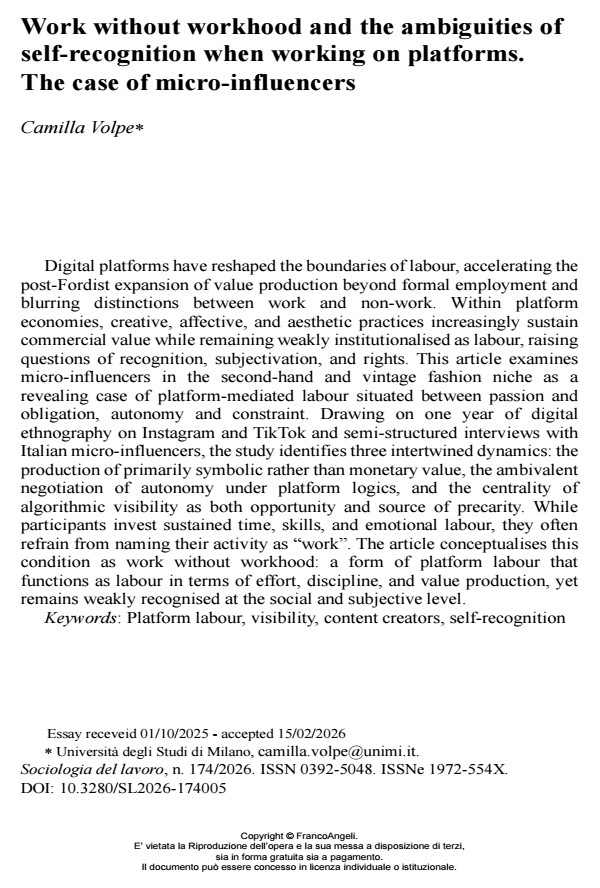
Digital platforms have reshaped the boundaries of labour, accelerating the post-Fordist expansion of value production beyond formal employment and blurring distinctions between work and non-work. Within platform economies, creative, affective, and aesthetic practices increasingly sustain commercial value while remaining weakly institutionalised as labour, raising questions of recognition, subjectivation, and rights. This article examines micro-influencers in the second-hand and vintage fashion niche as a revealing case of platform-mediated labour situated between passion and obligation, autonomy and constraint. Drawing on one year of digital ethnography on Instagram and TikTok and semi-structured interviews with Italian micro-influencers, the study identifies three intertwined dynamics: the production of primarily symbolic rather than monetary value, the ambivalent negotiation of autonomy under platform logics, and the centrality of algorithmic visibility as both opportunity and source of precarity. While participants invest sustained time, skills, and emotional labour, they often refrain from naming their activity as “work”. The article conceptualises this condition as work without workhood: a form of platform labour that functions as labour in terms of effort, discipline, and value production, yet remains weakly recognised at the social and subjective level.
Keywords: Platform labour, visibility, content creators, self-recognition
- Are C. (2022). The Shadowban Cycle: An autoethnography of pole dancing, nudity and censorship on Instagram. Feminist Media Studies, 22(8): 2002-2019. DOI: 10.1080/14680777.2021.192825
- Abidin C. (2016). “Aren’t these just young rich women doing vain things online?”: Influencer selfies as subversive frivolity. Social Media and Society, April-Jun, 1-17. DOI: 10.1177/205630511664134
- Arriagada A., Ibáñez F. (2020). “You Need At Least One Picture Daily, if Not, You’re Dead”: Content Creators and Platform Evolution in the Social Media Ecology. Social Media + Society, 6(3). DOI: 10.1177/205630512094462
- Bainotti L. (2024). How conspicuousness becomes productive on social media. Marketing Theory, 24(2): 339-356. DOI: 10.1177/1470593123120243
- Bishop S. (2019). Managing visibility on YouTube through algorithmic gossip. New Media & Society, 21(11-12): 2589-2606. DOI: 10.1177/146144481985473
- Bucher T. (2017). The algorithmic imaginary: Exploring the ordinary affects of Facebook algorithms. Information, Communication & Society, 20(1): 30-44. DOI: 10.1080/1369118X.2016.115408
- Caliandro A. (2024). Follow the user: Taking advantage of Internet users as methodological resources. Convergence, 31(5): 1549-1572.
- Caplan R., boyd, d. (2018). Isomorphism through algorithms: Institutional dependencies in the case of Facebook. Big Data & Society, 5(1).
- Casilli A.A. (2020). Schiavi del clic: Perché lavoriamo tutti per il nuovo capitalismo? Milano: Feltrinelli Editore.
- Cotter K. (2019). Playing the visibility game: How digital influencers and algorithms negotiate influence on Instagram. New Media & Society, 21(4): 895-913. DOI: 10.1177/146144481881568
- Couldry N., Mejias U.A. (2019). Data Colonialism: Rethinking Big Data’s Relation to the Contemporary Subject. Television & New Media, 20(4): 336-349. DOI: 10.1177/152747641879663
- Denzin N.K., Lincoln Y.S. (2000). Handbook of Qualitative Research (Subsequent edition). Thousand Oaks: Sage Pubns.
- Duffy B.E. (2017). (Not) Getting Paid to Do what You Love: Gender, Social Media, and Aspirational Work. New Haven: Yale University Press.
- Duffy B.E., Pinch A., Sannon S., Sawey M. (2021). The nested precarities of creative labour on social media. Social Media+ Society, 7(2).
- Gandini A. (2016). The Reputation Economy: Understanding Knowledge Work in Digital Society. Springer.
- Gandini A. (2019). Labour process theory and the gig economy. Human Relations, 72(6): 1039-1056. DOI: 10.1177/001872671879000
- Gandini A., Casagrande G., Giorgi G., Peterlongo G., Tonetta M. (2024). ‘Platform-ised’ work? The case of neo-craft work. International Journal of Cultural Studies, 28(1): 204-222.
- Gill R., Pratt A. (2008). In the Social Factory?: Immaterial labour, Precariousness and Cultural Work. Theory, Culture & Society, 25(7-8): 1-30.
- Gupta V.P., Sharief S., Rani S. (2024). Digital Fashion and Social Media Influencer in Industry 5.0. In: Raj P., Rocha A., Dutta P.K., Fiorini M. and C. Prakash, eds., Illustrating Digital Innovations Towards Intelligent Fashion: Leveraging Information System Engineering and Digital Twins for Efficient Design of Next-Generation Fashion. Springer Nature Switzerland.
- Harrison L. (2024). Personal Attributes of Micro-Influencers. In: L. Harrison, ed., Unpacking Micro-Influence within the Australian Creative Sectors: A Theoretical Framework for Understanding the Skills, Knowledge, and Capabilities of Micro-Influencers. Springer Nature.
- Hardt M., Negri A. (2002). Impero: Il nuovo ordine della globalizzazione. Rizzoli. Jarrett K. (2022). Digital Labor (1st ed.). Polity Pr.
- Joyce S., Stuart M. (2021). Chapter 7: Digitalised management, control and resistance in platform work: a labour process analysis. https://www.elgaronline.com/edcollchapoa/edcoll/9781802205121/9781802205121.00017.xml
- Lata L.N., Burdon J., Reddel T. (2023). New tech, old exploitation: Gig economy, algorithmic control and migrant labour. Sociology Compass, 17(1): e13028.
- Mackenzie E., McKinlay A. (2021). Hope labour and the psychic life of cultural work. Human Relations, 74(11): 1841-1863. DOI: 10.1177/001872672094077
- Oksala J. (2023). Neoliberal Subjectivation: Between Foucault and Marx. Critical Inquiry, 49(4): 581-604. DOI: 10.1086/72502
- Peters L. (2014). Performing Vintage: The Cultivation and Dissemination of Vintage Sensibilities at the Brooklyn Flea. Canadian Review of American Studies, 44, 214-239.
- Pignot E. (2023). Who is pulling the strings in the platform economy? Accounting for the dark and unexpected sides of algorithmic control. Organization, 30(1): 140-167. DOI: 10.1177/135050842097452
- Rosenblat A., Stark L. (2016). Algorithmic labour and Information Asymmetries: A Case Study of Uber’s Drivers. International Journal of Communication, 10(0), Article 0.
- Ryding D., Henninger C.E., Cano M.B. (2019). Vintage Luxury Fashion: Exploring the Rise of the Secondhand Clothing Trade (Softcover reprint of the original 1st ed. 2018). Palgrave Macmillan.
- Srnicek N. (2016). Platform Capitalism. John Wiley & Sons.
- Stark D., Pais I. (2021). Algorithmic Management in the Platform Economy. Journal of Economic Sociology, 22(3): 71-103.
- Terranova T. (2000). Free Labor: Producing Culture for the Digital Economy. Social Text, 18(2): 33-58. DOI: 10.1215/01642472-18-2_63-3
- van Doorn N., Shapiro A. (2023). Studying the Gig Economy ‘Beyond the Gig’: A Research Agenda (SSRN Scholarly Paper No. 4583329).
- Venturini T., Rogers R. (2019). “API-Based Research” or How can Digital Sociology and Journalism Studies Learn from the Facebook and Cambridge Analytica Data Breach. Digital Journalism, 7(4): 532-540. DOI: 10.1080/21670811.2019.159192
- Wood A.J., Graham M., Lehdonvirta V., Hjorth I. (2019). Good Gig, Bad Gig: Autonomy and Algorithmic Control in the Global Gig Economy. Work, Employment and Society, 33(1): 56-75. DOI: 10.1177/095001701878561
- Woodcock J., Graham M. (2020). The gig economy: A critical introduction. Polity.
- Worth N. (2019). Making sense of precarity: Talking about economic insecurity with millennials in Canada. Journal of Cultural Economy, 12(5): 441-447. DOI: 10.1080/17530350.2018.148504
- Zuboff S. (2019). The age of surveillance capitalism: The fight for the future at the new frontier of power. Faber and Faber.
Camilla Volpe, Work without workhood and the ambiguities of self-recognition when working on platforms. The case of micro-influencers in "SOCIOLOGIA DEL LAVORO " 174/2026, pp 91-106, DOI: