Criminalità organizzata e sindacato: repertori di elusione attraverso la mediazione di datori di lavoro e lavoratori. Il caso del processo ‘Aemilia’ Organized Crime and Trade Unions: schemes to circumvent the law through the mediation of employers and employees. The case of the ‘Aemilia’ trial
Journal title SOCIOLOGIA DEL LAVORO
Author/s Anna Mori, Federica Cabras
Publishing Year 2026 Issue 2026/174
Language Italian Pages 29 P. 209-237 File size 381 KB
DOI
DOI is like a bar code for intellectual property: to have more infomation
click here
Below, you can see the article first page
If you want to buy this article in PDF format, you can do it, following the instructions to buy download credits
FrancoAngeli is member of Publishers International Linking Association, Inc (PILA), a not-for-profit association which run the CrossRef service enabling links to and from online scholarly content.
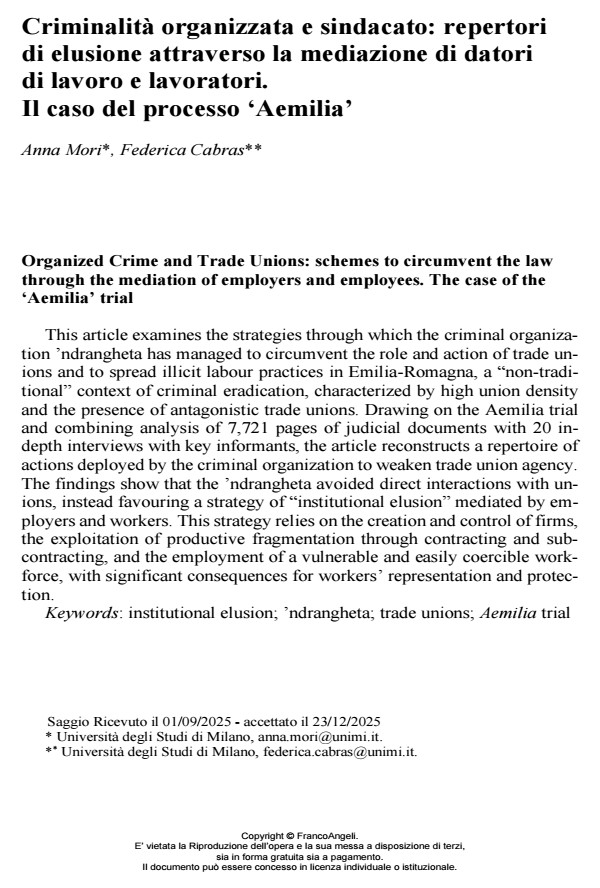
This article examines the strategies through which the criminal organization ’ndrangheta has managed to circumvent the role and action of trade unions and to spread illicit labour practices in Emilia-Romagna, a “non-traditional” context of criminal eradication, characterized by high union density and the presence of antagonistic trade unions. Drawing on the Aemilia trial and combining analysis of 7,721 pages of judicial documents with 20 in-depth interviews with key informants, the article reconstructs a repertoire of actions deployed by the criminal organization to weaken trade union agency. The findings show that the ’ndrangheta avoided direct interactions with unions, instead favouring a strategy of “institutional elusion” mediated by employers and workers. This strategy relies on the creation and control of firms, the exploitation of productive fragmentation through contracting and subcontracting, and the employment of a vulnerable and easily coercible workforce, with significant consequences for workers’ representation and protection.
Keywords: institutional elusion; ’ndrangheta; trade unions; Aemilia trial
- Streeck W. e Thelen K.A. (a cura di). (2005). Beyond continuity: Institutional change in advanced political economies. Oxford: OUP.
- Goldstock R. (1991). Corruption and Racketeering in the New York City Construc-tion Industry: Final Report to Governor Mario M. Cuomo. New York: NYU Press.
- Akhmetzharov S. e Orazgaliyev S. (2021). Labor unions and institutional corruption: The case of Kazakhstan. Journal of Eurasian Studies, 12 (2): 133-144.
- Allum F. e Siebert R. (a cura di) (2003). Organised crime and the challenge to de-mocracy. New York: Routledge.
- Armao F. (2003). Why is organized crime so successful. In: Allum F. e Siebert R., a cura di, Organised Crime and the Challenge to Democracy. New York: Routledge.
- Bagnasco A. (1977). Tre Italie: la problematica territoriale dello sviluppo italiano. Bologna: Il Mulino.
- Barbagli M. e Colombo A. (2004). Partecipazione civica, società e cultura in Emi-lia-Romagna. Milano: Franco Angeli.
- Bertrand O., Lumineau F. e Fedorova E. (2014). The supportive factors of firms’ collusive behavior: Empirical evidence from cartels in the European Union. Or-ganization Studies, 35(6): 881-908.
- Block A.A. e Chambliss W.J. (1979). Miners, tailors and teamsters: Business rack-eteering and trade unionism. Crime and Social Justice, 11: 14-27.
- Borghi V., Lugli L. e Minghini C. (2009). Emilia-Romagna Europa: le ragioni di un progetto. ERE Emilia-Romagna Europa, 1: 5-8.
- Carberry C.A. (2006). Symptoms of corruption and union denial. Trends in Orga-nized Crime, 9(4): 35-38.
- Catino, M. (2018). Colletti bianchi e mafie. Le relazioni pericolose nell’economia del Nord Italia. Stato e mercato, 38(1): 149-188.
- Cederström C. e Fleming P. (2016). On bandit organizations and their (il)legitimacy: Concept development and illustration. Organization Studies, 37(11): 1575-1594. Cressey D. R. e Finckenauer J. (2017). Theft of the nation: The structure and operations of organized crime in America. New York: Routledge.
- dalla Chiesa N., Dino A., Gribaudi G., Marmo M., Santoro M., Coordina R.S. e Massari M. (2017). La violenza delle mafie. Meridiana, 90: 255-292.
- dalla Chiesa, N. e Cabras, F. (2019). Rosso mafia. La ’ndrangheta a Reggio Emilia. Milano: Bompiani.
- De Maria C. (a cura di) (2013). Le Camere del Lavoro in Emilia-Romagna: ieri e domani, Bologna: Editrice Socialmente.
- Dorigatti L. e Mori, A. (2025). The role of trade union power resources in experi-menting with ‘buying decent work’: the case of the Italian public procurement protocols. Transfer: European Review of Labour and Research, (online first).
- Eisenhardt K.M., Graebner M.E. e Sonenshein S. (2016). Grand challenges and in-ductive methods: Rigor without rigor mortis. Academy of management journal, 59 (4): 1113-1123.
- Guerci M., Sferrazzo R., Cabras F., e Radaelli G. (2021). Organized Crime and Em-ployment Relations: A Personal Story of ‘‘ndrangheta Control on Employment Relations Management Practices in Southern Italy. Work, Employment and So-ciety, 36 (4): 758-768.
- Hacker J.S. (2005). Policy Drift: The Hidden Politics of US Welfare State Retrench-ment. In Streeck W. e Thelen K.A., a cura di, Beyond continuity: Institutional change in advanced political economies, Oxford: Oxford University Press.
- Heery E. e Adler L. (2004). Organising the unorganised. In Frege C. e Kelly J., a cura di, Varieties of Unionism: Strategies for Unions Revitalization in a Global-izing Economy. Oxford: OUP.
- Helfen M. e Sydow J. (2013). Negotiating as institutional work: The case of labour standards and international framework agreements. Organization Studies, 34(8): 1073-1098.
- Hobbs D. e Antonopoulos G.A. (2014). How to research organized crime. In Paoli L., a cura di, The Oxford Handbook of Organized Crime. Oxford: OUP.
- Jacobs J.B. (2007). Mobsters, unions, and feds: The mafia and the American labor movement. New York: NYU Press.
- Jacobs J.B. e Peters E. (2003). Labor racketeering: The mafia and the unions. Crime and justice, 30: 229-282.
- Jacobs, J. B. (2007). Mobsters, unions, and feds: The mafia and the American labor movement. New York: NYU Press.
- Jaehrling, K. e Méhaut, P. (2013). ‘Varieties of institutional avoidance’: employers’ strategies in low-waged service sector occupations in France and Germany. So-cio-Economic Review, 11(4): 687-710.
- Joseph J. e Smith C. M. (2021). The ties that bribe: Corruption’s embeddedness in Chicago organized crime. Criminology, 59 (4): 671-703.
- Kimeldorf H. (1992). Reds or rackets?: The making of radical and conservative un-ions on the waterfront. Berkeley: University of California Press.
- Lawrence T.B. e Suddaby R. (2006). Institutions and institutional work. In Clegg S.R., Hardy C., Lawrence T.B. e Nord W.R., a cura di, The SAGE Handbook of Organization Studies. London: Sage.
- Mori A., Guerci M., Radaelli, G. e Cabras, F. (2024). An old recipe, with a new spice: Union avoidance tactics adopted by organized crime when expanding in new territories. Economic and Industrial Democracy, (online first).
- Paoli L. (a cura di) (2014). The Oxford Handbook of Organized Crime. Oxford: Ox-ford Handbooks.
- Paoli L. e Vander Beken T. (2014). Organized crime: A contested concept. In Paoli L., a cura di, The Oxford handbook of organized crime, 13-31. Oxford: OUP.
- Piore M.J. e Sabel C. (1984). The second divide: Possibilities for prosperity. New York: Basic Books.
- Rhodes R.A. (1994). The hollowing out of the state: The changing nature of the public service in Britain. The Political Quarterly, 65(2): 138-151.
- Santoro M. e Solaroli M. (2017). Forme di capitale mafioso e risonanza culturale. Studio di un caso regionale e proposta di una strategia concettuale. Polis, 31(3): 375-408.
- Santoro, A. (2017). L’impatto sul sindacato della penetrazione criminale nel settore edile in Emilia-Romagna dal 2004 in poi: una stima quantitativa. Milano: Uni-versità degli Studi di Milano Bicocca.
- Sciarrone, R. (a cura di) (2019). Mafie del nord. Strategie criminali e contesti locali. Roma: Donzelli.
- Scott W.R. (2003). Institutional carriers: reviewing modes of transporting ideas over time and space and considering their consequences. Industrial and corporate change, 12(4): 879-894.
- Thelen K. (2002). How Institutions Evolve: Insights from Comparative-Historical Analysis. In Mahoney J. e Rueschemeyer D., a cura di, Comparative Historical Analysis in the Social Sciences. New York: Cambridge University Press.
- Vaccaro A. e Palazzo G. (2015). Values against violence: Institutional change in societies dominated by organized crime. Academy of Management Journal, 58(4): 1075-1101.
- Wehrle E.F. (2007). Mobsters, Unions, and Feds: The Mafia and the American La-bor Movement. Labor Studies Journal, 31(4): 102-103.
- Woodbury S. A. (1987). Power in the labor market: Institutionalist approaches to labor problems. Journal of Economic Issues, 21(4): 1781-1807.
Anna Mori, Federica Cabras, Criminalità organizzata e sindacato: repertori di elusione attraverso la mediazione di datori di lavoro e lavoratori. Il caso del processo ‘Aemilia’ in "SOCIOLOGIA DEL LAVORO " 174/2026, pp 209-237, DOI: