The pain that dares not speaking name. Hypnosis in chronic pelvic pain: from theory to clinical practice
Journal title IPNOSI
Author/s Giuseppe De Benedittis
Publishing Year 2026 Issue 2026/1
Language Italian Pages 13 P. 16-28 File size 91 KB
DOI 10.3280/IPN2026-001002
DOI is like a bar code for intellectual property: to have more infomation
click here
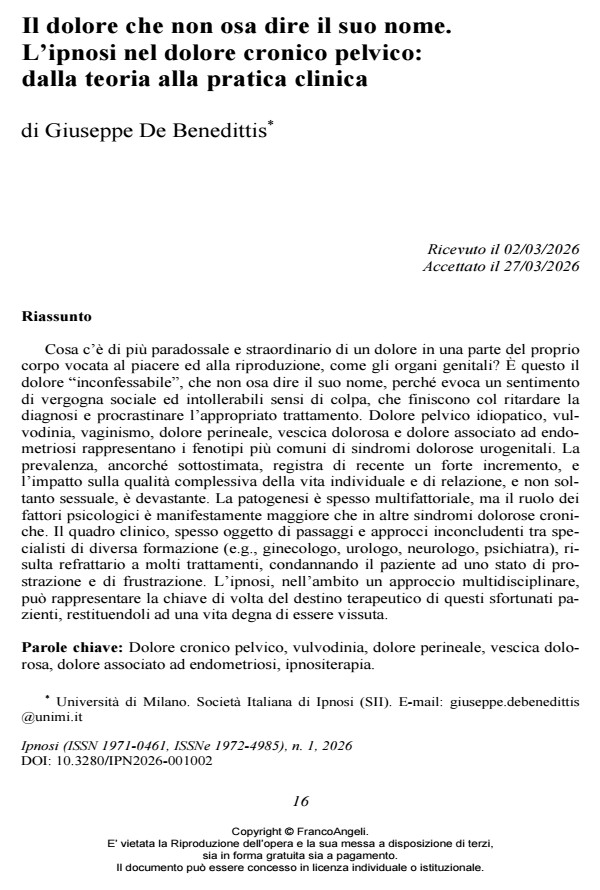
Below, you can see the article first page
If you want to buy this article in PDF format, you can do it, following the instructions to buy download credits
FrancoAngeli is member of Publishers International Linking Association, Inc (PILA), a not-for-profit association which run the CrossRef service enabling links to and from online scholarly content.
What is more paradoxical and extraordinary than pain in a part of the body dedicated to pleasure and reproduction, such as the genitals? This is the “unspeakable” pain, one that dares not speak its name because it evokes feelings of social shame and intolerable guilt—factors that ultimately delay diagnosis and postpone appropriate treatment. Idiopathic pelvic pain, vulvodynia, vaginismus, perineal pain, painful bladder syndrome, and pain associated with endometriosis represent the most common phenotypes of urogenital pain syndromes. Although still underestimated, prevalence has recently shown a sharp increase and the impact on the overall quality of individual and interpersonal life, not just sexual life, is devastating. Its pathogenesis is often multifactorial, but the role of psychological factors is manifestly greater than in other chronic pain syndromes. The clinical picture is frequently subjected to inconclusive hand-offs and approaches between specialists of different backgrounds (e.g., gynecologists, urologists, neurologists, psychiatrists) and remains refractory to many treatments, condemning the patient to a state of exhaustion and frustration. Hypnosis, within a multidisciplinary approach, can represent the turning point in the therapeutic destiny of these unfortunate patients, restoring them to a life worth living.
Keywords: Chronic pelvic pain, vulvodynia, perineal pain, painful bladder, pain associated with endometriosis, hypnotherapy.
- As-Sanie S., Kim J., Schmidt-Wilcke T., Sundgren P.C., Clauw D.J., Napadow V., Harris R.E. (2016). Functional connectivity is associated with altered brain chemistry in women with endometriosis-associated chronic pelvic pain. The Journal of Pain, 17(1): 1-13.
- Bohm-Starke N., Ramsay K.W., Lytsy P., Nordgren B., Sjo¨berg I., Moberg K., Flink I. (2022). Treatment of provoked vulvodynia: a systematic review. The Journal of Sexual Medicine, 19(5): 789-808.
- Brooks T., Sharp R., Evan S., Baranoff J., Esterman A. (2020). Predictors of psychological outcomes and the effectiveness and experience of psychological interventions for adult women with chronic pelvic pain: a scoping review. Journal of Pain Research, 13: 1081-1102. DOI: 10.2147/JPR.S245723
- Bryant C., Cockburn R., Plante A.F., Chia A. (2016). The psychological profile of women presenting to a multidisciplinary clinic for chronic pelvic pain: High levels of psychological dysfunction and implications for practice. Journal of Pain Research, 9: 1049-1056. DOI: 10.2147/JPR.S115065
- Cheong Y., William Stones R. (2006). Chronic pelvic pain: aetiology and therapy. Best Practice & Research Clinical Obstetrics & Gynaecology, 20(5): 695-711.
- Coitinho Biurra Y., Chesterman S., Skvarc D., Mikocka-Walus A., Evans S. (2023). Hypnotherapy for chronic pelvic pain: A scoping systematic review and meta-analysis. Complementary Therapies in Clinical Practice, 52: 101771.
- De Benedittis G. (2001). Hypnotic Synaesthesia: The Divine Banquet of Senses. Hypnos, 28(1): 15-22.
- De Benedittis G. (2016). Hypnosis and Fibromyalgia. In: Elkins G., ed., Handbook of Medical and Psychological Hypnosis. New York: Springer Publishing Company.
- De Benedittis G. (2021). Neural mechanisms of hypnosis and meditation-induced analgesia: a narrative review. International Journal of Clinical and Experimental Hypnosis, 69(3): 363-382. DOI: 10.1080/00207144.2021.1917294
- De Benedittis G. (2024). Hypnotic modulation of autonomic nervous system (ANS) activity. Brain Sciences, 14(3): 249.
- Doggweiler R., Whitmore K.E., Meijlink J.M., Drake M.J., Frawley H., Nordling J., Hanno P., Fraser M.O., Homma Y., Garrido G., Gomes M.J., Elneil S., Van De Merwe J.P., Lin A.T.L., Tomoe H. (2017). A standard for terminology in chronic pelvic pain syndromes: a report from the chronic pelvic pain working group of the international continence society. Neurourology and Urodynamics, 36(4): 984-1008.
- EAU Guidelines (2025). Edn. presented at the EAU Annual Congress Madrid 2025. ISBN 978-94-92671- 29-5. EAU Guidelines Office, Arnhem, the Netherlands.
- Elkins G., Jensen M.P., Patterson D.R. (2007). Hypnotherapy for the management of chronic pain. International Journal of Clinical and Experimental Hypnosis, 55(3): 275-287. DOI: 10.1080/00207140701338621
- Grinberg K., Sela Y., Nissanholtz-Gannot R. (2020). New insights about chronic pelvic pain syndrome (CPPS). International Journal of Environmental Research and Public Health, 17(9): 3005.
- Hampson J.P., Reed B.D., Clauw D.J., Bhavsar R., Gracely R.H., Haefner H.K., Harris R.E. (2013). Augmented central pain processing in vulvodynia. The Journal of Pain, 14(6): 579-589.
- Ha¨user W., De Benedittis G. (2024). Hypnosis and fibromyalgia syndrome. In: Linden J.H., De Benedittis G., Sugarman L.I., Varga K., eds, The Routledge International Handbook of Clinical Hypnosis 1: 640-649. DOI: 10.4324/9781003449126-58
- He H., Luo H., Qian B., Xu H., Zhang G., Zou X., Zou J. (2024). Autonomic nervous system dysfunction is related to chronic prostatitis/chronic pelvic pain syndrome. The World Journal of Men’s Health, 42(1).
- Jensen M.P. (2011). Psychosocial approaches to pain management: an organizational framework. Pain, 152(4): 717-725.
- Kaya S., Hermans L., Willems T., Roussel N., Meeus M. (2013). Central sensitization in urogynecological chronic pelvic pain: a systematic literature review. Pain Physician, 16(4): 291-308.
- Kovac?evic´ I., Pavic´ J., Filipovic´ B., OzimecVulinec S?., Ilic´ B., Petek D. (2024). Integrated approach to chronic pain: the role of psychosocial factors and multidisciplinary treatment: a narrative review. International Journal of Environmental Research and Public Health, 21(9): 1135.
- Lackner J.M., Clemens J.Q., Radziwon C., Danforth T.L., Ablove T.S., Krasner S.S., Vargovich A.M., O’Leary P.C., Marotto T., Naliboff B.D. (2024). Cognitive behavioral therapy for chronic pelvic pain: what is it and does it work? Journal of Urology, 211(4): 539-550. DOI: 10.1097/JU.0000000000003847
- Martucci K.T., Shirer W.R., Bagarinao E., Johnson K.A., Farmer M.A., Labus J.S., Apkarian A.V., Deutsch G., Harris R.E., Mayer E.A., Clauw D.J., Greicius M.D., Mackey S.C. (2015). The posterior medial cortex in urologic chronic pelvic pain syndrome: detachment from default mode network, a resting-state study from the MAPP Research Network. Pain, 156(9): 1755-1764.
- Mathias S. (1996). Chronic pelvic pain: prevalence, health-related quality of life, and economic correlates. Obstetrics & Gynecology, 87(3): 321-327. DOI: 10.1016/0029-7844(95)00458-0
- Milling L.S., Valentine K.E., LoStimolo L.M., Net, A.M., McCarley H.S. (2021). Hypnosis and the alleviation of clinical pain: a comprehensive meta-analysis. International Journal of Clinical and Experimental Hypnosis, 69(3): 297-322. DOI: 10.1080/00207144.2021.1920330
- Nimnuan C., Rabe-Hesketh S., Wessely S., Hotopf M. (2001). How many functional somatic syndromes? Journal of Psychosomatic Research, 51(4): 549-557. DOI: 10.1016/S0022-3999(01)00224-0
- Pukall C., Kandyba K., Amsel R., Khalife´ S., Binik Y. (2007). Effectiveness of hypnosis for the treatment of vulvar vestibulitis syndrome: a preliminary investigation. The Journal of Sexual Medicine, 4(2): 417-425.
- Rosenbaum T.Y., Owens A. (2008). Continuing medical education: the role of pelvic floor physical therapy in the treatment of pelvic and genital pain-related sexual dysfunction (CME). The Journal of Sexual Medicine, 5(3): 513-523.
- Starzec-Proserpio M., Frawley H., Bø K., Morin M. (2025). Effectiveness of nonpharmacological conservative therapies for chronic pelvic pain in women: A systematic review and meta-analysis. American Journal of Obstetrics and Gynecology, 232(1): 42-71.
- Till S.R., As-Sanie S., Schrepf A. (2019). Psychology of chronic pelvic pain: prevalence, neurobiological vulnerabilities, and treatment. Clinical Obstetrics & Gynecology, 62(1): 22-36. DOI: 10.1097/GRF.0000000000000412
Giuseppe De Benedittis, Il dolore che non osa dire il suo nome. L’ipnosi nel dolore cronico pelvico: dalla teoria alla pratica clinica in "IPNOSI" 1/2026, pp 16-28, DOI: 10.3280/IPN2026-001002