Artificial Intelligence in Care Work in Italy: Social Representations across Strategic Governance and Healthcare Professions
Journal title WELFARE E ERGONOMIA
Author/s Giulia Banfi, Miriam Ferraro, Pierpaola Pierucci
Publishing Year 2026 Issue 2026/1
Language Italian Pages 16 P. 55-70 File size 119 KB
DOI 10.3280/WE2026-0001005
DOI is like a bar code for intellectual property: to have more infomation
click here
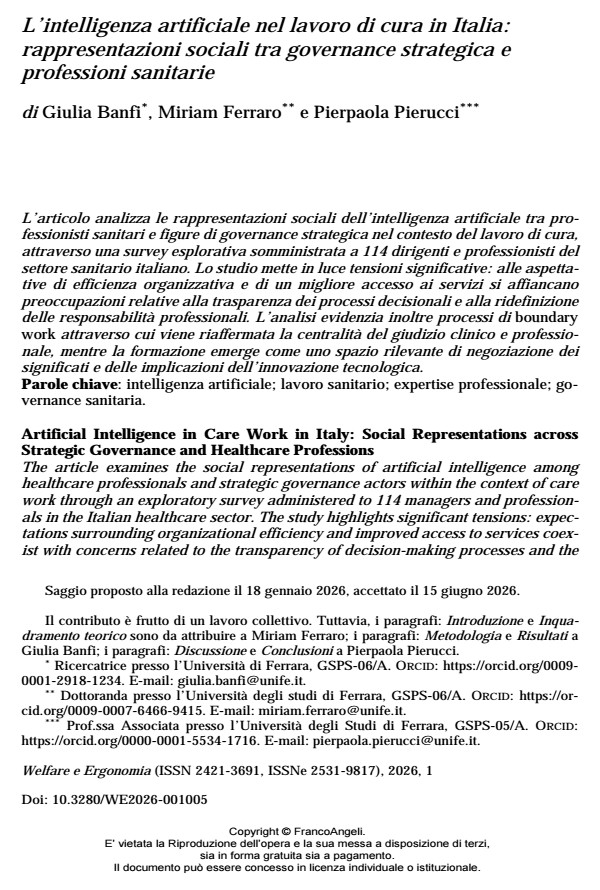
Below, you can see the article first page
If you want to buy this article in PDF format, you can do it, following the instructions to buy download credits
FrancoAngeli is member of Publishers International Linking Association, Inc (PILA), a not-for-profit association which run the CrossRef service enabling links to and from online scholarly content.
The article examines the social representations of artificial intelligence among healthcare professionals and strategic governance actors within the context of care work through an exploratory survey administered to 114 managers and professionals in the Italian healthcare sector. The study highlights significant tensions: expectations surrounding organizational efficiency and improved access to services coexist with concerns related to the transparency of decision-making processes and the reconfiguration of professional responsibilities. The analysis also reveals processes of boundary work through which the centrality of clinical and professional judgment is reaffirmed, while training emerges as a key space for negotiating the meanings and implications of technological innovation.
Keywords: artificial intelligence; healthcare work; professional expertise; healthcare governance.
- Akrich M. (1992). The description of technical objects. In: W. Bijker and J. Law, editor, Shaping technology/building society: Studies in sociotechnical change, pp. 205-224. MIT Press.
- Castagno S. and Khalifa M. (2020). Perceptions of artificial intelligence among healthcare staff: A qualitative survey study. Frontiers in Artificial Intelligence, 3, 578983.
- Benvenga L. (2023). Le ICT e il rapporto medico-paziente: sistema sanitario, politiche, soggetti. Milano: FrancoAngeli.
- Greenhalgh T., Wherton J., Papoutsi C., Lynch J., Hughes G., A’Court C., Hinder S., Fahy N., Procter R. and Shaw S. (2017). Beyond adoption: A new framework for theorizing and evaluating nonadoption, abandonment, and challenges to the scale-up of health and care technologies. Journal of Medical Internet Research, 19(11), e367.
- Höijer B. (2011). Social representations theory. A new theory for media research. Nordicom Review, 32(2): 3-16.
- Irgang L., Sestino A., Barth H. and Holmén M. (2025). Healthcare workers’ adoption of and satisfaction with artificial intelligence: The counterintuitive role of paradoxical tensions and paradoxical mindset. Technological Forecasting and Social Change, 212, 123967.
- Jasanoff S. (2004). The idiom of co-production. States of knowledge, 1-12. London: Routledge.
- Jobin A., Ienca M. and Vayena E. (2019). The global landscape of AI ethics guidelines. Nature Machine Intelligence, 1: 389-399.
- Latour B. (1992). Where are the missing masses? The sociology of a few mundane artifacts. In: W. Bijker and J. Law, editor, Shaping technology/building society: Studies in sociotechnical change, 225-258. MIT Press.
- Lambert S.I., Madi M., Sopka S., Lenes A., Stange H., Buszello C.P. and Stephan A. (2023). An integrative review on the acceptance of artificial intelligence among healthcare professionals in hospitals. NPJ Digital Medicine, 6(1), 111.
- Lombi L. and Rossero E. (2024). How artificial intelligence is reshaping the autonomy and boundary work of radiologists. A qualitative study. Sociology of Health & Illness, 46(2): 200-218.
- Longoni C., Bonezzi A. and Morewedge C.K. (2019). Resistance to Medical Artificial Intelligence. Journal of Consumer Research, 46, 4: 629-650.
- Martínez-Martínez H., Martínez-Alfonso J., Sánchez-Rojo-Huertas B., Reynolds-Cortez V., Turégano-Chumillas A., Meseguer-Ruiz V.A., ... and Martínez-Vizcaíno V. (2025). Perceptions of, barriers to, and facilitators of the use of AI in primary care: systematic review of qualitative studies. Journal of Medical Internet Research, 27, e71186.
- Moldt J.A., Festl-Wietek T., Fuhl W., Zabel S., Claassen M., Wagner S. and Herrmann-Werner A. (2025). Exploring the social dimensions of AI integration in healthcare: a qualitative study of stakeholder views on challenges and opportunities. BMJ Open, 15(6), e096208.
- Moretti V. and Pronzato R. (2024). The emotional ambiguities of healthcare professionals’ platform experiences. Social Science & Medicine, 357, 117185.
- Morgenstern J.D., Rosella L.C., Daley M.J., Goel V., Schünemann H.J. and Piggott T. (2021). AI’s gonna have an impact on everything in society, so it has to have an impact on public health: a fundamental qualitative descriptive study of the implications of artificial intelligence for public health. BMC Public Health, 21(1): 40.
- Moscovici S. (2001). Social representations: Essays in social psychology. NYU Press.
- Nuccetelli F., Gabellone V., Marsano F., Giovanetti F., Dri P., Valetto M.R. and Prato R. (2025). The use of artificial intelligence in healthcare as perceived by the citizens and patients: a narrative review of the literature. European Journal of Public Health, 35(6): 1092-1099.
- Pronzato R. and Gibin M. (2025). L’impatto dell’IA e dell’Automated Decision-Making sulle relazioni di cura: nuove sfide per la sociologia della salute. Studi di Sociologia, LXIII(1): 61-73.
- Reddy S., Allan S., Coghlan S. and Cooper P. (2020). A governance model for the application of AI in health care. Journal of the American Medical Informatics Association, 27(3): 491-497.
- Torricelli P., Torricelli C., Bertelli B., Sandi M. and Pecchi A. (2025). Physician perceptions of artificial intelligence in Northern Italy healthcare: a survey of fears and expectations. Frontiers in Artificial Intelligence, 8, 1624789.
Giulia Banfi, Miriam Ferraro, Pierpaola Pierucci, L’intelligenza artificiale nel lavoro di cura in Italia: rappresentazioni sociali tra governance strategica e professioni sanitarie in "WELFARE E ERGONOMIA" 1/2026, pp 55-70, DOI: 10.3280/WE2026-0001005