The Electronic Health Record (EHR) as a Prism of Inequalities: A Qualitative Analysis among Healthcare Professionals in Lombardy and Campania
Journal title WELFARE E ERGONOMIA
Author/s Marino Pezzolo, Giuseppe Gargiulo, Adriana Cerasuolo
Publishing Year 2026 Issue 2026/1
Language Italian Pages 16 P. 101-116 File size 108 KB
DOI 10.3280/WE2026-0001008
DOI is like a bar code for intellectual property: to have more infomation
click here
Below, you can see the article first page
If you want to buy this article in PDF format, you can do it, following the instructions to buy download credits
FrancoAngeli is member of Publishers International Linking Association, Inc (PILA), a not-for-profit association which run the CrossRef service enabling links to and from online scholarly content.
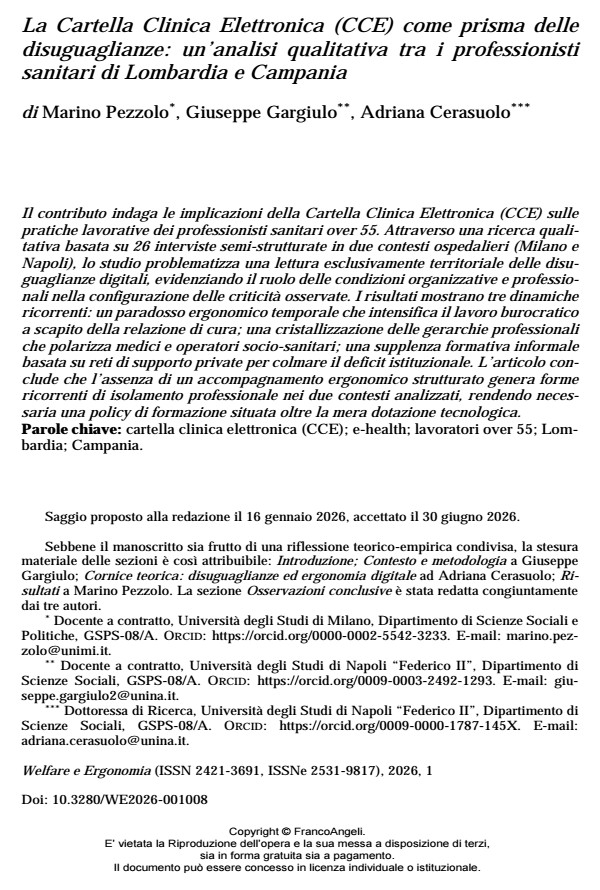
This paper investigates the implications of the Electronic Health Record (EHR) on the work practices of over-55 healthcare professionals. Through a qualitative study based on 26 semi-structured interviews in two Italian hospitals (in Milan and Naples), the analysis problematizes an exclusively territorial interpretation of digital inequalities by highlighting the role of organizational conditions in shaping the observed challenges. Results reveal three key dynamics: a temporal ergonomic paradox that intensifies bureaucratic tasks at the expense of patient care; a crystallization of professional hierarchies that polarizes doctors and support staff; and an informal training substitution relying on private networks to bridge institutional gaps. The article concludes that the lack of structured ergonomic support generates a homogeneous professional isolation across the two organizational settings, calling for situated training policies beyond mere technological infrastructure deployment.
Keywords: electronic health record (EHR); e-health; over 55 workers; Lombardy; Campania.
- Ascoli U. e Vicarelli G. (2024). Quo Vadis? Il lavoro nel sistema sanitario italiano tra pubblico e privato. La Rivista delle Politiche Sociali, 3: 7-29.
- Bowker G.C. and Star S.L. (1999). Sorting Things Out. Cambridge, MA: MIT Press.
- Braun V. and Clarke V. (2019). Reflecting on reflexive thematic analysis. Qualitative Research in Sport, Exercise and Health, 11(4): 589-597. DOI: 10.1080/2159676X.2019.1628806
- Cantillon B. and Van Lancker W. (2013). Three Shortcomings of the Social Investment Perspective. Social Policy and Society, 12(4): 553-564. DOI: 10.1017/S1474746413000080
- Capogna S. (2020). Sanità digitale tra organizzazione e innovazione. Un caso di studio. Salute e Società, 1: 35-51. DOI: 10.3280/SES2020-001004
- Cipolla C. e Ardissone A. (2017). Un paradigma cittadino-centrico nella m-Health. Salute e Società, 16(2): 11-31. DOI: 10.3280/SES2017-002002
- Corbisiero M.F., Rizzo D., Gallus R., Loreti P., Bracciale L. and Bussu F. (2024). Opportunities and obstacles of electronic health records in Italy: towards enhanced surgical care. Acta Otorhinolaryngologica Italica, 44(2): 140-142. DOI: 10.14639/0392-100X-N2727
- De Benedictis A., Lettieri E., Gastaldi L., Masella C., Urgu A. and Tartaglini D. (2020). Electronic Medical Records implementation in hospital: An empirical investigation of individual and organizational determinants. PLOS ONE, 15(6), e0234108.
- European Commission (2025). State of the Digital Decade 2025: Keep building the EU’s sovereignty and digital future. Brussels.
- Ferrera M., Fargion V. e Jessoula M. (2012). Alle radici del welfare all’italiana: origini e futuro di un modello sociale squilibrato. Venezia: Marsilio.
- Flyvbjerg B. (2006). Five Misunderstandings About Case-Study Research. Qualitative Inquiry, 12(2): 219-245. DOI: 10.1177/1077800405284363
- Helsper E. (2021). The Digital Disconnect: The Social Causes and Consequences of Digital Inequalities. London: SAGE Publications. DOI: 10.4135/9781526492982
- Hemerijck A. (2014). Changing Welfare States. Oxford: Oxford University Press.
- Lupton D. (2018). Digital Health: Critical and Cross-Disciplinary Perspectives. London: Routledge.
- Maino F. e Longo F. (2021). Platform Welfare. Nuove logiche per innovare i servizi locali. Milano: Egea.
- Malterud K., Siersma V.D. and Guassora A.D. (2016). Sample Size in Qualitative Interview Studies: Guided by Information Power. Qualitative Health Research, 26(13): 1753-1760. DOI: 10.1177/1049732315617444
- Ministero della Salute (2023). Decreto 7 settembre 2023. Fascicolo sanitario elettronico 2.0. Gazzetta Ufficiale della Repubblica Italiana, Serie Generale, 249, 24 ottobre 2023.
- Ministero della Salute (2022). Decreto 20 maggio 2022. Adozione delle Linee guida per l’attuazione del Fascicolo sanitario elettronico. Gazzetta Ufficiale della Repubblica Italiana, Serie Generale, 160, 11 luglio 2022.
- Nedeljko M., Gu Y. and Bostan C.M. (2024). The dual impact of technological tools on health and technostress among older workers: an integrative literature review. Cognition, Technology & Work, 26(1): 47-61. DOI: 10.1007/S10111-023-00741-7
- Provenzano M., Cillara N., Curcio F., Pisu M.O., González C.I.A. and Jiménez-Herrera M.F. (2024). Electronic Health Record Adoption and Its Effects on Healthcare Staff: A Qualitative Study of Well-Being and Workplace Stress. International Journal of Environmental Research and Public Health, 21(11): 1430. DOI: 10.3390/IJERPH21111430
- Rašticová M., Šácha J., Lakomý M. and Mishra P.K. (2025). Technostress Among Older Workers: A Central European Perspective. Psychology Research and Behavior Management, 18, 1211. DOI: 10.2147/PRBM.S508500
- Regione Piemonte (2018). Linee guida Repository Clinico Documentale, Dossier Clinico e Gestione Consenso.
- Santoni V. (2018). Gli investimenti, le opportunita` e i rischi della digital health nel campo del welfare aziendale. Politiche Sociali, 5(2): 217-234. DOI: 10.7389/90595
- Serratore G. (2025). La cartella clinica tra analogico e digitale: gestione e conservazione a norma. AIDAinformazioni, 43(1-2): 63-84. DOI: 10.57574/596554934
- Suppa A., Bullini Orlandi L., Zardini A. and Pierce P. (2018). Use of Electronic Medical Records in Academic Hospitals: limits and remedies. Lund University.
- SVIMEZ (2025). Rapporto SVIMEZ 2024 sull’economia e la società del Mezzogiorno. Bologna: il Mulino.
- Warschauer M. (2003). Technology and Social Inclusion: Rethinking the Digital Divide. Cambridge, MA: MIT Press.
- Yin R.K. (2018). Case study research and applications: design and methods (6th ed.). Los Angeles: SAGE Publications.
- Zardini A., Rossignoli C. and Campedelli B. (2016). The impact of the implementation of the electronic medical record in an Italian university hospital. In: Rossignoli C., Gatti M. and Agrifoglio R., editors, Organizational Innovation and Change: Managing Information and Technology. Lecture Notes in Information Systems and Organisation, 13: 63-73. Cham: Springer. DOI: 10.1007/978-3-319-22921-8_6
Marino Pezzolo, Giuseppe Gargiulo, Adriana Cerasuolo, La Cartella Clinica Elettronica (CCE) come prisma delle disuguaglianze: un’analisi qualitativa tra i professionisti sanitari di Lombardia e Campania in "WELFARE E ERGONOMIA" 1/2026, pp 101-116, DOI: 10.3280/WE2026-0001008