The invisibility of women in science and research: A new interpretative paradigm from the PRIN PNRR 2022 “LeI” project
Journal title WELFARE E ERGONOMIA
Author/s Gabriella D’Ambrosio, Maria Cristina Antonucci, Ilaria Di Tullio
Publishing Year 2026 Issue 2026/1
Language Italian Pages 16 P. 183-198 File size 89 KB
DOI 10.3280/WE2026-0001014
DOI is like a bar code for intellectual property: to have more infomation
click here
Below, you can see the article first page
If you want to buy this article in PDF format, you can do it, following the instructions to buy download credits
FrancoAngeli is member of Publishers International Linking Association, Inc (PILA), a not-for-profit association which run the CrossRef service enabling links to and from online scholarly content.
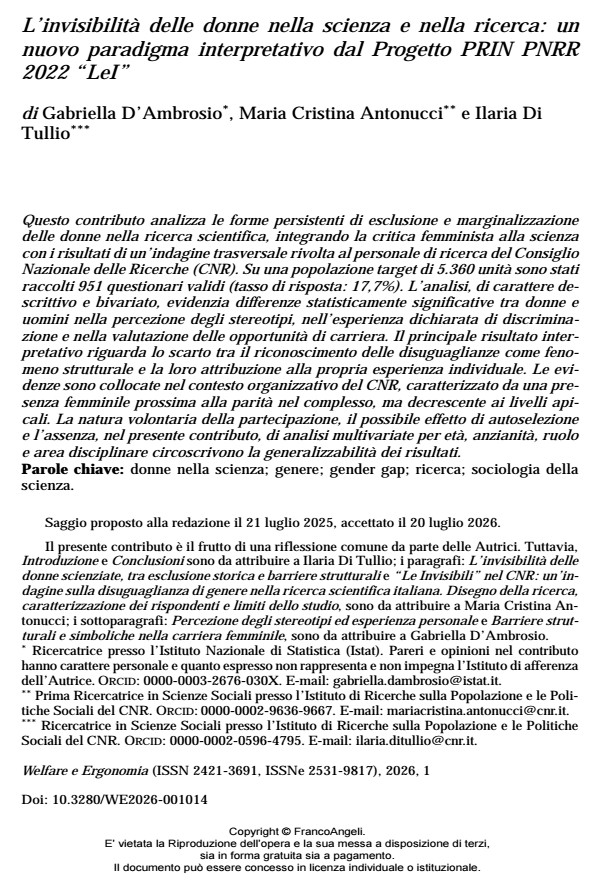
This paper examines persistent forms of exclusion and marginalisation of women in scientific research by combining feminist critiques of science with evidence from a cross-sectional survey of research staff at the Italian National Research Council (CNR). A total of 951 valid questionnaires were collected from a target population of 5,360 employees (response rate: 17.7%). The descriptive and bivariate analysis identifies statistically significant gender differences in the perception of stereotypes, self-reported experiences of discrimination, and assessments of career opportunities. The main interpretative finding concerns the gap between recognizing gender inequality as a structural phenomenon and identifying one’s own experience as discriminatory. Survey representations are situated within the organisational context of the CNR, where women are close to parity overall but remain underrepresented at senior levels. Voluntary participation, possible self-selection, and the absence of multivariate analyses by age, seniority, role, and disciplinary area limit the generalisability of the findings.
Keywords: women in science; gender; gender gap; research; sociology of science.
- Acker J. (1990). Hierarchies, Jobs, Bodies: A Theory of Gendered Organizations. Gender & Society, 4(2): 139-158. -- https://www.jstor.org/stable/189609.
- Abuwatfa W., Zamel N., and Al-Othman A. (2021). Lessons Learned from the Underrepresentation of Women in STEM: AI-Enabled Solutions and More. Energy and AI, 5(4).
- Allen A., Forst R., Haugaard M. and Reed, I.A. (2021). Debating the dimensions: Amy Allen, Rainer Forst and Isaac Ariail Reed in dialogue-review of the four dimensions of power by Mark Haugaard. Journal of Political Power, 14(3): 493-519. DOI: 10.1080/2158379X.2021.1972745
- Antonucci M.C. e Cellini M. (2021). Genere e segregazione verticale nell’accademia italiana: un’analisi nei settori giuridico, economico-statistico e socio-politico prima e dopo l’introduzione dell’abilitazione scientifica nazionale. In: Avveduto S., a cura di, Eppur si muove. Nuovi e rinnovati impegni per la parità di genere. Roma: CNR.
- Arena G. (2022). Il bilancio di genere di Ateneo come strumento di policy per la parità di genere. Sicurezza e Scienze Sociali, 3: 51-61.
- Avolio B., Chávez J., and Vílchez-Román C. (2020). Factors that contribute to the underrepresentation of women in science careers worldwide: A literature review. Social Psychology of Education, 23(3): 773-794.
- Blackburn R.M., Jarman J., and Brooks B. (2000). The puzzle of gender segregation and inequality: A cross-national analysis. European Sociological Review, 16(2): 119-135. -- https://www.jstor.org/stable/522673.
- Blackburn R.M., Jarman J., and Brooks B. (2001). The vertical dimension of occupational segregation. Work, Employment and Society, 15(3): 511-538. DOI: 10.1177/09500170122119138
- Carnes M. and Bigby J. (2007). Jennifer fever in academic medicine. Journal of Women’s Health, 16(3): 299-301.
- Carnes M., Bartels C.M., Kaatz A., and Kolehmainen C. (2015). Why is John more likely to become department chair than Jennifer?. Transactions of the American Clinical and Climatological Association, 126, 197. -- https://pubmed.ncbi.nlm.nih.gov/26330674/.
- Consiglio Nazionale delle Ricerche (2024a). Bilancio di Genere CNR 2023. Roma: CNR.
- Consiglio Nazionale delle Ricerche (2024b). Bilancio di genere. Il personale CNR. Infografica aggiornata al 31 dicembre 2023. Roma: CNR.
- Dordoni A. e Anzivino M. (2022). La produttività scientifica nell’accademia italiana in una prospettiva di genere. Sociologia del Lavoro, 162(1): 141-163. DOI: 10.3280/SL2022-162007
- Eslen-Ziya H. and Yildirim T.M. (2022). Perceptions of gendered-challenges in academia: How women academics see gender hierarchies as barriers to achievement. Gender, Work & Organization, 29(1): 301-308.
- Haraway D. (2013). Situated knowledges: The science question in feminism and the privilege of partial perspective. In: Wyer M., Barbercheck M., Cookmeyer D., Ozturk H., and Wayne M., editors, Women, science, and technology. London: Routledge.
- Harding S. (1986). The Science Question in Feminism. New York: Cornell University Press.
- Harding S. (2009). Postcolonial and feminist philosophies of science and technology: Convergences and dissonances. Postcolonial Studies, 12(4): 401-421. DOI: 10.1080/13688790903350658
- Lewis S., Lang C., and McKay J. (2007). An inconvenient truth: The invisibility of women in ICT. Australasian Journal of Information Systems, 15(1).
- Lewiss R.E., Silver J.K., Bernstein C.A., Mills A.M., Overholser B., and Spector N.D. (2020). Is Academic Medicine Making Mid-career Women Physicians Invisible?. Journal of Women’s Health, 29(2): 187-192.
- Macarie F.C. and Moldovan O. (2015). Horizontal and vertical gender segregation in higher education: EU 28 under scrutiny. Managerial Challenges of the Contemporary Society. Proceedings, 8(1): 162.
- Meulders D., Plasman R., Rigo A., and O’Dorchai S. (2010). Horizontal and vertical segregation. Meta-analysis of gender and science research-topic report, -- testo disponibile al sito: https://www.genderportal.eu/sites/default/files/resource_pool/TR1_Segregation.pdf.
- Ministero dell’Università e della Ricerca (2024). Focus “Il personale docente e non docente nel sistema universitario italiano – Anno 2023”. Roma: Ministero dell’Università e della Ricerca. -- https://ustat.mur.gov.it/media/1294/focus_pers_univ2023.pdf.
- Oreskes N. (1996). Objectivity or Heroism? On the Invisibility of Women in Science. Osiris, 11: 87-113. -- https://history.ucsd.edu/_files/faculty/oreskes-naomi/ObjectivityOrHeroism.pdf.
- Picardi I. (2019). The glass door of academia: Unveiling new gendered bias in academic recruitment. Social Sciences, 8(5): 160.
- Probert B. (2005). ‘I just couldn’t fit it in’: Gender and unequal outcomes in academic careers. Gender, Work & Organization, 12(1): 50-72.
- Rossi B. (2026). Oltre la neutralità: istituzioni accademiche e divario di genere. CALUMET, 25: 84-102.
- Ruggiero K.M. and Taylor D.M. (1994). The personal/group discrimination discrepancy: Women talk about their experiences. Journal of Applied Social Psychology, 24(20): 1806-1826.
- Santero A. e Bertolini S. (2023). Avanzamenti di carriera e soffitto di cristallo. In: Naldini M., e Poggio B., a cura di, Genere e accademia. Carriere, culture e politiche. Bologna: il Mulino.
- Taylor D.M., Wright S.C., Moghaddam F.M., and Lalonde R.N. (1990). The personal/group discrimination discrepancy: Perceiving my group, but not myself, to be a target for discrimination. Personality and Social Psychology Bulletin, 16(2): 254-262. DOI: 10.1177/0146167290162006
- Ward K. (2014). Having it all: women, work, family, and the academic career. Labour, 73: 255-264. -- https://id.erudit.org/iderudit/1025203ar.
Gabriella D’Ambrosio, Maria Cristina Antonucci, Ilaria Di Tullio, L’invisibilità delle donne nella scienza e nella ricerca: un nuovo paradigma interpretativo dal Progetto PRIN PNRR 2022 “LeI” in "WELFARE E ERGONOMIA" 1/2026, pp 183-198, DOI: 10.3280/WE2026-0001014