The problem of training analysis
Journal title PSICOTERAPIA E SCIENZE UMANE
Author/s Anna Freud
Publishing Year 2026 Issue 2026/3
Language Italian Pages 10 P. 363-372 File size 265 KB
DOI 10.3280/PU2026-003002
DOI is like a bar code for intellectual property: to have more infomation
click here
Below, you can see the article first page
If you want to buy this article in PDF format, you can do it, following the instructions to buy download credits
FrancoAngeli is member of Publishers International Linking Association, Inc (PILA), a not-for-profit association which run the CrossRef service enabling links to and from online scholarly content.
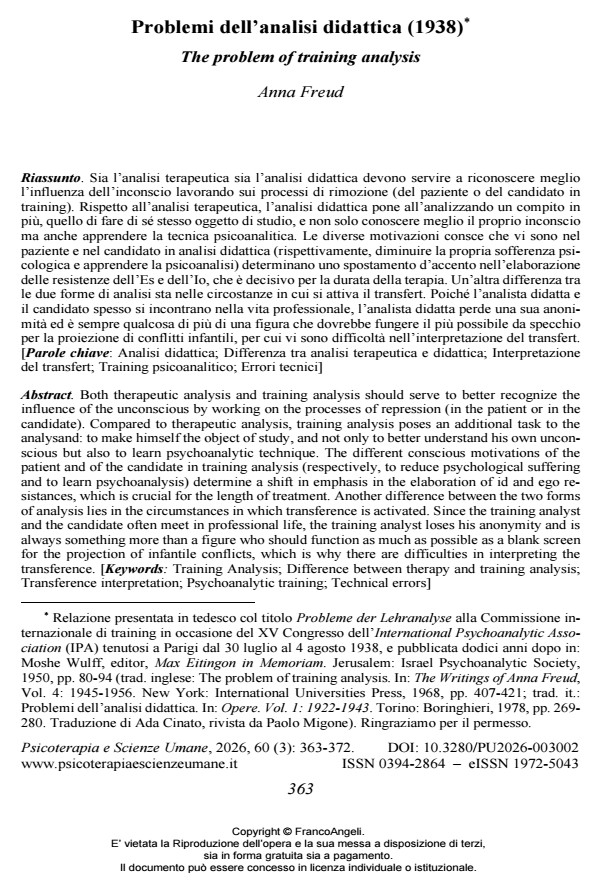
Both therapeutic analysis and training analysis should serve to better recognize the influence of the unconscious by working on the processes of repression (in the patient or in the candidate). Compared to therapeutic analysis, training analysis poses an additional task to the analysand: to make himself the object of study, and not only to better understand his own unconscious but also to learn psychoanalytic technique. The different conscious motivations of the patient and of the candidate in training analysis (respectively, to reduce psychological suffering and to learn psychoanalysis) determine a shift in emphasis in the elaboration of id and ego resistances, which is crucial for the length of treatment. Another difference between the two forms of analysis lies in the circumstances in which transference is activated. Since the training analyst and the candidate often meet in professional life, the training analyst loses his anonymity and is always something more than a figure who should function as much as possible as a blank screen for the projection of infantile conflicts, which is why there are difficulties in interpreting the transference.
Keywords: Training Analysis; Difference between therapy and training analysis; Transference interpretation; Psychoanalytic training; Technical errors
Anna Freud, Problemi dell’analisi didattica (1938) in "PSICOTERAPIA E SCIENZE UMANE" 3/2026, pp 363-372, DOI: 10.3280/PU2026-003002