Role of research and critical thinking in psychoanalytic training and education. Criticisms and calls for change
Journal title PSICOTERAPIA E SCIENZE UMANE
Author/s Morris N. Eagle, Paul L. Wachtel
Publishing Year 2026 Issue 2026/3
Language Italian Pages 26 P. 631-656 File size 412 KB
DOI 10.3280/PU2026-003018
DOI is like a bar code for intellectual property: to have more infomation
click here
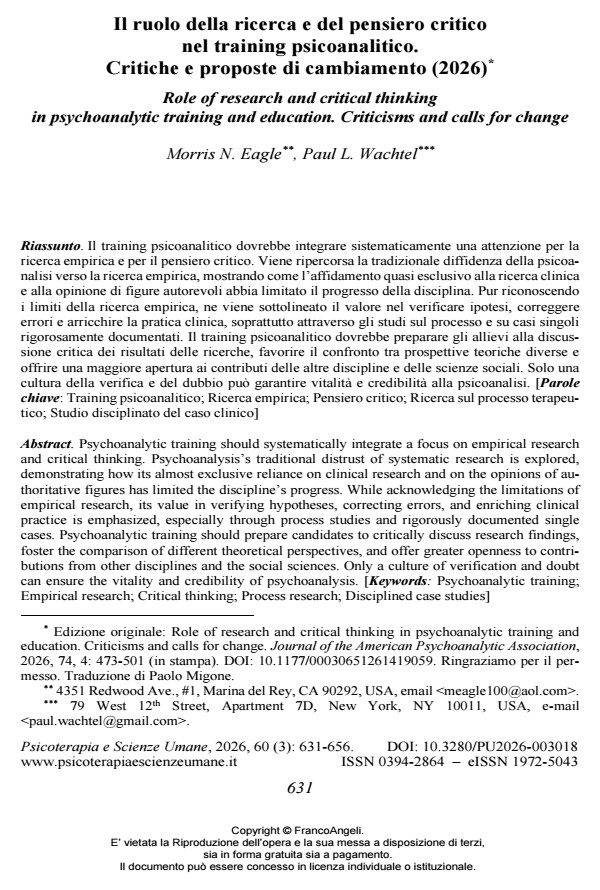
Below, you can see the article first page
If you want to buy this article in PDF format, you can do it, following the instructions to buy download credits
FrancoAngeli is member of Publishers International Linking Association, Inc (PILA), a not-for-profit association which run the CrossRef service enabling links to and from online scholarly content.
Psychoanalytic training should systematically integrate a focus on empirical research and critical thinking. Psychoanalysis’s traditional distrust of systematic research is explored, demonstrating how its almost exclusive reliance on clinical research and on the opinions of authoritative figures has limited the discipline’s progress. While acknowledging the limitations of empirical research, its value in verifying hypotheses, correcting errors, and enriching clinical practice is emphasized, especially through process studies and rigorously documented single cases. Psychoanalytic training should prepare candidates to critically discuss research findings, foster the comparison of different theoretical perspectives, and offer greater openness to contributions from other disciplines and the social sciences. Only a culture of verification and doubt can ensure the vitality and credibility of psychoanalysis.
Keywords: Psychoanalytic training; Empirical research; Critical thinking; Process research; Disciplined case studies
- Bader M.J. (1994). The tendency to neglect therapeutic aims in psychoanalysis. Psychoanalytic Quarterly, 63, 2: 246270. DOI: 10.1080/21674086.1994.11927414
- Barber J.P., Muran J.C., McCarthy K.S. & Keefe R.J. (2013). Research on psychodynamic therapies. In: Lambert, 2013, pp. 443494.
- Altimir C. & Jiménez J.P. (2021). The clinical relevance of interdisciplinary research on affect regulation in the analytic relationship. Frontiers in Psychology, 12, 718490.
- Aron L. & Starr K. (2013). A Psychotherapy for the People: Toward a Progressive Psychoanalysis. New York: Routledge.
- Blatt S.J. (1992). The differential effect of psychotherapy and psychoanalysis with anaclitic and introjective patients: The Menninger Psychotherapy Research Project revisited. Journal of the American Psychoanalytic Association, 40, 3: 691724. DOI: 10.1177/000306519204000303
- Blatt S.J. (2006). Una polarità fondamentale in psicoanalisi: implicazioni per lo sviluppo della personalità, la psicopatologia e il processo terapeutico. Psicoterapia e Scienze Umane, 15, 4: 743764.
- Bowlby J. (1979). The Making and Breaking of Affectional Bonds. London: Tavistock (trad. it.: Costruzione e rottura dei legami affettivi. Milano: Raffaello Cortina, 1982).
- Brenner C. (1976). Psychoanalytic Technique and Psychic Conflict. New York: International Universities Press (trad. it.: Tecnica psicoanalitica e conflitto psichico. Firenze: Martinelli, 1978).
- Busch F.N. & Milrod B.L. (2010). The ongoing struggle for psychoanalytic research: Some steps forward. Psychoanalytic Psychotherapy, 24, 4: 306314. DOI: 10.1080/02668734.2010.519234
- Chambless D.L. & Ollendick T.H. (2001). Empirically supported psychological interventions: controversies and evidence. Annual Review of Psychology, 52: 685716.
- Clark K.B. & Clark M.P. (1947). Racial identification and preference in negro children. In: Newcomb T.M. & Hartley E.L., editors, Readings in Social Psychology. New York: Holt, 1947, pp. 169178.
- Cooper A.M. (2008). American psychoanalysis today: A plurality of orthodoxies. Journal of the American Academy of Psychoanalysis and Dynamic Psychiatry, 36, 2: 235263.
- CritsChristoph P. & Gibbons M.B.C. (2021). Psychotherapy processoutcome research: Advances in understanding causal connections. In: Barkham M., Lutz W. & Castonguay L., editors, Bergin and Garfield’s Handbook of Psychotherapy and Behavior Change. 7th Edition. New York: Wiley, 2021, pp. 263295.
- CritsChristoph P., Gibbons M.B.C. & Mukherjee D. (2013). Psychotherapy processoutcome research. In: Lambert, 2013, pp. 298340.
- Curtis R.C., editor (2017). Psychoanalytic Case Studies from an Interpersonal/Relational Perspective. New York: Routledge.
- Dajani K. (2020). The cultural understanding of subjectivity and intersubjectivity: A discussion of “Trump cards and Klein bottles: On the collective of the individual. Psychoanalytic Dialogues, 30, 4: 399407. DOI: 10.1080/10481885.2020.1774330
- Dajani K. (2022). The social unconscious: Then and now. International Journal of Applied Psychoanalytic Studies, 19, 2: 179186.
- Dodge K.A., Price J.M., Bacharowski J.A. & Newman J.P. (1990). Hostile attributional biases in severely aggressive adolescents. Journal of Abnormal Psychology, 99, 4: 385392.
- Dodge K.A. Petit G.S., Bates J.E. & Valente E. (1995). Social information processing patterns partially mediate the effect of early abuse on later conduct problems. Journal of Abnormal Psychology, 104, 4: 632643.
- Eagle M.N. (1997). Contributions of Erik Erikson. Psychoanalytic Review, 84, 3: 337347.
- Eagle M.N. (2018a). Core Concepts in Classical Psychoanalysis. Clinical, Research Evidence and Conceptual Critique (Volume 1). New York: Routledge.
- Eagle M.N. (2018b). Core Concepts in Contemporary Psychoanalysis. Clinical, Research Evidence and Conceptual Critique (Volume 2). New York: Routledge (trad. it. di una bozza del cap. 2: Il controtransfert rivisitato. Psicoterapia e Scienze Umane, 2015, 49, 4: 535572. DOI: 10.3280/PU2015004001)
- Philips B. & Falkenström F. (2021). What research evidence is valid for psychotherapy research? Frontiers in Psychiatry, 11: 625380.
- Eagle M.N. (2021). The role of critical thinking and research in psychoanalytic education. In LeuzingerBohleber M., Solms M. & Arnold S.E., editors, Outcome Research and the Future of Psychoanalysis: Clinicians and Researchers in Dialogue. New York: Routledge, 2021, pp. 249259.
- Eagle M.N. (2024). Subjective Experience: Its Fate in Psychology, Psychoanalysis, and Philosophy of Mind. London: Routledge (trad. it. della Introduzione: La esperienza soggettiva: il suo destino in psicologia, psicoanalisi e filosofia della mente. Psicoterapia e Scienze Umane, 2023, 57, 4: 557562. DOI: 10.3280/PU2023004001)
- Eagle M.N. (2025). Psychoanalytic conceptions of agoraphobia. Psychoanalytic Review, 112, 2: 199222.
- Edelson M. (1985). The hermeneutic turn and the case study in psychoanalysis. Psychoanalysis and Contemporary Thought, 8: 4: 567614.
- Emmelkamp P.M. (2013). Behavior therapy in adults. In: Lambert, 2013, pp. 495538
- Erikson E.H. (1950). Childhood and Society. New York: Norton (trad. it.: Infanzia e società. Roma: Armando, 1963).
- Erikson E.H. (1958). Young Man Luther: A Study in Psychoanalysis and History. New York: Norton (trad. it.: Giovane Lutero. Milano: Il Saggiatore, 1967).
- Erikson E.H. (1959). Identity and the Life Cycle (Psychological Issues, 1). New York: International Universities Press (trad. it.: I cicli della vita. Continuità e mutamenti. Roma: Armando, 1984).
- Erikson E.H. (1969). Gandhi’s Truth. On the Origins of Militant Nonviolence. New York: Norton (trad. it.: La verità di Gandhi. Sulle origini della nonviolenza militante. Milano: Feltrinelli, 1972).
- Falkenström F. (2022). Data analytic advances that bridge the scientistpractitioner gap. Cognitive and Behavioral Practice, 29, 3: 585590.
- Falkenström F., Finkel S., Sandell R., Rubel J.A. & Holmqvist R. (2017). Dynamic models of individual change in psychotherapy process research. Journal of Consulting and Clinical Psychology, 85, 6: 537549.
- Falkenström F., Solomonov N. & Rubel J. (2020). Using time lagged panel data analysis to study mechanisms of change in psychotherapy research: Methodological recommendations. Counselling and Psychotherapy Research, 20, 3: 435441.
- Fishman D.B. (2013). The pragmatic case study method for creating rigorous and systematic practitioner friendly research. Pragmatic Case Studies in Psychotherapy, 9, 4: 403425.
- Freud S. (1914). Per la storia del movimento psicoanalitico. Opere, 7: 377438. Torino: Boringhieri, 1975.
- Freud S. (1922 [1923]). Due voci di enciclopedia: “Psicoanalisi” e “Teoria della libido”. 1. Psicoanalisi. Opere, 9: 439457. Torino: Boringhieri, 1977.
- Frie R. (2014). Cultural psychoanalysis: Psychoanalytic anthropology and the interpersonal tradition. Contemporary Psychoanalysis, 50, 3: 371394. DOI: 10.1080/00107530.2014.895929
- Gedo J. (1984). Letter to the Editor. Review of Psychoanalytic Books, 3, 4: 511515.
- Gilman S.L. (2009). Psychoanalysis in the university: The clinical dimension. International Journal of Psychoanalysis, 90, 5: 11031105.
- Glover E. (1952). Research methods in psychoanalysis. International Journal of Psychoanalysis, 33, 4: 403409.
- Greenberg J.R. & Mitchell S.A. (1983). Object Relations in Psychoanalytic Theory. Cambridge, MA: Harvard University Press (trad. it.: Le relazioni oggettuali nella teoria psicoanalitica. Bologna: Il Mulino, 1986).
- Hoffman I.Z. (2007). Doublethinking our way to “scientific” legitimacy: The desiccation of human experience. Journal of the American Psychoanalytic Association, 2009, 57, 5: 10431069.
- Høglend P., Amlo S., Bogwald A., Sorbye K.P., Jaasted O. & Hyerdahl G. (2006). Analysis of the patienttherapist relationship in dynamic psychotherapy: An experimental study of transference interpretations. American Journal of Psychiatry, 164, 10: 97120.
- Hopper E. (1996). The social unconscious in clinical work. Group, 20, 1: 742.
- Horney K. (1939). New Ways in Psychoanalysis. New York: Norton (trad. it.: Nuove vie della psicoanalisi. Milano: Bompiani, 1959).
- Kächele H. (2017). Lo studio del caso singolo dalla ricerca clinica alla ricerca sperimentale: un eterno dilemma? Psicoterapia e Scienze Umane, 51, 2: 187210.
- Kardiner A. & Ovesey L. (1951). The Mark of Oppression: A Psychological Study of the American Negro. New York: Norton.
- Karen R. (1994). Becoming Attached: First Relationships and How they Shape our Capacity to Love. New York: Warner Books; New York: Oxford University Press, 1998.
- Kazdin A.E. (2007). Mediators and mechanisms of change in psychotherapy research. Annual Review of Clinical Psychology, 3: 127.
- Kazdin A. (2016). Methodological Issues and Strategies in Clinical Research. 4th Edition. Washington, D.C.: American Psychological Association
- Kazdin A.E. (2021). Singlecase Research Designs: Methods for Clinical and Applied Settings 3rd Edition. New York: Oxford University Press.
- Kernberg O.F. (2000). A concerned critique of psychoanalytic education. International Journal of Psychoanalysis, 81, 1: 97120. DOI: 10.1516/0020757001599555
- Kernberg O.F. (2012). Suicide prevention for psychoanalytic institutes and societies. Journal of the American Psychoanalytic Association, 60, 4: 707719.
- Kernberg O. (2016). A proposal for innovation in psychoanalytic education. Division/Review, 15: 1316.
- Kernberg O.F., Burnstein E., Coyne L., Appelbaum A., Horowitz L., Voth H. (1972). Psychotherapy and psychoanalysis: Final report of the Menninger Foundation’s Psychotherapy Research Project. Bulletin of the Menninger Clinic, 36, 1/2: 1275.
- Lambert M.J., editor (2013) Bergin and Garfield’s Handbook of Psychotherapy and Behavior Change. 6th Edition. New York: Wiley.
- Layton L. (2006). Racial identities, racial enactments, and normative unconscious processes. Psychoanalytic Quarterly, 75, 1: 237269.
- Leichsenring F. & Steinert C. (2017). La terapia cognitivocomportamentale è veramente la più efficace? Psicoterapia e Scienze Umane, 51, 4: 551558.
- Leichsenring F., Steiner C., Rabung S. & Ioannidis J.P. (2022). The efficacy of psychotherapies and pharmacotherapies for mental disorders in adults: An umbrella review and metaanalytic evaluation of recent metaanalyses. World Psychiatry, 21, 1: 133145.
- McManus R., Roulston K., Zomeren M. & Fiedler K. (2023). Psychology is a property of persons, not averages or distributions: Confronting the grouptoperson generalizability problem in experimental psychology. Advances in Methods and Practices in Psychological Science, 6, 3. DOI: 10.1177/25152459231186615
- Midgely M. (2006). The “inseparable bond between cure and research”: Clinical case study as a method of psychoanalytic inquiry. Journal of Child Psychotherapy, 32, 2: 122147. DOI: 10.1080/00754170600780273
- Migone P., a cura di (2021). La terapia psicodinamica è efficace? Il dibattito e le evidenze empiriche. Milano: FrancoAngeli.
- Orwell G. (1949). Nineteen EightyFour. London: Secker & Warburg (trad. it.: 1984. Milano, Mondadori, 1950).
- Pretsky J. (2021). Teaching empirical research in psychodynamic psychotherapy: How to make research really matter. In: LeuzingerBohleber M., Solms M. & Arnold S.E., editors, Outcome Research and the Future of Psychoanalysis: Clinicians and Researchers in Dialogue. London: Routledge, 2021, pp. 238248.
- Reichenbach H. (1938). Experience and Prediction: An Analysis of the Foundation and the Structure of Knowledge. Chicago, IL: University of Chicago Press.
- Riviere J. (1927). Symposium on childanalysis. International journal of Psychoanalysis, 8, 3: 370377.
- Rosenzweig S. (1934). Letters by Freud on experimental psychodynamics. American Psychologist, 52, 5: 571.
- Shedler J. (2010). The efficacy of psychodynamic therapy. American Psychologist, 65, 2: 98 109.
- Shedler J. (2018). Where is the evidence for “evidencebased” therapy? Psychiatric Clinics of North America, 41, 2: 319329.
- Sleek S. (2025). When one size doesn’t fit all: Uncovering individual and contextual differences in experimental outcomes. APS Observer, February 27, 2025: www.psychological science.org/observer/onesizedoesn’tfitall.
- Solms M. (2013). The conscious id. Neuropsychoanalysis, 15, 1: 585.
- Solms, M. (2021). Revision of drive theory. Journal of the American Psychoanalytic Association, 69, 6: 10331091.
- Spence D.P. (1994). The rhetorical voice of psychoanalysis: Displacement of evidence by theory. Cambridge, MA: Harvard University Press (trad. it.: La voce retorica della psicoanalisi. Roma: Fioriti, 2016).
- Sullivan H.S. (1940). Warren Wall [Clinical study of a negro youth]. In: Frazier E.F., Negro Youth at the Crossways: Their Personality Development in the Middle States. New York: American Council on Education, 1940, cap. VIII, pp. 200234.
- Wachtel P.L. (1994). Cyclical processes in psychopathology. Journal of Abnormal Psychology, 103, 1: 5154. DOI: 10.1037/0021843X.103.1.51
- Wachtel P.L. (2008). Relational Theory and the Practice of Psychotherapy. New York: Guilford. Wachtel P.L. (2009). Knowing oneself from the inside out, knowing oneself from the outside in. The “inner” and “outer” worlds and their link through action. Psychoanalytic Psychology, 26, 2: 158170. 2016, 50, 2: 189206.
- Wachtel P.L. (2010). Beyond “ESTs”. Problematic assumptions in the pursuit of evidencebased practice. Psychoanalytic Psychology, 27, 3: 251272.
- Wachtel P. L. (2014). Cyclical Psychodynamics and the Contextual Self: The Inner World, the Intimate World, and the World of Culture and Society. London: Routledge
- Wachtel P.L. (2023). Making Room for the Disavowed: Reclaiming the Self in Psychotherapy. New York: Guilford.
- Wachtel P.L. (2024). My evolution as a psychotherapist. Journal of Contemporary Psychotherapy, 54, 4: 289294. 10.3280/pu2023002002.
- Wallerstein R.S. (1986). Fortytwo Lives in Treatment: A Study of Psychoanalysis and Psychotherapy. New York: Guilford.
- Wampold B.E. (2015). How important are the common factors in psychotherapy? An update. World Psychiatry, 14, 3: 270277.
- Wampold B. E. & Ulvenes P. G. (2019). Integration of common factors and specific ingredients. In: Norcross J.C. & Goldfried M.R., editors, Handbook of Psychotherapy Integration. New York: Oxford University Press, 2019, pp. 6987.
- Wampold B.E. & Imel Z. E. (2015). The Great Psychotherapy Debate: The Evidence for What Makes Psychotherapy Work. Second Edition (First Edition: 2001). London: Routledge (trad. it: Il grande dibattito in psicoterapia. L’evidenza della ricerca scientifica avanzata applicata alla clinica. Roma: Sovera, 2017; Roma: Armando. 2022).
- Westen D., Novotny K. & ThompsonBrenner H. (2004). The empirical status of empirically supported psychotherapies: Assumptions, findings, and reporting in controlled clinical trials. Psychological Bulletin, 130, 4: 631663.
Morris N. Eagle, Paul L. Wachtel, Il ruolo della ricerca e del pensiero critico nel training psicoanalitico. Critiche e proposte di cambiamento (2026) in "PSICOTERAPIA E SCIENZE UMANE" 3/2026, pp 631-656, DOI: 10.3280/PU2026-003018