Dalla comunità alla metropoli: la città latinoamericana come laboratorio
Titolo Rivista SOCIOLOGIA URBANA E RURALE
Autori/Curatori Adrián Gorelik
Anno di pubblicazione 2026 Fascicolo 2026/140
Lingua Italiano Numero pagine 16 P. 121-13616 Dimensione file 146 KB
DOI 10.3280/SUR2026-140006
Il DOI è il codice a barre della proprietà intellettuale: per saperne di più
clicca qui
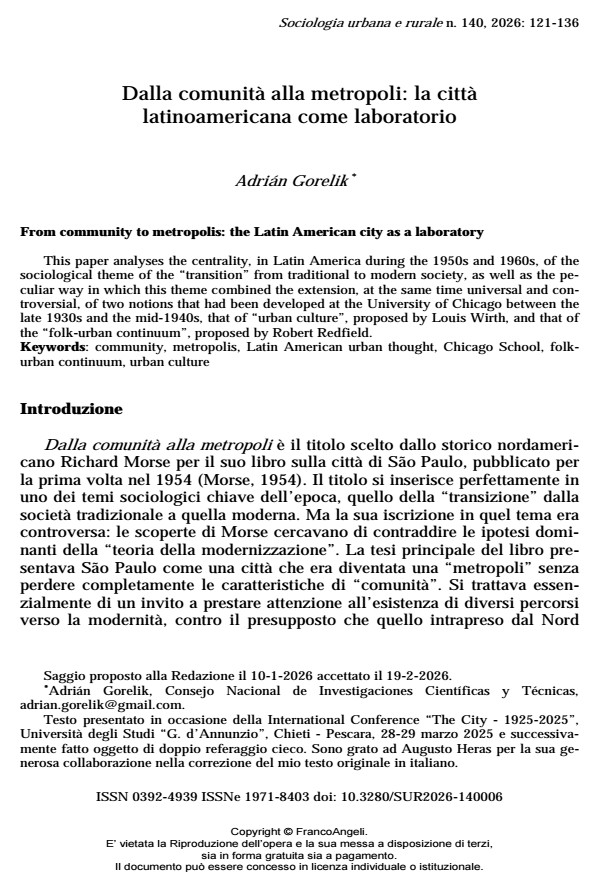
Qui sotto puoi vedere in anteprima la prima pagina di questo articolo.
Se questo articolo ti interessa, lo puoi acquistare (e scaricare in formato pdf) seguendo le facili indicazioni per acquistare il download credit. Acquista Download Credits per scaricare questo Articolo in formato PDF
FrancoAngeli è membro della Publishers International Linking Association, Inc (PILA), associazione indipendente e non profit per facilitare (attraverso i servizi tecnologici implementati da CrossRef.org) l’accesso degli studiosi ai contenuti digitali nelle pubblicazioni professionali e scientifiche.
This paper analyses the centrality, in Latin America during the 1950s and 1960s, of the sociological theme of the “transition” from traditional to modern society, as well as the peculiar way in which this theme combined the extension, at the same time universal and controversial, of two notions that had been developed at the University of Chicago between the late 1930s and the mid-1940s, that of “urban culture”, proposed by Louis Wirth, and that of the “folk-urban continuum”, proposed by Robert Redfield.
Parole chiave:community, metropolis, Latin American urban thought, Chicago School, folk-urban continuum, urban culture
- Blanco A. (2006). Razón y modernidad. Gino Germani y la sociología en la Argentina. Buenos Aires: Siglo XXI Editores.
- Blanco A. (2007). La temprana recepción de Max Weber en la sociología argentina (1930-1950). Revista Perfiles Latinoamericanos, 15(30): 9-38.
- Burucúa José E., Devoto F. Gorelik A. (eds.) (2013). José Luis Romero. Vida histórica, ciudad y cultura. Buenos Aires: Unsam Edita.
- Cáceres G. (2016). Santiago de Chile. La capital de la izquierda. In Gorelik A., Arêas Peixoto F. (dir.). Ciudades sudamericanas como arenas culturales. Buenos Aires, Siglo XXI Editores.
- Castells M. (1972). La question urbaine. Paris: François Maspero.
- Castells M. (1974). Movimientos sociales urbanos. México: Siglo XXI Editores.
- Cullather N. (2010). The Hungry World. America’s Cold War Battle against Poverty in Asia. Cambridge - London: Harvard University Press.
- Gorelik A. (2022). La ciudad latinoamericana. Una figura de la imaginación social del siglo XX. Buenos Aires: Siglo XXI Editores.
- Hannerz U. (1980). Exploring the City. Inquires Toward an Urban Anthropology. New York: Columbia University Press.
- Hauser P. (ed.) (1967). La urbanización en América Latina. Buenos Aires: Solar/Hachette.
- Jedlovski P. (1995). Introduzione. In Simmel G. Le metropoli e la vita dello spirito. Roma: Armando.
- Lattes A.E. (2000). Población urbana y urbanización en América Latina. In Carrión F. (ed.). La Ciudad Construida: urbanismo en América Latina. Quito: FLACSO.
- Lewis O. (1952). Urbanization without breakdown: A case study. The Scientific Monthly, 75(1): 31-41.
- Lewis O. (1965). Further Observations on the Folk-Urban Continuum and Urbanization with Special Reference to Mexico City. In Hauser P., Schnore L.F. (eds.). The Study of Urbanization. New York-London-Sydney: John Wiley & Sons.
- Lewis O. (1966). La vida. A Puerto Rican family in the culture of poverty. San Juan and New York. New York: Random House.
- Matos Mar J. (1967). Las barriadas limeñas: un caso de integración a la vida urbana. In Hauser (ed.). La urbanización en América Latina. Buenos Aires: Solar/Hachette.
- Merquior J.G. (1972). Situación del escritor. In Fernández Moreno C. (coord.). América Latina en su literatura. México: UNESCO-Siglo XXI.
- Morse R. (1954). De comunidade a metrópole. Biografia de São Paulo. São Paulo: Comissão do IV Centenário da cidade de São Paulo.
- Morse R. (1971). Investigación reciente sobre urbanización latinoamericana: examen selectivo y comentarios. In Morse R. La investigación urbana latinoamericana: tendencias y planteos. Buenos Aires: Ediciones SIAP.
- Morse R. (1982). El espejo de Próspero. Un estudio de la dialéctica del Nuevo Mundo. México: Siglo XXI Editores.
- Park R. (1929). The City as a Social Laboratory. In Smith T.V., White L.D. (eds.). Chicago: An Experiment in Social Science. Chicago: University of Chicago Press.
- Park R. (1999). La ciudad y otros ensayos de ecología urbana. Barcelona: Ediciones del Serbal.
- Park R., Burgess E. (1984). The City. Suggestions for Investigation of Human Behavior in the Urban Environment. Chicago: The University of Chicago Press.
- Redfield R. (1941). The folk culture of Yucatán. Chicago: The University of Chicago Press.
- Redfield R. (1947). The folk society. The American Journal of Sociology, 52(4): 293-308. DOI: 10.1086/220015
- Rella F. (1984). Metamorfosi. Immagini del pensiero. Milano: Feltrinelli.
- Rest J. (1993). El cuarto en el recoveco. Buenos Aires: Centro Editor de América Latina.
- Romero J.L. (1989). Le città e le idee. Storia urbana del Nouvo mondo. Napoli: Guida Editori.
- Vernik E. (2020). Introduction. Heritage from Simmel in Latinamerica. Simmel Studies, 24(2): 9-20.
- Wirth L. (1938). Urbanism as a way of life. The American Journal of Sociology, 44(1): 1-24. DOI: 10.1086/217913
Adrián Gorelik, Dalla comunità alla metropoli: la città latinoamericana come laboratorio in "SOCIOLOGIA URBANA E RURALE" 140/2026, pp 121-13616, DOI: 10.3280/SUR2026-140006