Abitare della disperazione. Marginalità domestica e invisibilità sociale nello spazio abitativo
Titolo Rivista SOCIOLOGIA URBANA E RURALE
Autori/Curatori Fabrizio Floris
Pubblicazione Online First 07/10/2026 Fascicolo 2026/Online First
Lingua Italiano Numero pagine 18 P. 1-18 Dimensione file 134 KB
DOI 10.3280/SUR2026-22456
Il DOI è il codice a barre della proprietà intellettuale: per saperne di più
clicca qui
Qui sotto puoi vedere in anteprima la prima pagina di questo articolo.
Se questo articolo ti interessa, lo puoi acquistare (e scaricare in formato pdf) seguendo le facili indicazioni per acquistare il download credit. Acquista Download Credits per scaricare questo Articolo in formato PDF
FrancoAngeli è membro della Publishers International Linking Association, Inc (PILA), associazione indipendente e non profit per facilitare (attraverso i servizi tecnologici implementati da CrossRef.org) l’accesso degli studiosi ai contenuti digitali nelle pubblicazioni professionali e scientifiche.
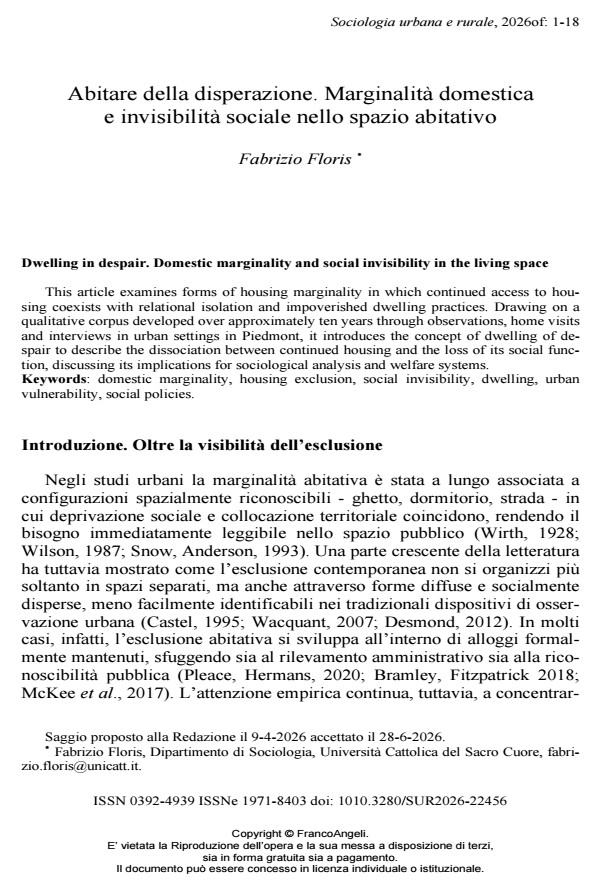
This article examines forms of housing marginality in which continued access to hou-sing coexists with relational isolation and impoverished dwelling practices. Drawing on a qualitative corpus developed over approximately ten years through observations, home visits and interviews in urban settings in Piedmont, it introduces the concept of dwelling of de-spair to describe the dissociation between continued housing and the loss of its social func-tion, discussing its implications for sociological analysis and welfare systems.
Parole chiave: domestic marginality, housing exclusion, social invisibility, dwelling, urban vulnerability, social policies.
- Pleace N., Hermans K. (2020). Counting all homelessness in Europe: The case for ending separate enumeration of ‘hidden homelessness’. European Journal of Homelessness, 14(3): 35–62.
- Simmel G. (1908). Soziologie. Leipzig: Duncker & Humblot.
- Small M.L. (2009). Unanticipated gains. New York: Oxford University Press.
- Snow D.A., Anderson L. (1993). Down on their luck. Berkeley: University of California Press. Soaita A.M., Marsh A., Gibb K. (2023). Policy movement in housing research: A critical interpre-tative synthesis. Housing Studies, 38(1): 107-127. DOI: 10.1080/02673037.2021.1879999
- Spini D., Bernardi L., Oris M. (2017). Toward a life course framework for studying vulnerabi-lity. Research in Human Development, 14(1): 5-25. DOI: 10.1080/15427609.2016.1268892
- van Oorschot W. (1998). Failing selectivity: On the extent and causes of non-take-up of so-cial security benefits. In Andress H.-J. (ed.). Empirical poverty research in a comparati-ve perspective. Aldershot: Ashgate.
- van Oorschot W., Roosma F., Meuleman B., Reeskens T. (eds.). (2017). The social legitimacy of targeted welfare: Attitudes to welfare deservingness. Cheltenham: Edward Elgar.
- Wacquant L. (2008). Urban outcasts. Cambridge: Polity Press.
- Warin P. (2017). Le non-recours aux politiques sociales. Fontaine: Presses universitaires de Grenoble.
- Weber M. (1922). Wirtschaft und Gesellschaft. Tübingen: Mohr.
- Wilson W.J. (1987). The truly disadvantaged. Chicago: University of Chicago Press.
- Wirth L. (1928). The ghetto. American Journal of Sociology, 33(1): 57-71.
- Bachelard G. (1957). La poétique de l’espace. Paris: Presses Universitaires de France. Bauman Z. (2000). Liquid modernity. Polity Press.
- Baptista I., Marlier E. (2020). Access to housing and homelessness policies in Europe. Bru-xelles: European Commission.
- Baxter R., Brickell K. (2014). For home unmaking. Home Cultures, 11(2): 133-143. DOI: 10.2752/175174214X13891916944553
- Beck U. (1992). Risk society: Towards a new modernity. London: Sage. Becker H.S. (1998). Tricks of the trade. Chicago: University of Chicago Press. Bourdieu P. (1993). La misère du monde. Paris: Seuil.
- Bramley G., Fitzpatrick S. (2018). Homelessness in the UK: Who is most at risk? Housing Studies, 33(1), 96-116. DOI: 10.1080/02673037.2017.1344957
- Busch-Geertsema V. (2010). Defining and measuring homelessness. In O’Sullivan E., Busch-Geertsema V., Quilgars D., Pleace N. (eds.). Homelessness Research in Europe: Festschrift for Bill Edgar and Joe Doherty. Brussels: FEANTSA.
- Castel R. (1995). Les métamorphoses de la question sociale. Paris: Fayard.
- Cloke P., May J., Johnsen S. (2010). Swept up lives? Re-envisioning the homeless city.Wiley-Blackwell.
- Desmond M. (2012). Eviction and the reproduction of urban poverty. American Journal of Sociology, 118(1): 88-133. DOI: 10.1086/666082
- Desmond M. (2016). Evicted: Poverty and profit in the American city. New York: Crown. Douglas M. (1966). Purity and danger. London: Routledge.
- Dubois V. (2010). The bureaucrat and the poor: Encounters in French welfare offices. Far-nham: Ashgate.
- Edgar B., Doherty J., Meert H. (2002). Access to housing. Bristol: Policy Press.
- Edgar B., Doherty J., Meert H. (2007). Third review of statistics on homelessness in Europe. Bruxelles: FEANTSA.
- Fitzpatrick S., Watts B. (2017). Competing visions: Security of tenure and the welfarisation of English social housing. Housing Studies, 32(8): 1021-1038. DOI: 10.1080/02673037.2017.1291916
- Fitzpatrick S., Pawson H., Bramley G., Wood J., Watts B., Stephens M., Blenkinsopp J. (2021). The homelessness monitor: England 2021. London: Crisis.
- Geertz C. (1973). The interpretation of cultures. New York: Basic Books.
- Goffman E. (1963). Stigma: Notes on the management of spoiled identity. Englewood Cliffs: Prentice-Hall.
- Halbwachs M. (1950). La mémoire collective. Paris: PUF.
- Herd P., Moynihan D.P. (2019). Administrative burden. New York: Russell Sage Foundation. Hernanz V., Malherbet F., Pellizzari M. (2004). Take-up of welfare benefits in OECD coun-
- tries. Paris: OECD Social, Employment and Migration Working Papers.
- Hick R., Lanau A. (2018). Moving in and out of in-work poverty in the UK. Journal of So-cial Policy, 47(4): 661-682. DOI: 10.1017/S0047279418000028
- Hochstenbach C., Musterd S. (2018). Gentrification and the suburbanization of poverty: Changing urban geographies through boom and bust periods. Urban Geography, 39(1): 26-53. DOI: 10.1080/02723638.2016.1276718
- Hopper K. (2003). Reckoning with homelessness. New York: Cornell University Press. Jacobs J. (1961). The death and life of great American cities. New York: Random House.
- McKee K., Moore T., Soaita A.M., Crawford J. (2017). ‘Generation Rent’ and the fallacy of choice. International Journal of Urban and Regional Research, 41(2): 318-333. DOI: 10.1111/1468-2427.12445
- Musterd S., Ostendorf W. (1998). Urban segregation and the welfare state. London: Routledge. Pleace N. (2021). Rough sleeping in Europe. Bruxelles: FEANTSA.
Fabrizio Floris, Abitare della disperazione. Marginalità domestica e invisibilità sociale nello spazio abitativo in "SOCIOLOGIA URBANA E RURALE" Online First/2026, pp 1-18, DOI: 10.3280/SUR2026-22456