Standards of practice for culturally competent nursing care: 2011 Update
Titolo Rivista SALUTE E SOCIETÀ
Autori/Curatori Marilyn K. Douglas, Joan Uhl Pierce, Marlene Rosenkoetter, Dula Pacquiao, Lynn Clark Callister, Marianne Hattar-Pollara, Jana Lauderdale, Jeri Milstead, Deena Nardi, Larry Purnell
Anno di pubblicazione 2014 Fascicolo 2013/3En
Lingua Inglese Numero pagine 31 P. 34-64 Dimensione file 673 KB
DOI
Il DOI è il codice a barre della proprietà intellettuale: per saperne di più
clicca qui
Qui sotto puoi vedere in anteprima la prima pagina di questo articolo.
Se questo articolo ti interessa, lo puoi acquistare (e scaricare in formato pdf) seguendo le facili indicazioni per acquistare il download credit. Acquista Download Credits per scaricare questo Articolo in formato PDF
FrancoAngeli è membro della Publishers International Linking Association, Inc (PILA), associazione indipendente e non profit per facilitare (attraverso i servizi tecnologici implementati da CrossRef.org) l’accesso degli studiosi ai contenuti digitali nelle pubblicazioni professionali e scientifiche.
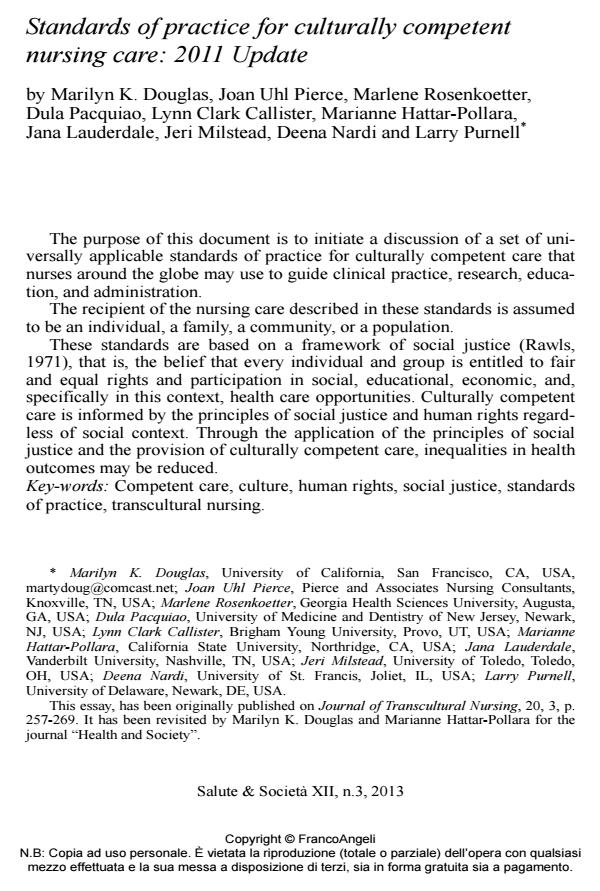
The purpose of this document is to initiate a discussion of a set of universally applicable standards of practice for culturally competent care that nurses around the globe may use to guide clinical practice, research, education, and administration. The recipient of the nursing care described in these standards is assumed to be an individual, a family, a community, or a population. These standards are based on a framework of social justice (Rawls, 1971), that is, the belief that every individual and group is entitled to fair and equal rights and participation in social, educational, economic, and, specifically in this context, health care opportunities. Culturally competent care is informed by the principles of social justice and human rights regardless of social context. Through the application of the principles of social justice and the provision of culturally competent care, inequalities in health outcomes may be reduced.
Parole chiave:Competent care, culture, human rights, social justice, standards of practice, transcultural nursing.
- The Sullivan Commission (2004). Missing person: minorities in the health professions—A report of the Sullivan Commission on Diversity in the Healthcare Workforce. Available in: http://www.sullivancommission.org
- Teekman B. (2000). Exploring reflective thinking in nursing practice. Journal of Advanced Nursing, 31: 1125-1135, DOI: 10.1046/j.1365-2648.2000.01424
- Thiagarajan S., Thiagarajan R. (2006). BARNGA: a simulation on cultural clashes. Available in: http://www.nationalservice resources.org/library/items/C3268
- Translation versus interpretation (2004). Translation central. Available in: http://www.translationcentral.com/translation_vs_interpretation.php
- Trimmer J., Warnock T., eds., (1992). Understanding others: cultural and crosscultural studies and the teaching of literature. Urbana, IL: National Council of Teachers of English. Available in: http://www.amazon.com/Understanding-Others-Cultural-Cross-Cultural-Literature/dp/0814155626 U.S. Department of Health & Human Services Administration. The Office of Minority
- Affairs (2001). National standards on culturally and linguistically appropriate services (CLAS). Available in: http://www.omhrc.gov/templates/browse.aspx?-lvl=2&lvlID=15
- U.S. Department of Health and Human Services. Office of Minority Health. Closing the health gap. Available in: http:// minorityhealth.hhs.gov/templates/content.-aspx?ID=2840
- U.S. Department of Health and Human Services. Cultural competency curricula modules. Available in: https://www.thinkculturalhealth.hhs.gov/cccm/
- United Nations (2008). Universal Declaration of Human Rights: Dignity and justice for all of us. Office of the High Commissioner for Human Rights. Available in: http://www.unhchr.ch/udhr/lang/eng.htm
- Verburg C. (2000). Ourselves among others: readings from home and abroad. New York, NY: Bedford/St. Martin’s
- Walsh R. (1985). Human survival: A psycho-evolutionary analysis. ReVision, 8, 7-10
- Wilson-Stronks A., Lee K.K., Cordero C.L., Kopp A.P., Galvez E. (2008). One size does not fit all: Meeting the health care needs of diverse populations. Oakbrook Terrace, IL: The Joint Commission. Available in: http://www.jointcommission.org/PatientSafety/HLC/one_size_meting_need_of_diverse_populations.htm
- Word IQ. (2010). Definition. ethnicity. Available in: http://www.wordiq.com/definition/Ethnicity
- World Health Organization (1979). Alma-Ata 1978: Primary health care, USSR, 6-12 September 1978. Geneva, Switzerland: Author. (Reprinted 1983 “Health for All”Series, No. 1)
- World Health Organization (2000). General guidelines for methodologies on research and evaluation of traditional medicine. Available in: http://whqlibdoc.who.int/hq/2000/WHO_EDM_TRM_2000.1.pdf
- Wu E., Martinez M. (2006). Taking cultural competency from theory to action. Available in: http://www.commonwealthfund.org/publications/publications_show.htm?do_id=414097
- Alwin D.F., Wray L.A. (2005). A life-span developmental perspective on social status and health. Journals of Gerontology, 60: 7-14, DOI: 10.1093/geronb/60.-Special_Issue_2.S
- American Association of Colleges of Nursing (2008a). The essentials of baccalaureate education for professional nursing practice. Washington, DC: American Association of Colleges of Nursing
- American Association of Colleges of Nursing (2008b). Tool kit of resources for cultural competency education for baccalaureate nurses. Available in: http://www.aacn.nche.edu/Education/ pdf/toolkit.pdf
- American Nurses Association. Code of ethics with interpretive statements. Available in: http://nursingworld.org/ethics/code/protected_nwcoe813.htm
- Anderson L.M., Scrimshaw S.C., Fullilove M.T., Fielding J.E., Normand J., the Task Force on Community Preventative Services (2003). Culturally competent healthcare systems. A systematic review. American Journal of Preventive Medicine, 24, suppl. 3: 68-79, DOI: 10.1016/S0749-3797(02)00657-
- Anderson N.L., Boyle J.S., Davidhizar R.E., Giger J.N., McFarland M.R., Papadopoulos I., Wehbe-Alamah H. (2010). Chapter 7. Cultural health assessment. In: Douglas M.K., Pacquiao D.F., eds., Core curriculum in transcultural nursing and health care. Journal of Transcultural Nursing, 21, suppl. 1, DOI: 10.1177/104365961141296
- Andrews M.M. (1992). Cultural perspectives on nursing in the 21st century. Journal of Professional Nursing, 8, 1: 7-15, DOI: 10.1016/8755-7223(92)90112-
- Atkins S., Murphy K. (1993). Reflection: A review of the literature. Journal of Advanced Nursing, 18: 1188-1192, DOI: 10.1046/j.1365-2648.1993.18081188
- Barker D.J.P. (2004). The developmental origins of adult chronic disease. Acta Paediatrica, S446: 26-33, DOI: 10.1111/j.1651-2227.2004.tb00236
- Barthum M.E. (2007). Global health research to promote social justice. Advances in Nursing Science, 30: 303-314, DOI: 10.1097/01.ANS.0000300180.71724.8
- Baumann A. (2007). Positive practice environments: Quality workplaces = quality patient care. Information and action tool kit. Geneva, Switzerland: International Council of Nurses
- Betancourt J.R., Green A.R., Emilio Carrillo J. (2002). Cultural competence in health care: Emerging frameworks and practical approaches. Field Report. Available in: http://www.commonwealthfund.org/usr_doc/betancourt_culturalcompetence_576.pdf
- Bosworth T.L., Haloburdo E.P., Hetrick C., Patchett K., Thompson M.A., Welch
- M. (2006). International partnerships to promote quality care: Faculty groundwork, student projects, and outcomes. Journal of Continuing Education in Nursing, 37: 32-38
- Callister L.C., Cox A.H. (2006). Opening our hearts and minds: The meaning of international clinical nursing electives in the personal and professional lives of nurses. Nursing Health Science, 8: 95-102, DOI: 10.1111/j.14422-018.2006.00259
- Campinha-Bacote J. (1994). Cultural competence in psychiatric mental health nursing: A conceptual model. Nursing Clinics of North America, 29: 1-8
- Canadian Nurses Association (2007). Nursing now: Issues and trends in Canadian nursing. Cultural diversity: Changes and challenges. Ottawa, Ontario, Canada.
- Available in: http://cna-aiic.ca/CNA/documents/pdf/publications
- Carpiano R.M. (2006). Toward a neighborhood resource-based theory of social control for health: Can Bourdieu and sociology help? Social Science & Medicine, 62: 165-175, DOI: 10.1016/j.socscimed.2005.05.02
- The Center for Nursing Advocacy Inc. (2003-2008). What is nursing? Available in: http://www.nursingadvocacy.org/faq/nursing_definition.html
- Coming together (2008). Organizational learning and development [DVD]. Duluth, MN: SMDC Health System Dignity and respect: Showing our patients cultural sensitivity (2006). [DVD]. Nashville, TN: Envision
- Eubanks R.L., McFarland M.R., Mixer S.J., Muñoz C., Pacquiao D.F., Wenger
- A.F.Z. (2010). Chapter 4. Cross cultural communication. In: Douglas M.K., Pacquiao D.F., eds., Core curriculum in transcultural nursing and health care. Journal of Transcultural Nursing, 21, suppl. 1, DOI: 10.1177/104365961037432
- Fahrenwald N.L. (2003). Teaching social justice. Nurse Educator, 28, 5: 222-6, DOI: 10.1097/00006223-200309000-0000
- Gehlert S., Sohmer D., Sacks T., Mininger C., McClintock M., Olopade O. (2008).
- Targeting helath disparities: A model linking upstream determinants to downstream interventions. Health Affairs, 27: 339-349, DOI: 10.1377/hlthaff.27.2.33
- Giddings L.S. (2005). A theoretical model of social consciousness. Advances in Nursing Science, 28: 224-239
- Giger J., Davidhizar R., Purnell L., Harden T., Phillips J., Strickland O. (2007).
- American Academy of Nursing expert panel report: Developing cultural competencies to eliminate health disparities in ethnic minorities and other vulnerable populations. Journal of Transcultural Nursing, 18: 100,
- 10.1177/1043659606298618
- Goode T., Jones W. (2009). Linguistic competence. National Center for Cultural Competence. Available in: www11georgetown.edu/research/gucchd/nccc/documents/Definition%20of%20Linguistic%20Competence.pdf
- Graham H., Power C. (2004). Childhood disadvantage and health inequalities: A framework for policy based on life course research. Child Care Health Development, 30: 671-678, 10.1111/j.1365-2214.2004.00457.x
- Granger B.B., Chulay M. (1999). Research strategies for clinicians. Stamford, CT: Appleton & Lange
- Harris W. (1983). The womb of space. The cross cultural imagination. Westport, CT: Greenwood
- Health Evidence Network (2006). What is the evidence on effectiveness of empowerment to improve health? Copenhagen, Denmark: World Health Organization Regional Office for Europe. Available in: http://www.euro.who.int/data/assets/-pdf_file/0010/74656/E88086.pdf
- Husted J.H., Husted G. (2008). Ethical decision making in nursing and health care: The symphonological approach (4th ed). New York, NY: Springer
- Institute of Medicine (2001). Crossing the quality chasm. A new health system for the21st century. Committee on Healthcare in America. Washington, DC: National Academies Press
- International Council of Nurses (2006a). The ICN code of ethics for nurses. Geneva, Switzerland: Author. Available in: http://www.icn.ch/icncode.pdf
- International Council of Nurses (2006b). Position statements. Nurses and human rights. Available in: http://www.icn.ch/pshumrights.htm
- International Council of Nurses (2007a). The health of indigenous peoples. Nursing matters fact sheet. Available in: http://www.icn.ch/images/stories/ documents/-publications/fact_sheets/10c_FS-Health_Indigenous_People.pdf
- International Council of Nurses (2007b). Position statement. Cultural and linguistic competence. Available in: http://www.icn.ch/images/stories/documents/publications/position_statements/B03_Cultural_Lin guistic_Competence.pdf
- International Council of Nurses (2007c). Vision for the future of nurses. Available in: http://www.icn.ch/about-icn/icnsvision-for-the-future-of-nursing/International Council of Nurses (2010). Definition of nursing. Available in: http://www.icn.ch/about-icn/icn-definition-ofnursing/
- Jackson V., Lopez L., eds., (1999). Cultural competency in managed behavioral healthcare. Dover, NH: Odyssey Press
- Jenerette C.M., Funk M., Ruff, C., Grey M., Adderley-Kelly B., McCorkle R.
- (2008). Models of inter-institutional collaboration to build research capacity for reducing health disparities. Nursing Outlook, 56, 1: 16-24, DOI: 10.1016/j.outlook.2007.11.00
- Joint Commission (2008). Developing culturally competent patient-centered care standards. Available in: October 29, 2010 from
- http://www.jointcommission.org/PatientSafety/HLC/HLC_Develop_Culturall_Competent_Pt_Centered_Stds.htm
- Kenny A.S. (2007). Culturally competent nursing modules. Available in: http://apha.confex.com/apha/135am/techprogram/paper_156568.htm
- Kleinman A. (1990). Patients and healers in the context of culture. Berkeley, CA: University of California Press
- Kreps G.L., Kunimoto E.N. (1994). Effective communication in multicultural health care settings. Thousand Oaks, CA: Sage
- Kreztmann J., McKnight J. (1993). Building communities from the inside out: A path toward finding and mobilizing a community’s assets. Chicago, IL: ACTA
- Krieger N. (2001). Theories of social epidemiology in the 21st century: An ecosocial perspective. International Journal of Epidemiology, 30: 668-677, DOI: 10.1093/ije/30.4.66
- Leininger M.M., McFarland M.R. (2002). Transcultural nursing: concepts, theories, research and practice (3rd ed). New York, NY: McGraw-Hill Leininger M.M., McFarland M.R. (2006). Culture care diversity and universality: A worldwide nursing theory. Boston, MA: Jones & Bartlett
- Link B.G., Phelan J.C., Miech R., Westin E.L. (2008). The resources that matter: fundamental social causes of health disparities and the challenge of intelligence. Journal of Health and Social Behavior, 49: 79-91, DOI: 10.1177/002-21465080490010
- Lipson J.G., Dibble S.L., Minarik P.A. (2005). Culture and nursing care: A pocket guide. San Francisco: UCSF Nursing Press
- Lurie N., Fremont A., Somers S.A., Coltin K., Geltzer A., Johnson R., Zimmerman D. (2008). The national health plan collaborative to reduce disparities and improve quality. Joint Commission Journal on Quality and Patient Safety, 34: 256-265
- Lynch E.W., Hanson M.J. (1992). Developing cross-cultural competence: A guide for working with young children and their families. Baltimore, MD: Paul H. Brookes
- Lynch J., Smith G.D. (2005). A life course approach to chronic disease epidemiology. Annual Review of Public Health, 26: 1-35, DOI: 10.1146/annurev.publhealth.26.021304.14450
- Madden-Styles M., Affara F. (1996). ICN on regulation: Towards 21st century models. Global health care is core knowledge. Geneva, Switzerland: International Council of Nurses
- Manthey M. (2008). Social justice and nursing: The key is respect. Creative Nursing, 14, 2: 62-65, DOI: 10.1891/1078-4535.14.2.6
- Meleis A.I., Hattar-Pollara M. (1995). Arab American women: Stereotyped, invisible but powerful. In: Adams D., ed., Health issues for women of color: a cultural diversity perspective (pp.133-163). Thousand Oaks, CA: Sage
- Miller J.E., Leininger M., Leuning C., Pacquiao D.F., Andrews M., Ludwig-Beyer P. (2008). Transcultural Nursing Society position statement on human rights. Journal of Transcultural Nursing, 19: 5-8, DOI: 10.1177/104365960730914
- Moore M.L., Moos M.K., Callister L.C. (2010). Cultural competence: an essential journal for perinatal nurses. White Plains, NY: March of Dimes Foundation
- Mosby’s Medical Dictionary (2009). 8th ed., Philadelphia, PA: Elsevier. Available in: http://medicaldictionary.thefreedictionary.com/evidence-based+practice
- National Association of Social Workers (2001). Standards for cultural competence in social work practice. Available in: http://www.socialworkers.org/sections/credtials/cultural_comp.asp
- Newhouse R.P., Dearholt S.L., Poe S.S., Pugh L.C., White K.M. (2007). Johns Hopkins Nursing evidence-based practice: models and guidelines. Indianapolis, IN: Sigma Theta Tau International
- Nursing Council of New Zealand (2009a). Code of conduct for nurses. Available in: http://www.nursingcouncil.org.nz/download/48/code-of-conduct-nov09.pdf
- Nursing Council of New Zealand (2009b). Guidelines for cultural safety, the Treaty of Waitangi and Maori health in nursing education and practice. Available in: http://www.nursingcouncil.org.nz/download/97/cultural-safety09.pdf Office of Minority Health (2005). What is cultural competency? Available in: http://minorityhealth.hhs.gov/templates/browse. aspx?lvl=2&lvlID=11
- Purnell L. (2008a). The Purnell model for cultural competence. In: Purnell L., Paulanka B., eds., Transcultural health care: A culturally competent approach (3rd ed., pp. 19-56). Philadelphia, PA: F.A. Davis
- Purnell L. (2008b). Transcultural health care: A culturally competent approach. Philadelphia, PA: F.A. Davis
- Rawls J. (1971). A theory of justice. Cambridge, MA: Belknap Press of Harvard University Press
- Reimer-Kirkham S., Van Holegen L., Ho-Harwood C. (2005). Narratives of social justice learning in innovative clinical settings. International Journal of Nursing Education Scholarship, 2, 1: 1-14, DOI: 10.2202/1548-923X.116
- Rosenkoetter M., Rosenkoetter J. (2005). Creativity, reflection and the pedagogy of nursing. In: Klein H., ed., Creative teaching (pp. 13-21). Boston, MA: WACRA
- Rosenkoetter M.M., Nardi D.A. (2007). American academy of nursing expert panel on global nursing and health: White Paper on global nursing and health. Journal of Transcultural Nursing, 18: 305-315, DOI: 10.1177/104365960730518
- Sackett D., Straus S., Richardson W., Rosenberg W., Haynes R. (2000). Evidencebased medicine: How to practice and teach EBM. 2nd ed., London: Churchill Livingstone
- Shirts G. (2001). BaFa’ BaFa’ cultural simulation. Available in: http://www.stsintl.com/business/bafa.html
- Smith, L. (1998). Concept analysis: Culture competence. Journal of Cultural Diversity, 5: 4-10
- Stetler C. (1999). Clinical scholarship exemplars: The Baystate Medical Center. In Clinical Scholarship Task Force’s clinical scholarship white paper: Knowledge work, in service of care, based on evidence. Indianapolis, IN: Sigma Theta Tau International
- Stetler C., Brunell M., Giuliano K. (1998). Evidence based practice and the role of nursing leadership. Journal of Nursing Administration, 8, 7/8: 45-53, DOI: 10.1097/00005110-199807000-0001
Marilyn K. Douglas, Joan Uhl Pierce, Marlene Rosenkoetter, Dula Pacquiao, Lynn Clark Callister, Marianne Hattar-Pollara, Jana Lauderdale, Jeri Milstead, Deena Nardi, Larry Purnell, Standards of practice for culturally competent nursing care: 2011 Update in "SALUTE E SOCIETÀ" 3En/2013, pp 34-64, DOI: