Imaginaries of social innovation in the Italian residential sector: A participatory research
Journal title WELFARE E ERGONOMIA
Author/s Riccardo Prandini, Giulia Ganugi, Fiorentina Longobardi
Publishing Year 2026 Issue 2025/2
Language Italian Pages 15 P. 201-215 File size 90 KB
DOI 10.3280/WE2025-002014
DOI is like a bar code for intellectual property: to have more infomation
click here
Below, you can see the article first page
If you want to buy this article in PDF format, you can do it, following the instructions to buy download credits
FrancoAngeli is member of Publishers International Linking Association, Inc (PILA), a not-for-profit association which run the CrossRef service enabling links to and from online scholarly content.
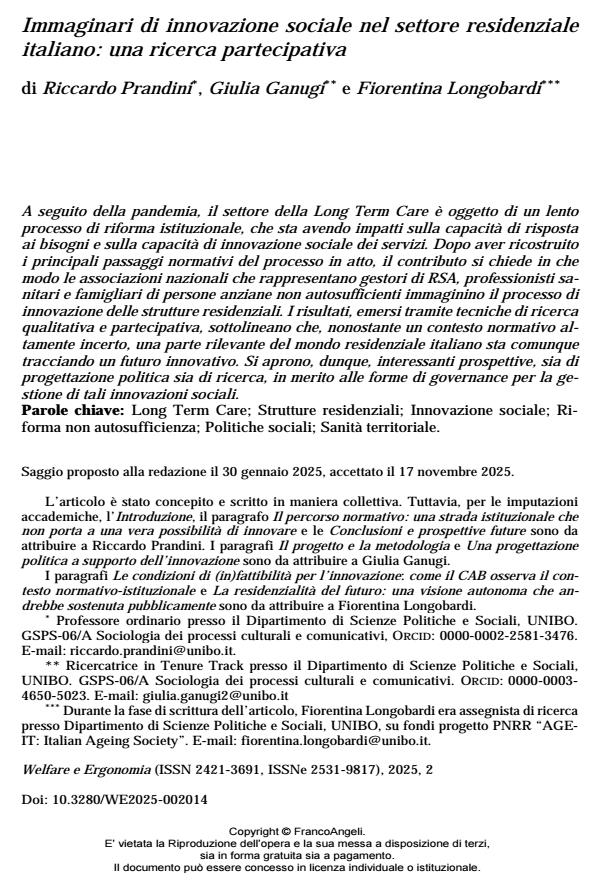
After the Covid-19 pandemic, the Long-Term Care sector is undergoing a slow process of institutional reform, impacting the ability to respond to needs and the capacity for social innovation in services. After reconstructing the main regulatory steps of the ongoing process, the contribution investigates how national associations representing RSA managers, healthcare professionals, and families of non-self-sufficient elderly people imagine the process of innovation in residential facilities. The data were collected through qualitative and participatory research techniques. The results highlight that, despite a highly uncertain regulatory context, a significant part of the Italian residential sector is nonetheless mapping out an innovative future. Therefore, interesting – policy and research – perspectives have opened up regarding the potential forms of governance for managing such social innovations.
Keywords: Long Term Care; Residential Facilities; Social Innovation; Non-Self-Sufficiency Reform; Social Policies; Community Health.
- Arbizzani E. e Reale L., a cura di (2024). L’abitante fragile. Dalla residenza assistita alla casa multigenerazionale. Macerata: Quodlibet.
- Becker D.R., Harris C.C., McLaughlin W.G. and Nielsen E.A. (2003). A participatory approach to social impact assessment: the interactive community forum. Environmental Impact Assessment Review, 23: 367-382.
- Boarelli M., Bodini C. e Betti L. (2020). Medicina, territorio e salute: lezioni dall’epidemia. Gli Asini, 6 aprile.
- Brenna E. (2021). Assistenza residenziale: le risposte del SSN ai bisogni degli anziani. In: Spandonaro F., d’Angela D. e Polistena B., A discursive-institutional perspective on transformative governance: a case from a fire management policy sector. Enviromental Policy Governance, 28(6)., a cura di, 17° Rapporto Sanità, Il futuro del SSN: visioni tecnocratiche e aspettative della popolazione. Roma: C.R.E.A. Sanità.
- Bucci R., Mutti A. e Pedrini A., a cura di (2024). Anziani e residenzialità. Le sfide future. Roma: Carocci editore.
- Clements R., Alizadeh T., Kamruzzaman L., Searle G. and Legacy C. (2023). A systematic literature review of infrastructure governance: cross-sectoral lessons for transformative governance approaches, Journal of Planning Literature, 38(1): 70-87.
- Costanzi C., a cura di (2024). Progettare, ristrutturare e riqualificare le RSA. Verso moderni centri di servizio nella filiera della cura territoriale per l’invecchiamento. Rimini: Maggioli.
- De Tommaso C.V. e Maino F. (2024). La Legge 33/2023 di riforma dell’assistenza a lungo termine in Italia tra policy e politics: oltre l’immobilismo, un’opportunità di riforma?. In: Gui L. e Salvati A., a cura di, Sfide del welfare. Sostenibilità, co-progettazione, innovazione. Milano: FrancoAngeli.
- Duea S.R., Zimmerman E.B., Vaughn L.M., Dias S. and Harris J. (2022). A Guide to Selecting Participatory Research Methods Based on Project and Partnership Goals. Journal of Participatory Research Method, 33(1).
- EPML (2021). Ageing Policies. Access to services in different member states. European Parliament, Luxembourg.
- Eurostat (2023). Healthcare resource statistics - beds, Statistic explained, 21 marzo.
- Fosti G., Notarnicola E. e Perobelli E. (2023). Il personale come fattore critico di qualità per il settore Long Term Care, 5° Rapporto Osservatorio Long Term Care. Milano: EGEA.
- Galera G. (2020). Verso un sistema sanitario di comunità. Il contributo del Terzo settore. Rivista Impresa Sociale, 2.
- Ganugi G. (2024). Coesione sociale e pratiche di urbanità innovativa. Una ricerca sulle Social Street tra sociologia e narrazione. Milano: FrancoAngeli.
- Gori C. (2025). RSA: La riforma incompiuta produce il caos rette, in -- https://lavoce.info/archives/107636/rsa-la-riforma-incompiuta-produce-il-caos-rette/.
- Gori C. (2021). La proposta di inserire nel PNRR la riforma dell’assistenza agli anziani non autosufficienti: un primo bilancio. I luoghi della cura online, 27 aprile.
- Gori C. e Trabucchi M. (2021). Che cosa abbiamo imparato dal Covid. In: Network Non Autosufficienza, a cura di, L’assistenza agli anziani non autosufficienti in Italia, 7° Rapporto 2020/2021. Rimini: Maggioli Editore.
- Istat (2023). Le strutture residenziali socioassistenziali e sociosanitarie al 1° gennaio 2022. Roma: ISTAT.
- Macchioni E. e Prandini R. (2022). Elderly Care During the Pandemic and Its Future Transformation. Italian Sociological Review, 12(6S): 347.
- Maino F. e Razzetti F. (2019). Long term care: riflessioni e spunti dall’Ue, fra innovazione e investimento sociale. Rivista delle Politiche Sociali, 1: 143-162.
- Monroe M.C., Oxarart A., McDonell L., and Plate R. (2009). Using Community Forums to Enhance Public Engagement in Environmental Issues. Journal of Education for Sustainable Development, 3(2): 171-182. DOI: 10.1177/097340820900300212
- Newman S.D., Andrews J.O., Magwood G.S., Jenkins C., Cox M.J. and Williamson D.C. (2011). Community advisory boards in community-based participatory research: a synthesis of best processes. Prev Chronic Dis, 8(3). -- https://www.cdc.gov/pcd/issues/2011/may/10_0045.htm. Accessed 22/01/2025.
- Patto per un Nuovo Welfare sulla Non Autosufficienza (2024). Alla ricerca del futuro. La riforma dell’assistenza agli anziani non autosufficienti, Rimini, Maggioli Editore.
- Pesaresi F. (2024). Anziani. Raggiunto l’obiettivo del Pnrr, ma la riforma non c’è. Quotidianosanità.it, 25 marzo.
- Prandini R. (2024). (Eco)Sistemi per l’innovazione sociale. Ripensarli e governarli in modo “innovativo”. In: Ecchia G., Ganugi G., Prandini R., a cura di, Verso (Eco)Sistemi di Innovazione sociale. Un percorso di capacity building. Milano: FrancoAngeli.
- Prandini R. and Ganugi G. (2024). Co-governance and co-management as preliminary conditions for social justice in co-creation. In: Baines S., Wilson R., Fox C., Aflaki I.N., Bassi A., Aramo-Immonen H., Prandini R., editors, Co-creation in Public Services for Innovation and Social Justice, 111-126. Bristol: Policy Press.
- Prandini R. and Ganugi G. (2022). Citizens’ networks and civic responsibility chains for a communitarian response to the post-pandemic vulnerabilities. Studi di Sociologia, 1: 51-63. DOI: 10.26350/000309_000133
- Ranci C. (2024). Cronaca di una strage nascosta. La pandemia nelle case di riposo. Milano: Mimesis.
- Ranci C., Audino F., Mazzaferro C. e Morciano M. (2024). Stima del fabbisogno e della spesa long term-care in Italia: valutazioni ex-ante di una proposta di riforma. DAStU, Working Papers, n. 01. LPS. 2023.
- Ritchie J., Spencer L. and O’Connor W. (2003). Carrying out qualitative analysis. In: J. Ritchie and J. Lewis, a cura di, Qualitative research practice, 219-262. Sage.
- Rothgang H., Fischer J., Sternnkpf M. and Dotter L.F. (2020). The classification of distinct long-term care systems worldwide: the empirical application of an actor-centred multidimensional typology. Università di Brema, Research Centre in Inequality and Social Policy.
- Sabel C.F. (2013). Esperimenti di nuova democrazia. Roma: Armando editore
- Saldaña J. (2016). The coding manual for qualitative researchers. Sage.
- Spasova S. (2018). Challenges in long-term care in Europe. A study of national policies. Brussels: European Social Policy Network (ESPN), European Commission.
- Tonurist P. and Hanson A. (2020). Anticipatory Innovation Governance. Shaping the future through proactive policy making. Oecd WP on Public Governance, 44.
- UPB, Ufficio Parlamentare di bilancio (2023). L’assistenza sanitaria territoriale: una sfida per il Servizio sanitario nazionale. Focus, 2, -- https://www.upbilancio.it/pubblicato-il-focus-n-2-2023-lassistenza-sanitaria-territoriale-una-sfida-per-il-servizio-sanitario-nazionale/.
- Vaughn L.M. and Jacquez F. (2020). Participatory Research Methods - Choice Points in the Research Process. Journal of Participatory Research Method, 1(1).
Riccardo Prandini, Giulia Ganugi, Fiorentina Longobardi, Immaginari di innovazione sociale nel settore residenziale italiano: una ricerca partecipativa in "WELFARE E ERGONOMIA" 2/2025, pp 201-215, DOI: 10.3280/WE2025-002014