The use of Storytelling Thinking® in the treatment of patients with Gambling Disorder
Journal title PSICOLOGIA DELLA SALUTE
Author/s Andrea Costa, Chiara Magri, Giulia Zane, Cristina Maurelli
Publishing Year 2026 Issue 2026/1
Language Italian Pages 23 P. 15-37 File size 215 KB
DOI 10.3280/PDS2026-001003
DOI is like a bar code for intellectual property: to have more infomation
click here
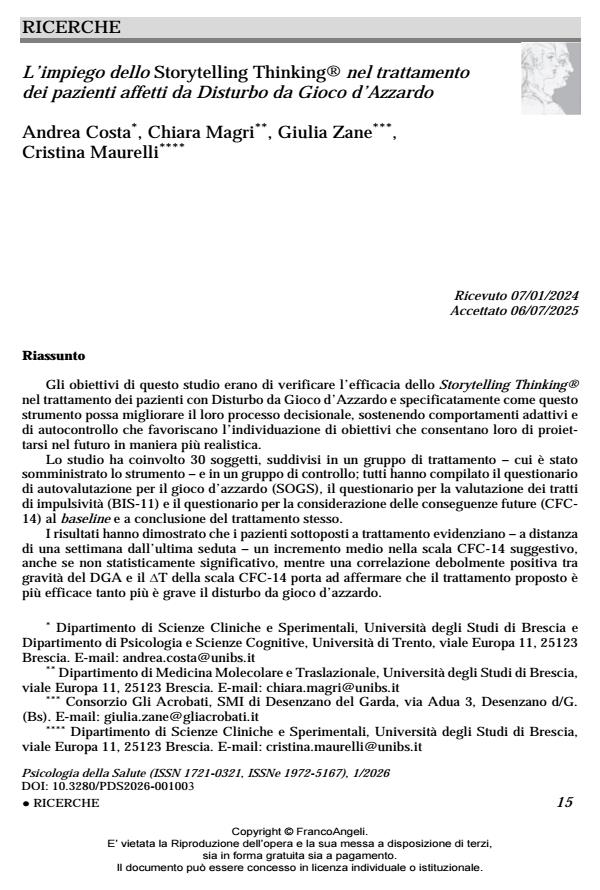
Below, you can see the article first page
If you want to buy this article in PDF format, you can do it, following the instructions to buy download credits
FrancoAngeli is member of Publishers International Linking Association, Inc (PILA), a not-for-profit association which run the CrossRef service enabling links to and from online scholarly content.
The main aim of this study was to verify the effectiveness of Storytelling Thinking® in the treatment of patients with Gambling Disorder (GD). Particularly, this study focused on how this tool can improve the decision-making process, supporting adaptive and self-control behaviors that favor the identification of goals and the projection into the future in a more realistic way. The study involved 30 subjects, divided into a treatment group, which received the Storytelling Thinking® intervention, and a control group. All participants completed the South Oaks Gambling Screen (SOGS), the Barratt Impulsiveness Scale (BIS-11) and the Consideration of Future Consequences (CFC-14) questionnaires at baseline and after two weeks (upon completion of the intervention for the treatment group). In the treatment group, the analyses revealed a suggestive increase of the mean CFC-14 scores (although not statistically significant) one week after the last session. Additionally, a weakly positive correlation between the severity of the GD and the changes over the time (∆T) of the CFC-14 scale was observed. This suggests that the proposed treatment is more effective the more severe the gambling disorder. In conclusion, the use of narrative techniques focused on the future dimension and on awareness of decision-making seems to show potential in the treatment of GD.
Keywords: Gambling Disorder, Storytelling Thinking®, Narrative, Behavioral addictions
- Alastra, V. (2016). Ambienti narrativi, territori di cura e formazione. Milano: FrancoAngeli.
- American Psychiatric Association (2013). Manuale diagnostico e statistico dei disturbi Mentali (V ed.). Milano: Raffaello Cortina.
- Agenzia delle Accise, Dogane e Monopoli (2022). Libro Blu 2021. Relazione. Roma: L’Agenzia ADM.
- Bechara, A., Damasio, A. R., Damasio, H. & Anderson, S. W. (1994). Insensitivity to future consequences following damage to human prefrontal cortex. Cognition, 50 (1-3): 7-15. DOI: 10.1016/0010-0277(94)90018-
- Bellio, G. & Croce, M. (a cura di) (2016). Manuale sul gioco d’azzardo; Diagnosi,valutazione e trattamenti. Milano: FrancoAngeli.
- Brunella, B. & Faillace, G. (2019). La terapia come narrazione di sé: leggere la propria storia di dipendenza con lenti diverse. Federserd Informa, 33: 11-14.
- Bruner, J. (2002). La cultura dell’educazione. Milano: Feltrinelli.
- Canali, S. (2018). Il racconto delle storie nella diagnosi e nella clinica delle dipendenze. Psychiatry on line Italia (http://www.psychiatryonline.it/node/7714).
- Canali, S., Altavilla, D., Acciai, A., Deriu, V., Chiera, A., Adornetti, I. & Ferretti, F. (2021). The Narrative of Persons with Gambling Problems and Substance Use: A Multidimensional Analysis of the Language of Addiction. Journal of Gambling Issues, 47: 167-198.
- Caretti, V. & Barbera, D.L. (a cura di) (2010). Addiction: aspetti biologici e di ricerca. Milano: Raffaello Cortina.
- Caretti, V. & Barbera, D. L. (a cura di) (2014). Le nuove dipendenze: diagnosi e clinica. Roma: Carocci.
- Carli, R. & Paniccia, R. M. (2003). Analisi della domanda. Teoria e tecnica dell’intervento in psicologia clinica. Bologna: il Mulino.
- Casciani, O. & De Luca, O. (a cura di) (2018). Il Trattamento Psicologico e Psicoterapeutico del Disturbo da Gioco d’Azzardo in una prospettiva multidisciplinare. Roma: Publiedit.
- Cerrai, S., Resce, G. & Molinaro, S. (a cura di) (2017). Consumi d’azzardo 2017 – Rapporto di ricerca sulla diffusione del gioco d’azzardo fra gli italiani attraverso gli studi IPSAD® e ESPAD® Italia. Roma: Cnr Edizioni.
- Chase, H.W. & Clark, L. (2010). Gambling Severity Predicts Midbrain Response to Near-Miss Outcomes. The journal of Neuroscience, 30(18): 6180-6187. DOI: 10.1523/JNEUROSCI.5758-09.201
- Ciccarelli, M., Griffiths, M.D., Nigro, G. & Cosenza, M. (2017). Decision making, cognitive distortions and emotional distress: A comparison between pathological gamblers and healthy controls. Journal of Behavior Therapy and Experimental Psychiatry, 54: 204-210.
- Ciccarelli, M., Cosenza, M., Griffiths, M., D’Olimpio, F. & Nigro, G. (2019). The interplay between chasing behavior, time perspective, and gambling severity: An experimental study. Journal of Behavioral Addictions, 7: 259-267. DOI: 10.1556/2006.8.2019.2
- Coco, L. (2022). Il trattamento del Disturbo da gioco d’azzardo in un servizio pubblico: l’esperienza del Centro specifico per il Disturbo da gioco d’azzardo di Foligno (USL UMBRIA 2). ALEA BULLETTIN, X: 87-97.
- Cosenza, M., Ciccarelli, M. & Nigro, G. (2019). The steamy mirror of adolescent gamblers: Mentalization, impulsivity, and time horizon. Addictive Behaviors, 89: 156-162.
- Cosenza, M., Ciccarelli, M., Matarazzo, O., Griffiths, M. D. & Nigro, G. (2024). The Role of Aging, Time Perspective, and Gambling-Related Cognitions in Affective Decision-Making. International Journal of Mental Health and Addiction, 22(5), 3244-3261.
- Croce, M. (2018a). Il lavoro clinico nel gambling. Tra approcci di senso ed approcci oggettivanti. In: Casciani, O. & De Luca, O. (a cura di), Il trattamento psicologico e Psicoterapeutico del Disturbo da Gioco d’Azzardo in una prospettiva multidisciplinare. Roma: Publiedit.
- Croce, M. (2018b). Psicologia del giocatore. In: Lugoboni, F. & Zamboni, L. Sostanza. Manuale sulle dipendenze patologiche (Vol. II). Verona: CLAD.
- Demetrio, D. (1996). Raccontarsi. L’autobiografia come cura di sé. Milano: Raffaello Cortina.
- Donati, M. A., Sottili, E., Morsanyi, K. & Primi, C. (2019). Time Perspectives and Gambling in Adolescent Boys: Differential Effects of Present- and Future-Orientation. Journal of Gambling Studies, 35(1): 107-124.
- Faul, F., Erdfelder, E., Lang, A.-G., & Buchner, A. (2007). G*Power 3: A flexible statistical power analysis program for the social, behavioral, and biomedical sciences. Behavior Research Methods, 39: 175-191. DOI: 10.3758/BF0319314
- Fossati, A., Di Ceglie, A., Acquarini, E., & Barratt, E. S. (2001). Psychometric properties of an Italian version of the Barratt Impulsiveness Scale-11 (BIS-11) in nonclinical subjects. Journal of Clinical Psychology, 57(6): 815–828.
- Guerreschi, C., & Gander, S. (2000). Versione italiana del South Oaks Gambling Screen (SOGS) di H. R. Lesieur e S. B. Blume. In: Guerreschi, C. (a cura di), Giocati dal gioco. Milano: San Paolo.
- Herrera-Sànchez, I.M., Rueda-Mendez, S., & Medina-Anzano, S. (2019). Storytelling in addiction prevention: a basis for developing effective programs from a systematic review. Human Affairs, 29(1): 32-47.
- Jiménez-Murcia, S., Tremblay, J., Stinchfield, R., Granero, R., Fernández-Aranda, F., Mestre-Bach, G., Steward, T., Del Pino-Gutiérrez, A., Baño, M., Moragas, L., Aymamí, N., Gómez-Peña, M., Tárrega, S., Valenciano-Mendoza, E., Giroux, I., Sancho, M., Sánchez, I., Mallorquí-Bagué, N., González, V., Martín-Romera, V. & Menchón, J.M. (2017). The Involvement of a Concerned Significant Other in Gambling Disorder Treatment Outcome. Journal of Gambling Studies, 33(3): 937-953.
- Joireman, J., Shaffer, M.J., Balliet, D. & Strathman, A. (2012). Promotion orientation explain why future-oriented people exercise and eat healthy: Evidence from the two-factor Consideration of Future Consequences-14 Scale. Personality and Social Psychology Bulletin, 38: 1272-1287. DOI: 10.1177/014616721244936
- ISTAT (2024). Livelli di istruzione e ritorni occupazionali – Anno 2023 (Retrieved from: https://www.istat.it/comunicato-stampa/livelli-di-istruzione-e-ritorni-occupazionali-anno-2023/)
- Lazzaro, S., Chinellato, G., Pizzolitto, P., Gesmundo, F., Giordano A., Brizzi, A., Ranieri, R., Zecchinato G. & Cavallari G. (2021). Una proposta di follow-up come attività integrata nella presa in carico del paziente con disturbo da gioco d’azzardo. Analisi dei primi dati emersi dall’esperienza dell’Ambulatorio per la prevenzione e il trattamento del gioco d’azzardo patologico (DGA) del Ser.D. di Padova – Ulss 6 Euganea. Mission, 56: 47-59.
- Lesierur, H. & Blume, S. (1987). The South Oaks Gambling Screen (SOGS): a new instrument for the identification of pathological gamblers. American Journal of Psychiatry, 1: 1184-1188.
- Lucchini, F. (2017). Stratificazione sociale e gioco d’azzardo. Una rassegna ragionata. Sicurezza e Scienze sociali, 1: 145-158. DOI 10.3280/SISS2017-001014
- Maurelli, C. (2019). Video Partecipativo. Fare cinema come strumento educativo: il metodo PVCODE. Roma: Dino Audino.
- Maurelli, C. & Rossi, G. (2024). https://storytelling-thinking.com/
- Mezirow, J. (2003). Apprendimento e trasformazione. Milano: Raffaello Cortina.
- Moreira, D., Azeredo, A. & Dias, P. (2023). Risk Factors for Gambling Disorder: A Systematic Review. Journal of Gambling Studies, 39: 483-511.
- Nigro, G., Cosenza, M., Ciccarelli, M. & Joireman, J. (2016). An Italian translation and validation of the consideration of future consequences-14 scale. Personality and Individual Differences, 101: 333-340.
- Nigro, G., Matarazzo, O., Ciccarelli, M., Pizzini, B., Sacco, M. & Cosenza, M. (2022). Positive Illusions: The Role of Cognitive Distortions Related to Gambling and Temporal Perspective in Chasing Behavior. Journal of Gambling Studies, 38(3): 889-904.
- Nigro, G., D’Olimpio, F., Ciccarelli, M. & Cosenza, M. (2019). The fuzzyfuture: Time horizon, memory failures, and emotional distress in gambling disorder. Addictive Behaviors, 97: 7-13.
- Noël, X., Saeremans, M., Kornreich, C., Jaafari, N. & D’Argembeau, A. (2017). Future-oriented mental time travel in individuals with disordered gambling. Consciousness and Cognition, 49: 227-236.
- Osterwalder, A. & Pigneur, Y. (2019). Creare modelli di business. Un manuale pratico ed efficace per ispirare chi deve creare o innovare un modello di business. Milano: LSWR.
- Pani, R. & Biolcati, R. (2006). Le dipendenze senza droghe. Lo shopping compulsivo, Internet e il gioco d’azzardo. Milano: Utet.
- Patton, J.H., Stanford, M.S. & Barratt, E.S. (1995). Factor structure of the Barratt impulsiveness scale. Journal of clinical psychology, 51(6): 768–774.
- Portis, L. (2016). La medicina come sistema culturale: saperi, pratiche, narrazioni. In: Alastra, V., Ambienti narrativi, territori di cura e formazione. Milano: FrancoAngeli.
- Prever, F. (2018). Specificità della ricerca e del trattamento nel DGA femminile. In: Casciani, O. & De Luca, O. (a cura di), Il trattamento psicologico e psicoterapeutico del Disturbo da Gioco d’Azzardo in una prospettiva multidisciplinare. Roma: Publiedit.
- Prever, F. & Locati, V. (2021). Female gambling in Italy: a specific clinical experience. In: Bowden-Jones, H. & Prever, F. (eds.), Gambling disorders in women: an international female perspective on treatment and research. New York: Taylor & Francis.
- Ribeiro, E. O., Afonso, N. H. & Morgado, P. (2021). Non-pharmacological treatment of gambling disorder: a systematic review of randomized controlled trials. BMC Psychiatry, 21(1): 105.
- Sarti, S., & Triventi, M. (2012). Il gioco d’azzardo: l’iniquità di una tassa volontaria. La relazione tra posizione socio-economica e propensione al gioco. Stato e Mercato, 33(96): 507-511. DOI: 10.1425/3864
- Serpelloni, G. (2013). Gambling. Gioco d’azzardo problematico e patologico. Verona: Cierre Grafica.
- Smorti, A. (2018). Raccontare per capire. Bologna: il Mulino.
- Strathman, A., Gleicher, F., Boninger, D.S. & Edwards, C.S. (1994). The consideration of future consequences: Weighing immediate and distant outcomes of behavior. Journal of Personality and Social Psychology, 66: 742-752. DOI: 10.1037/0022-3514.66.4.74
- Vergura, D. & Luceri, B. (2015). The antecedents of gambling behaviour from asocial marketing perspective. The Journal of Gambling Business and Economics, 9(1): 1-12.
- Wilson, M. (2021). Storytelling with a social purpose, or how we are trying to change the world, one story at a time. Transactions of the Leicester Literary and Philosophical Society, 115: 13-16.
- Zannini, L. (2021). Intrecciare parole nelle pratiche di cura: il contributo della medicina narrativa. Autobiografie, 2: 37-46.
- Zimbardo, P. & Boyd, J. (1999). Putting Time into Perspective. A Valid, Reliable Individual-differences Metric Measurement. Journal of Personality and Social Psychology, 77(6): 1271-1288. DOI: 10.1037/0022-3514.77.6.127
Andrea Costa, Chiara Magri, Giulia Zane, Cristina Maurelli, L’impiego dello Storytelling Thinking® nel trattamento dei pazienti affetti da Disturbo da Gioco d’Azzardo in "PSICOLOGIA DELLA SALUTE" 1/2026, pp 15-37, DOI: 10.3280/PDS2026-001003