Is a different future possible? Enabling factors in the life stories of care leavers
Journal title MALTRATTAMENTO E ABUSO ALL’INFANZIA
Author/s Patrizia Moretti
Publishing Year 2026 Issue 2026/2
Language Italian Pages 19 P. 31-49 File size 99 KB
DOI 10.3280/MAL2026-002003
DOI is like a bar code for intellectual property: to have more infomation
click here
Below, you can see the article first page
If you want to buy this article in PDF format, you can do it, following the instructions to buy download credits
FrancoAngeli is member of Publishers International Linking Association, Inc (PILA), a not-for-profit association which run the CrossRef service enabling links to and from online scholarly content.
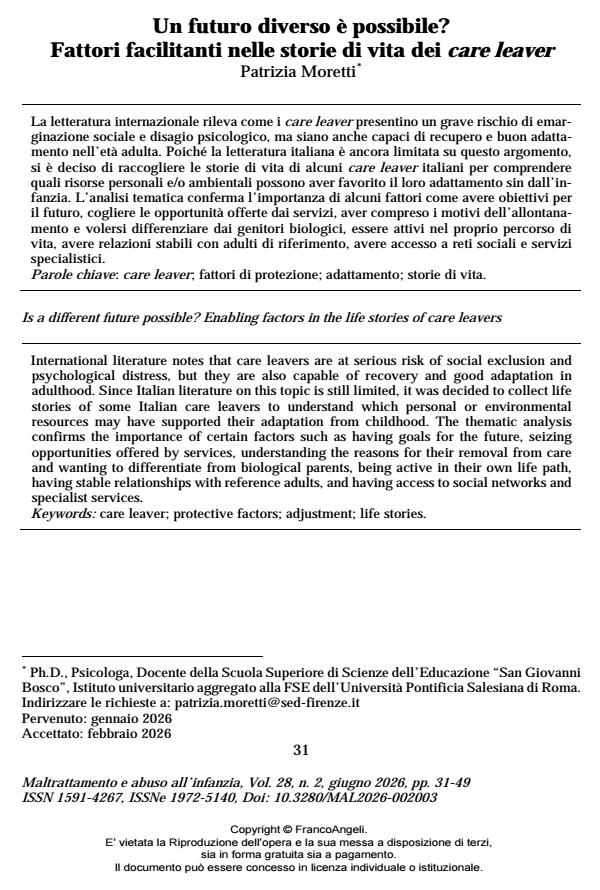
International literature notes that care leavers are at serious risk of social exclusion and psychological distress, but they are also capable of recovery and good adaptation in adulthood. Since Italian literature on this topic is still limited, it was decided to collect life stories of some Italian care leavers to understand which personal or environmental resources may have supported their adaptation from childhood. The thematic analysis confirms the importance of certain factors such as having goals for the future, seizing opportunities offered by services, understanding the reasons for their removal from care and wanting to differentiate from biological parents, being active in their own life path, having stable relationships with reference adults, and having access to social networks and specialist services.
Keywords: care leaver; protective factors; adjustment; life stories.
- Bengtsson, M., Sjöblom, Y., & Öberg, P. (2018). Young care leavers’ expectations of their future: A question of time horizon. Child & Family Social Work, 23(2), 188-195.
- Bertetti, B. (Ed.) (2008). Oltre il maltrattamento. La resilienza come capacità di superare il trauma, Milano: FrancoAngeli.
- Snow, K. (2013). Turning shame into pride: Reshaping stigma by raising voices. The Philanthropist, 25(2).
- Barbarotto, M., Zanuso, R., Mauri, L., (Eds.) (2012), 2012 Report on Abandonment and Care Leavers. Supporting life after institutional care. Milano: Ancora.
- Bastianoni, P. & Zullo, F. (Eds.) (2012). Neomaggiorenni e autonomia personale. Resilienza ed emancipazione. Roma: Carocci editore.
- Becciu, M. & Colasanti, A.R. (2016). Prevenzione e salute mentale. Manuale di psicologia preventiva. Milano: FrancoAngeli.
- Belotti V., Mauri D., Zullo F. (Eds.) (2021). Care leavers. Giovani, partecipazione e autonomia nel leaving care italiano. Trento: Edizioni Centro Studi Erickson.
- Bendeck, S., & Moore, M. (2024). Life after Foster Care: The Importance of Human and Social Capital for Post-Emancipation Outcomes. Child and Adolescent Social Work Journal, 41, 61-73.
- Biggs, A. T., Seech, T. R., Johnston, S. L., & Russell, D. W. (2024). Psychological endurance: how grit, resilience, and related factors contribute to sustained effort despite adversity. The Journal of general psychology, 151(3), 271-313. DOI: 10.1080/00221309.2023.2253955
- Boddy, J., Bakketeig, E., & Østergaard, J. (2020). Navigating precarious times? The experience of young adults who have been in care in Norway, Denmark and England. Journal of Youth Studies, 23(3), 291-306.
- Cardinali, P., Bizzi, F., & Migliorini, L. (2023). Through a relational lens: reflections about foster care experience in Italian emancipated foster youth. Frontiers in Psychology, 14, 1191307.
- Charmaz, K., & Thornberg, R. (2021). The pursuit of quality in grounded theory. Qualitative research in psychology, 18(3), 305-327. DOI: 10.1080/14780887.2020.1780357
- Coman, W., McGill, L., & Rainey, M. (2020). The Narrative Model for communicating with looked after children about challenging issues. Adoption & Fostering, 44(2), 142-155. DOI: 10.1177/0308575920925814
- Cushing, G., Samuels, G. M., & Kerman, B. (2014). Profiles of relational permanence at 22: Variability in parental supports and outcomes among young adults with foster care histories. Children and Youth Services Review, 39, 73-83.
- Desmond, C., Watt, K., Saha, A., Huang, J., & Lu, C. (2020). Prevalence and number of children living in institutional care: global, regional, and country estimates. The Lancet Child & Adolescent Health, 4(5), 370-377. DOI: 10.1016/S2352-4642(20)30022-5
- Furey, R., & Harris-Evans, J. (2021). Work and resilience: care leavers’ experiences of navigating towords employment and independence, Child & Family Social Work, 26(3), 404-414.
- García-Alba, L. G. (2022). Readiness for indipendent living of youth in redential childcare: A comparative study. Child & Family Social Work.
- Gypen, L., Vanderfaeillie, J., De Maeyer, S., Belenger, L., & Van Holen, F. (2017). Outcomes of children who grew up in foster care: Systematic-review. Children and youth services review, 76, 74-83.
- Gianturco, G. (2005), L’intervista qualitativa. Dal discorso al testo scritto. Milano: Guerini editore.
- Glaser, B. & Strauss, A. L. (1967). The Discovery of Grounded Theory: Strategies for Qualitative Research. Chicago: Aldine.
- Hadfield, M., Ruch, G., Winter, K., Cree, V., & Morrison, F. (2020). Social workers' reflexive understandings of their “everyday” communications with children. Child & Family Social Work, 25(2), 469-477.
- Häggman-Laitila, A., Salokekkilä, P., & Karki, S. (2018). Transition to adult life of young people leaving foster care: A qualitative systematic review. Children and Youth Services Review, 95, 134-143.
- Häggman-Laitila, A., Salokekkilä, P., & Karki, S. (2019). Young people’s preparedness for adult life and coping after foster care: A systematic review of perceptions and experiences in the transition period. Child & Youth Care Forum, 48(5), 633-661.
- Hanrahan, F., Boddy, J., & Owen, C. (2020). ‘Actually there is a brain in there’: Uncovering complexity in pathways through education for young adults who have been in care. Children & Society, 34(1), 46-61.
- Hines, A. M., Merdinger, J., & Wyatt, P. (2005). Former foster youth attending college: Resilience and the transition to young adulthood. American Journal of Orthopsychiatry, 75(3), 381-394. DOI: 10.1037/0002-9432.75.3.381
- Hoyle, V., Shepherd, E., Lomas, E., & Flinn, A. (2020). Recordkeeping and the life-long memory and identity needs of care-experienced children and young people. Child & Family Social Work, 25(4), 935-945.
- Howard, A. H., Roberts, M., Mitchell, T., & Wilke, N. G. (2023). The relationship between spirituality and resilience and well-being: A study of 529 care leavers from 11 nations. Adversity and Resilience Science, 4(2), 177-190.
- Rosnati, R., & Iafrate, R. (2023). Psicologia dell'adozione e dell'affido familiare. Milano: Vita e Pensiero.
- Jäggi, L., Jaramillo, J., Drazdowski, T. K., & Seker, S. (2022). Child welfare involvement and adjustment among care alumni and their children: a systematic review of risk and protective factors. Child Abuse & Neglect, 131, 105776.
- Landers, A. L., Reichard, K. D., Bellamy, J. L., & Muruthi, B. A. (2022). The Effect of Out-of-Home Placement on the School Engagement of Child Welfare-Involved Children. Journal of the Society for Social Work and Research, 15(2), 235-259 (disponibile online: https://www.journals.uchicago.edu/journal/jsswr).
- Mauri D. (2023), «Becoming parents as mending the past»: care-experienced parents and the relationship with their birth family. Children and Youth Services Review, 148, 106911.
- Munro, E. R., & Hardy, A. (2006). Placement stability: a review of the literature. Loughborough University. (disponibile online: https://repository.lboro.ac.uk/articles/report/Placement_stability_a_review_of_the_literature/9580304?file=17217350).
- Nunez, M., Beal, S. J., & Jacquez, F. (2022). Resilience factors in youth transitioning out of foster care: A systematic review. Psychological trauma: theory, research, practice, and policy, 14(S1), S72.
- Pandolfi, L. (2015). Costruire resilienza. Analisi e indicazioni per l'accompagnamento educativo in uscita dalle comunità per minori. Milano: Guerini Scientifica.
- Parry, S. L. & Weatherhead, S. (2014). A critical review of qualitative research into the experiences of young adults leaving foster care service. Journal of Children’s Services, 9(4). DOI: 10.1108/JCS-04-2014-0022
- Pepe, A., Biffi, E., Montà, C. C., Arciprete, C., & Biggeri, M. (2024). Agency, participation in decision making and wellbeing among care leavers in care system: A quantitative mediation study. Children and Youth Services Review, 160, 107500.
- Premoli S. (2009) (Ed.), Verso l’autonomia. Percorsi di sostegno all’integrazione sociale dei giovani. Milano: FrancoAngeli.
- Refaeli, T., Zeira, A., & Benbenishty, R. (2022). Ten years later: Satisfaction with intimate relationships and parenthood of young people aging out of residential care. Child Abuse & Neglect, 129, 105635.
- Sandford, R., Quarmby, T., & Hooper, O. (2024). Theorising the potential of physical education and school sport to support the educational engagement, transitions and outcomes of care-experienced young people. British Educational Research Journal, 50(2), 580-598.
- Sariaslan, A., Kääriälä, A., Pitkänen, J., Remes, H., Aaltonen, M., Hiilamo, H., ... & Fazel, S. (2022). Long-term health and social outcomes in children and adolescents placed in out-of-home care. JAMA pediatrics, 176(1), e214324-e214324.
- Schofield, G., Larsson, B., & Ward, E. (2017). Risk, resilience and identity construction in the life narratives of young people leaving residential care. Child & Family Social Work, 22(2), 782-791.
- Seker, S., Boonmann, C., Gerger, H., Jäggi, L., d’Huart, D., Schmeck, K., & Schmid, M. (2022). Mental disorders among adults formerly in out-of-home care: a systematic review and meta-analysis of longitudinal studies. European Child & Adolescent Psychiatry, 31(12), 1963-1982.
- Smorti A. (2022), Storytelling. Perché non possiamo fare a meno delle storie. Bologna: il Mulino.
- Sulimani-Aidan, Y., Achdut, N., Zeira, A., & Benbenishty, R. (2022). Psychological distress among care leavers during the transition to adulthood: Risk and protective factors throughout their life course. Child & Family Social Work, 27(2), 324-339.
- Staines, J., & Selwyn, J. (2020). “I wish someone would explain why I am in care”: The impact of children and young people’s lack of understanding of why they are in out-of-home care on their well-being and felt security. Child & Family Social Work, 25, 97-106.
- Stapley, E., Vainieri, I., Li, E., Merrick, H., Jeffery, M., Foreman, S.,Casey, P., Ullman, R., & Cortina, M. (2021). A scoping review of the factors that influence families’ ability or capacity to provide young people with emotional support over the transition to adulthood. Frontiers in Psychology, 12, 732899.
- Stein, M. (2012). La transizione all’autonomia dei giovani adulti in uscita dalla tutela. In Z. F. Bastianoni P., Neomaggiorenni e autonomia personale. Resilienza e partecipazione (pp. 18-33). Bologna: Carocci Editore.
- Trobia A. (2005), La ricerca sociale quali-quantitativa. Milano: FrancoAngeli.
- Wincentak, K. J. (2022). Girls in Child Protective Services: A Mixed Methods Exploration of Self-Perceptions, Interpersonal Connections, and Academic Resilience. In yorkspace.library.yorku.ca.
- Zanfrini, L. (1999). L’uso delle storie di vita nella ricerca sociologica. Studi di Sociologia, 55-76. Milano: Vita e Pensiero. (disponibile online: https://www.jstor.org/stable/23004997).
Patrizia Moretti, Un futuro diverso è possibile? Fattori facilitanti nelle storie di vita dei care leaver in "MALTRATTAMENTO E ABUSO ALL’INFANZIA" 2/2026, pp 31-49, DOI: 10.3280/MAL2026-002003