What legacy are we talking about? Chicago sociology and its legacy
Journal title SOCIOLOGIA URBANA E RURALE
Author/s Carolina Mudan Marelli
Publishing Year 2026 Issue 2026/140
Language Italian Pages 28 P. 46-73 File size 221 KB
DOI 10.3280/SUR2026-140003
DOI is like a bar code for intellectual property: to have more infomation
click here
Below, you can see the article first page
If you want to buy this article in PDF format, you can do it, following the instructions to buy download credits
FrancoAngeli is member of Publishers International Linking Association, Inc (PILA), a not-for-profit association which run the CrossRef service enabling links to and from online scholarly content.
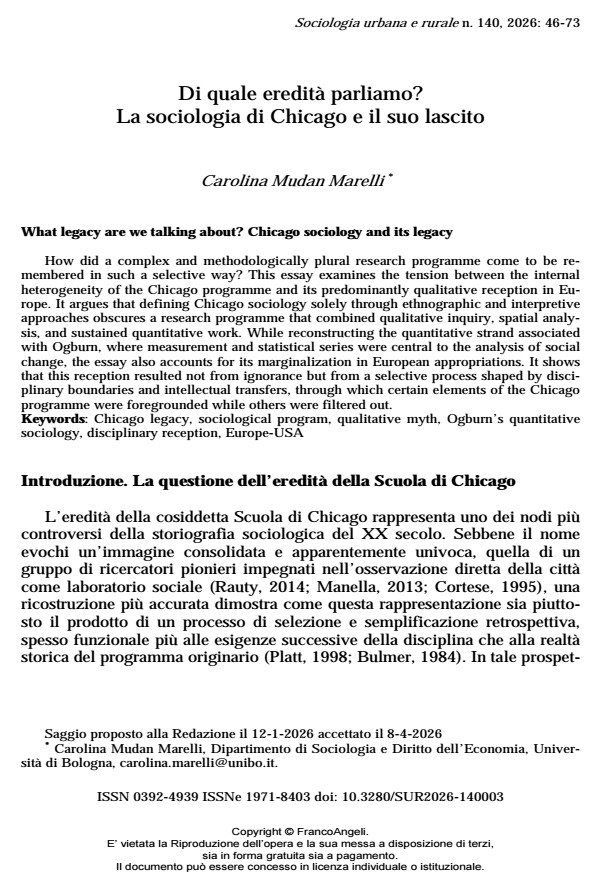
How did a complex and methodologically plural research programme come to be remembered in such a selective way? This essay examines the tension between the internal heterogeneity of the Chicago programme and its predominantly qualitative reception in Europe. It argues that defining Chicago sociology solely through ethnographic and interpretive approaches obscures a research programme that combined qualitative inquiry, spatial analysis, and sustained quantitative work. While reconstructing the quantitative strand associated with Ogburn, where measurement and statistical series were central to the analysis of social change, the essay also accounts for its marginalization in European appropriations. It shows that this reception resulted not from ignorance but from a selective process shaped by disciplinary boundaries and intellectual transfers, through which certain elements of the Chicago programme were foregrounded while others were filtered out.
Keywords: Chicago legacy, sociological program, qualitative myth, Ogburn’s quantitative sociology, disciplinary reception, Europe-USA
- Becker H. (1999). The Chicago School, So-called. Qualitative Sociology, 22(1): 3-12. DOI: 10.1023/A:1022107414846
- Berry K. (1974). Charles E. Merriam and the study of politics. Chicago: The Chicago University Press.
- Blumer M. (1937). Social Psychology. In Schmidt E.P. (ed). Man and Society: A Substantive Introduction to the Social Sciences. New York: Prentice-Hall.
- Bulmer M. (1981). Quantification and Chicago social science in the 1920s: A neglected tradition. Journal of the History of the Behavioral Sciences, 17(3): 312-331. DOI: 10.1002/1520-6696
- Bulmer M. (1983). The methodology of early social indicator research: William Fielding Ogburn and ‘Recent social trends’, 1933. Social Indicators Research, 13(2): 109-130. DOI: 10.1007/BF00344087
- Bulmer M. (1984). The Chicago School of Sociology: Institutionalization, Diversity, and the Rise of Sociological Research. Chicago: The University of Chicago Press.
- Burgess E.W., Bogue D.J.(1964). Contribution to Urban Sociology. Chicago: The University of Chicago Press.
- Carter N.T. (2025). Louis Leon Thurstone (1887-1955). In Koppes B., Vinchur A.J. (eds.). Key Thinkers in Industrial and Organizational Psychology. London: Routledge.
- Chapoulie J-M. (1998). Seventy years of fieldwork in sociology. From Nels Anderson’s The Hobo to Elijah Anderson’s Streetwise. In Tomasi L. (ed.). The tradition of the Chicago school of sociology. New York: Routledge.
- Cortese A.J. (1995). The rise, hegemony, and decline of the Chicago School of Sociology, 1892-1945. The Social Science Journal, 32(3): 235-254. DOI: 10.1016/0362-3319(95)90009-8
- Desrosières A. (1993). La politique des grands nombres. Histoire de la raison statistique. Paris: La Découverte.
- Gallino L. (1968). Introduzione. In Thomas W.I., Znaniecki F. Il contadino polacco in Europa e in America. Volume primo. Milano: Edizioni di Comunità.
- Gobo G. (2008). Con giustificato ritardo. La nascita della ricerca qualitativa in Italia. In Silverman D. Manuale di ricerca sociale qualitativa. Roma: Carocci.
- Grafmeyer Y., Joseph I. (1984). L’école de Chicago. Naissance de l’écologie urbaine. Paris: Aubier.
- Guilford J.P. (1955). Louis Leon Thurstone. Psychometrika 20: 263-265. DOI: 10.1007/BF02289032
- Harvey L. (1987). Myths of the Chicago school of sociology. Vermont: Avebury.
- Hobsbawm E.J., Ranger T. (a cura di). (2002). L’invenzione della tradizione. Torino: Einaudi.
- Iorio G. (2015). Una tradizione teorica diversa: W.F. Ogburn a Chicago. Sociologia: rivista quadrimestrale di scienze storiche e sociali, 1: 64-70. DOI: 10.36165/2684
- Jones L.V. (2000). Thurstone, Louis Leon. In Kazdin A.E. (ed.). Encyclopedia of psychology. Vol. 8. Oxford: Oxford University Press.
- Madge J. (1962). The Origins Of Scientific Sociology. New York: The Free Press.
- Manella G. (2013). Chicago e gli studi urbani. L'attualità della Scuola Ecologica. Milano: FrancoAngeli
- Nock D. (2004). The myth about “myths of the Chicago School”: Evidence from Floyd Nelson house. The American Sociologist, 35(1): 63-79.
- Ogburn W.F. (1922). Social Change with Respect to Culture and Original Nature. New York: B.W. Huebsch.
- Ogburn W.F. (1932). Note on method. In Recent Social Trends in the United States. Report of the President’s Research Committee on Social Trends. New York: McGraw-Hill.
- Pizzorno A. (1967). Introduzione. In Park R.E., Burgess E.W., Mckenzie R.D. (eds.). La città. Milano: Edizioni di Comunità.
- Platt J. (1993). When is a School? Intevento durante la conferenza di Cheiron che si è tenuta all’University of New Hampshire il 23 giugno, all’interno della sezione II intitolata Schools, Unity, and Dilemma in the Social Sciences.
- Platt J. (1996). A History of Sociological Research Methods in America. Cambridge: Cambridge University Press.
- Platt J. (1998). Chicago methods: reputations and realities. In Tomasi L. (ed.). The tradition of the Chicago school of sociology. New York: Routledge.
- Ploder A. (2018). Geschichte qualitativer und interpretativer Forschung in der deutschsprachigen Soziologie nach 1945. In Moebius S., Ploder A. (eds.). Handbuch Geschichte der deutschsprachigen Soziologie. Berlino: Springer.
- Porter T.M. (1995). Trust in Numbers: The Pursuit of Objectivity in Science and Public Life. Princeton: Princeton University Press.
- Rauty R. (2014). Ernest Watson Burgess, l’uomo di Chicago. Sociologia e ricerca sociale 103: 18-39. DOI: 10.3280/SR2014-103002
- Rochberg-Halton E. (1983). The real nature of pragmatism and Chicago sociology. Symbolic Interaction, 6(1): 139-153.
- Rossi P. (2003). Il ritorno alla sociologia. Un confronto tra sociologia italiana e sociologia tedesca nel dopoguerra. Quaderni di Sociologia, 33: 101-120.
- Scamuzzi S. (2023). Presentazione. Quaderni di Sociologia, 92-93.
- Schmidt E.P. (1937). Man and Society: A Substantive Introduction to the Social Sciences. New York: Prentice-Hall.
- Smith J. (1964). Book Review: Contributions to Urban Sociology. Edited by Ernest W. Burgess and Donald J. Bogue. Social Forces, 43(2): 263-264. DOI: 10.2307/2574342
- Stébé J.M., Marchal H. (2019). Introduction à la sociologie urbaine. Paris: Armand Colin.
- Stein M.R. (2015). The eclipse of community: An interpretation of American studies. Princeton: Princeton University Press.
- Stouffer S.A., Suchman E.A., DeVinney L.C., Star S.A., Williams R.M.Jr. (1949). The American Soldier (Vol.1-4). Princeton: Princeton University Press.
- Tomasi L. (a cura di). (1998). The tradition of the Chicago school of sociology. New York: Routledge.
Carolina Mudan Marelli, Di quale eredità parliamo? La sociologia di Chicago e il suo lascito in "SOCIOLOGIA URBANA E RURALE" 140/2026, pp 46-73, DOI: 10.3280/SUR2026-140003