Collective memory, urban space, and networks of relationships. The CELDIT world
Journal title SOCIOLOGIA URBANA E RURALE
Author/s Vanessa Russo
Publishing Year 2026 Issue 2026/140
Language Italian Pages 25 P. 137-161 File size 319 KB
DOI 10.3280/SUR2026-140007
DOI is like a bar code for intellectual property: to have more infomation
click here
Below, you can see the article first page
If you want to buy this article in PDF format, you can do it, following the instructions to buy download credits
FrancoAngeli is member of Publishers International Linking Association, Inc (PILA), a not-for-profit association which run the CrossRef service enabling links to and from online scholarly content.
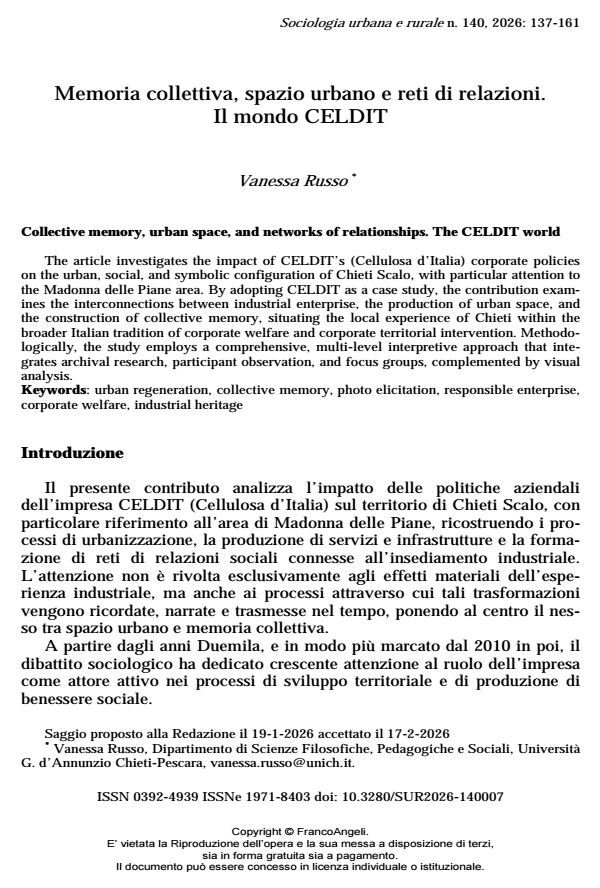
The article investigates the impact of CELDIT’s (Cellulosa d’Italia) corporate policies on the urban, social, and symbolic configuration of Chieti Scalo, with particular attention to the Madonna delle Piane area. By adopting CELDIT as a case study, the contribution examines the interconnections between industrial enterprise, the production of urban space, and the construction of collective memory, situating the local experience of Chieti within the broader Italian tradition of corporate welfare and corporate territorial intervention. Methodologically, the study employs a comprehensive, multi-level interpretive approach that integrates archival research, participant observation, and focus groups, complemented by visual analysis.
Keywords: urban regeneration, collective memory, photo elicitation, responsible enterprise, corporate welfare, industrial heritage
- Archivio di Stato di Chieti. (s.d.). Documentazione amministrativa e urbanistica relativa all’insediamento industriale della CELDIT e alla pianificazione urbana di Chieti Scalo. Chieti.
- Assmann J. (2008). Communicative and cultural memory. In Erll A., Nünning A. (eds.). Cultural Memory Studies. An International and Interdisciplinary Handbook. Berlin/New York: De Gruyter.
- Assmann J., Czaplicka J. (1995). Collective memory and cultural identity. New German Critique, 65: 125-133.
- Benegiamo M. (2000). Il decollo industriale di Chieti (1935-1958). Proposte e Ricerche, 45. Università Politecnica delle Marche. Testo disponibile al sito: https://proposteericerche.univpm.it/files/10ef1eaff45b75b39.pdf (consultato il 03/03/2026).
- Berkes F., Folke C. (1998). Linking Social and Ecological Systems. Cambridge: Cambridge University Press.
- Bichi R. (2002). La società raccontata. Metodi biografici e mondi sociali. Milano: FrancoAngeli.
- Brown L. (2002). Eco-Economy. Una nuova economia per la terra. Roma: Editori Riuniti.
- Ciarini A., Lucciarini S. (2015). Il welfare aziendale in Italia. Sociologia del lavoro, 139: 43-55. DOI: 10.3280/SL2015-139004
- De Lucia R. (2024). Acque che scorrono, storie che rimangono: il fiume Lambro come archivio della memoria collettiva. Geography Notebooks, 7: 61-69.
- Duncan O.D. (1961). From Social System to Ecosystem. Sociological Inquiry, 31(2): 140-149.
- Duncan O.D. (1964). Social Organization and the Ecosystem. In Faris R.E.L. (ed.). Handbook of Modern Sociology. Chicago: Rand McNally.
- Gambino E. (2023). Storie di carta: gli ex operai CELDIT: “Valeva come un posto in banca”. Il Centro, 15 gennaio.
- Halbwachs M. (1925). Les cadres sociaux de la mémoire. Paris: Librairie Félix Alcan.
- Hawley A.H. (1950). Human Ecology: A Theory of Community Structure. New York: Ronald Press.
- Heersmink R. (2023). Materialised identities: Cultural identity, collective memory, and artifacts. Review of Philosophy and Psychology, 14(1): 249-265.
- Jackson T. (2011). Prosperità senza crescita. Milano: Edizioni Ambiente.
- Mol A., Spaargaren G. (2000). Ecological modernisation theory in debate: A review. Environmental Politics, 9(1): 17-49. DOI: 10.1080/09644010008414511
- Nora P. (1989). Between memory and history: Les lieux de mémoire. Representations, 26: 7-24. DOI: 10.2307/2928520
- Olick J.K. (1999). Collective memory: The two cultures. Sociological Theory, 17(3): 333-348. DOI: 10.1111/0735-2751.00083
- Olick J.K., Vinitzky-Seroussi V., Levy D. (eds.). (2011). The Collective Memory Reader. Oxford: Oxford University Press.
- Ostrom E. (2009). A general framework for analyzing sustainability of social-ecological systems. Science, 325(5939): 419-422.
- Ostuni A. (2018). La CELDIT di Chieti tra autarchia e miracolo economico. Proposte e Ricerche. Economia e società nella storia dell’Italia centrale, 80(1): 39-60.
- Park R.E. (1936). Human ecology. American Journal of Sociology, 42(1): 1-15.
- Park R.E., Burgess E.W., McKenzie R.D. (eds). (1925). The City. Chicago: University of Chicago Press.
- Preite M. (2006). Il patrimonio industriale fra memoria e paesaggio. In Preite M. (a cura di). Paesaggi industriali del Novecento: siderurgia e miniere nella Maremma toscana. Roma: Carocci.
- Rendine G. (2018). Noi, quelli della cellulosa. Quando c’era la cartiera. Il Centro, 12 ottobre.
- Richard V.M., Lahman M.K. (2015). Photo-elicitation: Reflexivity on method, analysis, and graphic portraits. International Journal of Research & Method in Education, 38(1): 3-22. DOI: 10.1080/1743727X.2013.843073
- Romeo E. (2019). Memoria, conservazione, riuso del patrimonio industriale: il caso studio dell’IPCA di Cirié. Roma: WriteUp.
- Romeo F. (2010). Dal ricordo individuale alla memoria collettiva. Riflessioni per una “fabbrica della memoria”. In Colazzo S. (a cura di). Sapere Pedagogico. Scritti in onore di Nicola Paparella. Roma: Armando Editore.
- Russo V., Maretti M. (2023). Innovazione “for benefit”. Un’analisi di sfondo dell’esperienza italiana. The Lab’s Quarterly, 1: 1-25.
- Sachs W., Morosini M. (2011). Futuro sostenibile. Milano: Edizioni Ambiente.
- Santiago B.D.S., Scavarda L.F., Gusmão Caiado R.G., Santos R.S., Mattos Nascimento D.L.D. (2025). Corporate social responsibility and circular economy integration framework within sustainable supply chain management: Building blocks for Industry 5.0. Corporate Social Responsibility and Environmental Management, 32(1): 269-290.
- Schwartz B. (1991). Social change and collective memory: The democratization of George Washington. American Sociological Review, 56(2): 221-236.
- Schwartz B., Fukuoka K., Takita-Ishii S. (2005). Collective memory: Why culture matters. In Jacobs M.D., Hanrahan N.W. (eds.). The Blackwell Companion to the Sociology of Culture. Oxford: Blackwell.
- Semi G. (2010). L’osservazione partecipante. Una guida pratica. Bologna: il Mulino.
- Shaw D. (2013). A new look at an old research method: Photo-elicitation. TESOL Journal, 4(4): 785-799.
- Strauss A. (1978). A social world perspective. Studies in symbolic interaction, 1(1): 119-128.
- Tacchi E.M. (2011). Per una nuova ecologia umana: problemi, proposte e buone pratiche. Culture della sostenibilità, 4(8): 7-14.
- UNEP (2010). Towards a Green Economy. United Nations Environment Programme.
- Vismara N., Ruspini E. (2020). Recuperare la memoria collettiva. Bicocca prima della Grande Fabbrica. In Fontana G.L. (a cura di). Stati generali del patrimonio industriale 2018. Venezia: Marsilio.
- Walstra V. (2020). Picturing the group: Combining photo-elicitation and focus group methods. Anthrovision. Vaneasa Online Journal, 8(1).
- Wang Q. (2008). On the cultural constitution of collective memory. Memory, 16(3): 305-317. DOI: 10.1080/09658210701801467
- Zamagni V. (1993). The economic history of Italy, 1860-1990. Oxford: Clarendon Press.
Vanessa Russo, Memoria collettiva, spazio urbano e reti di relazioni. Il mondo CELDIT in "SOCIOLOGIA URBANA E RURALE" 140/2026, pp 137-161, DOI: 10.3280/SUR2026-140007