Between recognition and disenchantment: the centrality of work in Europe
Journal title SOCIOLOGIA DEL LAVORO
Author/s Giovanni Passarelli, Fabio Roma
Publishing Year 2026 Issue 2026/174
Language English Pages 29 P. 107-135 File size 452 KB
DOI
DOI is like a bar code for intellectual property: to have more infomation
click here
Below, you can see the article first page
If you want to buy this article in PDF format, you can do it, following the instructions to buy download credits
FrancoAngeli is member of Publishers International Linking Association, Inc (PILA), a not-for-profit association which run the CrossRef service enabling links to and from online scholarly content.
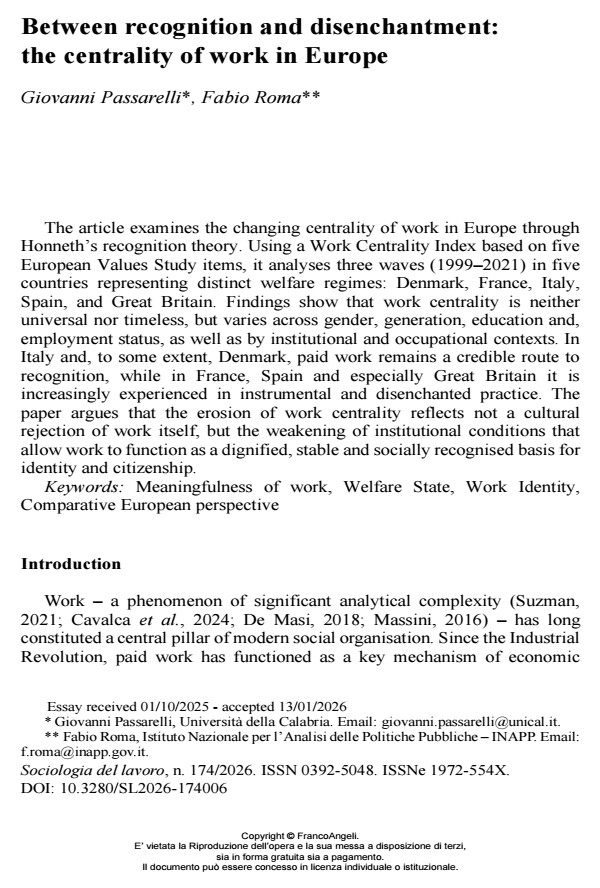
The article examines the changing centrality of work in Europe through Honneth’s recognition theory. Using a Work Centrality Index based on five European Values Study items, it analyses three waves (1999–2021) in five countries representing distinct welfare regimes: Denmark, France, Italy, Spain, and Great Britain. Findings show that work centrality is neither universal nor timeless, but varies across gender, generation, education and, employment status, as well as by institutional and occupational contexts. In Italy and, to some extent, Denmark, paid work remains a credible route to recognition, while in France, Spain and especially Great Britain it is increasingly experienced in instrumental and disenchanted practice. The paper argues that the erosion of work centrality reflects not a cultural rejection of work itself, but the weakening of institutional conditions that allow work to function as a dignified, stable and socially recognised basis for identity and citizenship.
Keywords: Meaningfulness of work, Welfare State, Work Identity, Comparative European perspective
- Antunes R. (2019). Addio al lavoro? La metamorfosi e la centralità del lavoro nell’era della globalizzazione. Trieste: Asterios Editore.
- Ashton D., Davies B., Felstead A., Green F. (1999), Work Skill in Britain. Oxford: SKOPE, Oxford and Warwick Universities.
- Ballarino G., Scherer S. (2013). More investment – but less returns? Changing returns to education in Italy across three decades. Stato e mercato, 33(3), 359-388. DOI: 10.1425/75010
- Barbieri P., Scherer S. (2009). Labour market flexibilization and its consequences in Italy. European Sociological Review, 25(6), 677–692.
- Bauman, Z. (2000). Liquid modernity. Cambridge, UK: Polity Press. (trad. it. Modernità Liquida. Roma-Bari: Laterza, 2002).
- Beck U. (2008). Una prospettiva globale: oltre la società del lavoro. Paradigmi, 1: 19-33. DOI: 10.1400/93123
- Bukodi E., & Goldthorpe J. H. (2019). Social mobility and education in Britain: Research, politics and policy. Cambridge: Cambridge University Press.
- Butera F., De Michelis G. (2024). Intelligenza artificiale e lavoro, una rivoluzione governabile. Venezia: Marsilio.
- Castel R. (1995). Les Métamorphoses de la question sociale : Une chronique du salariat. Paris: Librairie Arthème Fayard (trad. it. Le metamorfosi della questione sociale. Una cronaca del salariato. Milano: MIMESIS, 2019).
- Cavalca G., Mingione E., Pugliese E. (2024). Il lavoro. Dalla rivoluzione industriale alla transizione digitale. Roma. Carocci.
- Cohen, A.K. (1955). Delinquent Boys: The Culture of the Gang. Glencoe: Free Press.
- Confartigianato-Censis (2024). Giovani e lavoro: nuovi valori e attrattività dell’artigianato. Roma: Confartigianato Imprese / Censis. https://www.censis.it/sites/default/files/downloads/QUARTO%20RADAR%20 ARTIGIANO%20RAPPORTO%20FINALE.pdf (accessed: 08/09/2025).
- De Franco G., Marradi A. (2003). Analisi fattoriale e analisi in componenti principali. Catania: Bonanno.
- De Masi D. (2018). Il lavoro nel XXI secolo. Torino: Einaudi.
- Duru-Bellat M. (2006). L’inflation scolaire. Les désillusions de la méritocratie. Paris: Seuil.
- Emmenegger P., Häusermann, S., Palier, B., Seeleib-Kaiser, M. (eds.). (2012). The age of dualization: The changing face of inequality in deindustrializing societies. Oxford: Oxford University Press.
- Esping-Andersen G. (1990). The three worlds of welfare capitalism. Princeton: Princeton University Press.
- Esping-Andersen G. (1999). Social foundations of post-industrial economies. Oxford: Oxford University Press.
- European Values Study (EVS). (1999–2021). European Values Study Longitudinal Data, Waves 1999–2001, 2008–2010, 2017–2021 [Data sets]. GESIS Data Archive. Available at: https://www.gesis.org/evs.
- Eurostat (2023). Over-qualification rate by sex, age and educational attainment level. Luxembourg: Eurostat Database.
- Ferrera M. (1996). The ‘Southern Model’ of Welfare in Social Europe, Journal of European Social Policy, Volume 6; Issue 1. DOI: 10.1177/095892879600600102
- Ferrera M. (2025) Ripensare il modello di welfare sud-europeo, Conferenza Espanet 2025. https://www.secondowelfare.it/primo-welfare/ripensare-il-modello-di-welfare-sud-europeo/ (Accessed 01/12/2025).
- Gallie D. (2007). Production regimes and the quality of employment in Europe. Annual Review of Sociology, 33, 85–104. http://dx.doi.org/10.1146/annurev.soc.33.040406.131724.
- Gallie D. (2013). Economic crisis, quality of work, and social integration: The European experience. Oxford: Oxford University Press.
- Gorz A. (1980). Adieux au prolétariat: Adieux au prolétariat, Paris: Editions Galilée (trad. it. Addio al proletariato oltre il socialismo, Roma: Edizioni Lavoro, 1981. Gorz A. (1988). Métamorphoses du travail, quête du sens: Critique de la raison économique. Paris: Editions Galilée (trad. it. Metamorfosi del lavoro. Torino: Bollati Boringhieri, 1992).
- Guazzo C. (2023). Is work not working anymore? The cultural meaning of work in low work intensity contexts for young, highly-skilled Italians during the pandemic. PhD Thesis. Network for the Advancement of Social and Political Studies, University of Turin and Milan (Italy), Ph.D. in Sociology and Methodology of Social Research, XXXV Cycle.
- Honneth A. (1995). The struggle for recognition: The moral grammar of social conflicts. Cambridge: Polity Press.
- Honneth A., Sennet R., Supiot A. (2020) Perché lavoro? Narrative e diritti per lavoratrici e lavoratori del XXI secolo. Milano: Fondazione Giangiacomo Feltrinelli.
- Inglehart R. (1977). The silent revolution: Changing values and political styles among Western publics. Princeton: Princeton University Press.
- Inglehart R., Welzel, C. (2005). Modernization, cultural change, and democracy: The human development sequence. Cambridge: Cambridge University Press.
- ISFOL - Tomassini M. (eds), (2007). Organizzazione, Apprendimento, Competenze. Indagine sulle competenze nelle imprese industriali e di servizi in Italia. Soveria Mannelli (CZ): Rubbettino, https://oa.inapp.gov.it/handle/20. 500.12916/2290(accessed: 08/09/2025).
- ISTAT (2025) La soddisfazione dei cittadini per le condizioni di vita, Roma: Istituto Nazionale di Statistica, https://www.istat.it/wp-content/uploads/2025/05/Report_Soddifazione-dei-cittadini-per-le-condizioni-di-vita_Anno-2024.pdf (accessed: 08/09/2025).
- Jahoda M. (1982). Employment and unemployment: A social-psychological analysis. Cambridge: Cambridge University Press.
- Laaser K., (2022). Meaningful Work and Sociology: An Introduction to This Themed Issue. Work, Employment and Society, Volume 36, Issue 5, pp. 791-797 DOI: 10.1177/09500170221117082
- Laaser K., Karlsson J. C. (2022). Towards a Sociology of Meaningful Work. Work, Employment and Society, Volume 36, Issue 5, Pages 798-815 DOI: 10.1177/09500170211055998
- Maslow A. (1954). Motivation and personality. New York: Harper & Row. Massini S. (2016). Lavoro. Bologna: il Mulino.
- Musso S. (2020). Le trasformazioni del lavoro nelle rivoluzioni industriali. In: Mingioni E., a cura di, Lavoro: la grande trasformazione. L’impatto sociale del cambiamento del lavoro tra evoluzioni storiche e prospettive globali. Milano: Fondazione Giangiacomo Feltrinelli.
- Mustosmäki, A., Reisel, L., Sihto, T., Teigen, M. (2022). Gendered Labor Market (dis)advantages in Nordic Welfare States. Introduction to the Theme of the Special Issue. Nordic Journal of Working Life Studies, 11(S7).
- OECD (2021). Institutional set-up of active labour market policy provision in OECD and EU countries: Organisational set-up, regulation and capacity. Paris: OECD Publishing. https://dx.doi.org/10.1787/9f2cbaa5-en.
- OECD (2024). Investing in Youth: North Denmark Region, Investing in Youth. Paris: OECD Publishing.
- OECD (2025). OECD Employment Outlook 2025: Can We Get Through the Demographic Crunch? Paris: OECD Publishing.
- Oesch, Daniel (2013). Occupational Change in Europe: How Technology and Education Transform the Job Structure. Oxford: Oxford University Press.
- Piro P. (2018). Perdere il lavoro smarrire il senso. Esperienze educative e altri saggi di sociologia critica. Roma: Mimesis Edizioni.
- Rifkin J. (1995). The End of Work: The Decline of the Global Labor Force and the Dawn of the Post-Market Era. New York: Jeremy P. Tarcher - Putnam Book (trad. it La fine del lavoro. Il declino della forza lavoro globale e l’avvento dell’era post-mercato. Milano: Mondadori, 2005).
- Rosso, B. D., Dekas, K. H., Wrzesniewski, A. (2010). On the Meaning of Work: A Theoretical Integration and Review. Research in Organizational Behavior, 30, 91-127.
- Saraceno C. (2018). La dimensione di genere nell’analisi del welfare e nelle proposte di riforma. Rivista delle Politiche Sociali, n.1, pp. 113-130.
- Schwartz A. (1982). Meaningful Work, Ethics, Vol. 92, No. 4, pp. 634-646.
- Sennett R. (1998). Corrosion of Character: The Personal Consequences of Work in the New Capitalism. New York: W.W. Norton and Co (trad. it. L’uomo flessibile. Le conseguenze del nuovo capitalismo sulla vita personale. Milano: Feltrinelli, 2016.
- Sonia Bertolini S., Gobbino E. (2025). Lavoro 2.0: come i giovani ridefiniscono il significato del lavoro oggi, Sociologia del lavoro, n. 171/2025. http://dx.doi.org/10.3280/SL2025-171005.
- Standing G. (2011). The Precariat: The New Dangerous Class. London-New York: Blomsbury (trad. it. Precari. La nuova classe esplosiva. Bologna: il Mulino, 2012).
- Suzman J. (2021). Lavoro. Una storia culturale e sociale. Milano: Il Saggiatore. Taylor M. (2017). Good work: The Taylor review of modern working practices.
- Department for Business, Energy & Industrial Strategy. https://assets.publishing.service.gov.uk/media/5a82dcdce5274a2e87dc35a4/goo d-work-taylor-review-modern-working-practices-rg.pdf (accessed: 08/092025).
- Verd J.M., Godino A., Gonzalez-Heras A., Rodríguez-Soler J. (2024). Escaping the trap of temporary employment: Precariousness among young people before and after Spain’s 2021 labour market reform act. International of Social Welfare, 34(1), 1-24
- World Economic Forum (2025). The Future of Jobs Report 2025. Geneva: World Economic Forum.
Giovanni Passarelli, Fabio Roma, Between recognition and disenchantment: the centrality of work in Europe in "SOCIOLOGIA DEL LAVORO " 174/2026, pp 107-135, DOI: