Management Control Systems and Social Sustainability in Supply Chains: A Bibliometric-Systematic Literature Review
Journal title MANAGEMENT CONTROL
Author/s Mauro Romano, Chiara Pia Saraò, Marika Intenza, Christian Favino
Publishing Year 2026 Issue 2026/1 Suppl.
Language English Pages 26 P. 111-136 File size 166 KB
DOI 10.3280/MACO2026-001-S1006
DOI is like a bar code for intellectual property: to have more infomation
click here
FrancoAngeli is member of Publishers International Linking Association, Inc (PILA), a not-for-profit association which run the CrossRef service enabling links to and from online scholarly content.
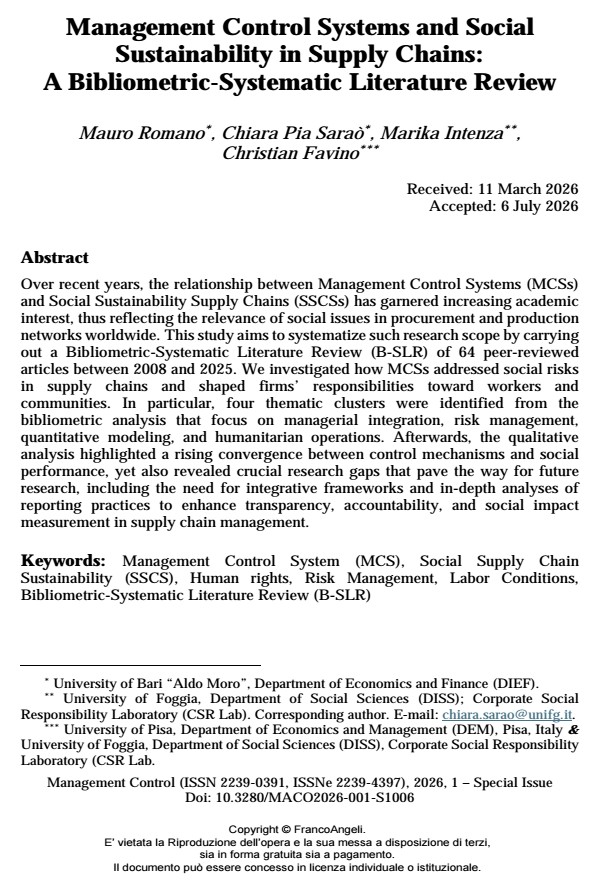
Over recent years, the relationship between Management Control Systems (MCSs) and Social Sustainability Supply Chains (SSCSs) has garnered increasing academic interest, thus reflecting the relevance of social issues in procurement and production networks worldwide. This study aims to systematize such research scope by carrying out a Bibliometric-Systematic Literature Review (B-SLR) of 64 peer-reviewed articles between 2008 and 2025. We investigated how MCSs addressed social risks in supply chains and shaped firms’ responsibilities toward workers and communities. In particular, four thematic clusters were identified from the bibliometric analysis that focus on managerial integration, risk management, quantitative modeling, and humanitarian operations. Afterwards, the qualitative analysis highlighted a rising convergence between control mechanisms and social performance, yet also revealed crucial research gaps that pave the way for future research, including the need for integrative frameworks and in-depth analyses of reporting practices to enhance transparency, accountability, and social impact measurement in supply chain management.
Keywords: Management Control System (MCS), Social Supply Chain Sustainability (SSCS), Human rights, Risk Management, Labor Conditions, Bibliometric-Systematic Literature Review (B-SLR)
- Anthony R. N. (1965). Planning and control systems: A framework for analysis. Boston: Division of Research, Graduate School of Business Administration, Harvard University.
- Ahuja N., Kaur R. (2025). An integrated fuzzy MADM framework for analyzing risk mitigation strategies in digitally sustainable supply chain. Opsearch.
- Autry C. W., Bobbitt L. M. (2008). Supply chain security orientation: Conceptual development and a proposed framework. The International Journal of Logistics Management, 19(1), pp. 42-64.
- Bechtsis D., Tsolakis N., Iakovou E., Vlachos D. (2022). Data-driven secure, resilient and sustainable supply chains: Gaps, opportunities, and a new generalised data sharing and data monetisation framework. International Journal of Production Research, 60(14), pp. 4397-4417.
- Beske P., Seuring S. (2014). Putting sustainability into supply chain management. Supply Chain Management, 19(3), pp. 322-331.
- Bragge J., Kauppi K., Ahola T., Aminoff A., Kaipia R., Tanskanen K. (2019). Unveiling the intellectual structure and evolution of external resource management research: Insights from a bibliometric study. Journal of Business Research, 97, pp. 141-159.
- Broccardo L., Giordino D., Yaqub M. Z., Alshibani S. M. (2025). Implementing sustainability: What role do knowledge management and management accounting play? Agenda for environmentally friendly businesses. Corporate Social Responsibility and Environmental Management, 32(1), pp. 383-403.
- Carter C. R., Easton P. L. (2011). Sustainable supply chain management: Evolution and future directions. International Journal of Physical Distribution & Logistics Management, 41(1), pp. 46-62. DOI: 10.1108/09600031111101420
- Chari F., Ngcamu B. S., Novukela C. (2021). Supply chain risks in humanitarian relief operations: A case of Cyclone Idai relief efforts in Zimbabwe. Journal of Humanitarian Logistics and Supply Chain Management, 11(1), pp. 29-45.
- Cole R., Aitken J. (2020). The role of intermediaries in establishing a sustainable supply chain. Journal of Purchasing and Supply Management, 26(2).
- Corvino A., Intenza M. (2026). Le aziende nell’era della twin transition: i sistemi di management e controllo a supporto dell’agilità e della resilienza. Management Control, (3), pp. 5-14. DOI: 10.3280/MACO2025-003001
- D’Onza G. (2022). L’orientamento delle aziende ad uno sviluppo sostenibile: quale contributo da parte dei sistemi di management e controllo?. Management Control, (1), pp. 5-15. DOI: 10.3280/MACO2022-001001
- Dass P. L., Nair S. V. R. (2025). The influence of sustainability risk management on supply chain sustainability and profitability of medical technology firms. International Journal of Services and Operations Management, 50(3), pp. 389-413.
- Distelhorst G., Shin J. (2023). Assessing the social impact of corporations: Evidence from management control interventions in the supply chain to increase worker wages. Journal of Accounting Research, 61(1), pp. 125-179.
- Ditillo A., Lisi I. E. (2016). Exploring sustainability control systems’ integration: The relevance of sustainability orientation. Journal of Management Accounting Research, 28(2), pp. 125-148.
- Dubey R., Gunasekaran A., Childe S. J., Roubaud D., Wamba S. F. (2020). Blockchain technology for enhancing swift-trust, collaboration and resilience within a humanitarian supply chain setting. International Journal of Production Research, 58(11), pp. 3381-3398.
- Ed-Dafali S., Adardour Z., Derj A., Bami A., Hussainey K. (2025). A PRISMA-based systematic review on economic, social, and governance practices: Insights and research agenda. Business Strategy and the Environment, 34(2), pp. 1896-1916.
- Ellison P. B., Cook R. A. (2020). Health economic analysis of pharmaceutical inventory levels. Journal of Humanitarian Logistics and Supply Chain Management, 10(4), pp. 645-664.
- Erkul M., Kaynak H., Montiel I. (2015). Supplier relations and sustainable operations: The roles of codes of conduct and human resource development. International Journal of Integrated Supply Management, 9(3), pp. 225-249.
- Fiorentino R., Garzella S., Lamboglia R., Mancini D. (2016). Strategie di sostenibilità: dalle motivazioni ai sistemi di misurazione della performance. Management Control, (2 Special Issue), pp. 115-142. DOI: 10.3280/MACO2016-002006
- Freitas K. A. de, Flynn B. B., Paiva E. L., Awaysheh A. (2024). Achieving risk resilience in an environment of mistrust: Supply chain piracy of physical goods. International Journal of Operations & Production Management, 44(3), pp. 565-590.
- Fung Y. N., Choi T. M., Liu R. (2020). Sustainable planning strategies in supply chain systems: Proposal and applications with a real case study in fashion. Production Planning & Control, 31(11-12), pp. 883-902.
- García-Cardona A., León-Darder F. (2023). Novel taxonomy of sustainability soft and hard practices in the food supply chain. International Journal of Logistics Research and Applications, 26(10), pp. 1241-1266.
- Garzella S., Capurro R. (2024). “Sostenibilità sostenibile” e creazione di valore: elementi di pianificazione, gestione, controllo e rendicontazione. Management Control, (2), pp. 5-14. DOI: 10.3280/MACO2024-002001
- Ghasemy Yaghin R., Sarlak P. (2019). Joint order allocation and transportation planning under uncertainty within a socially responsible supply chain. Journal of Modelling in Management, 235, pp. 953-968.
- Göçer A., Brockhaus S., Fawcett S. E., Vural C. A., Knemeyer A. M. (2025). Supply chain sustainability, risk and transformational tension: A systems perspective. International Journal of Logistics Management, 36(1), pp. 21-45.
- Govindan K., Azevedo S. G., Carvalho H., Cruz-Machado V. (2021). From a literature review to a multi-perspective framework for sustainable supply chain management. Journal of Cleaner Production, 282, 124379.
- Grassa R., Bocanet A. (2023). Developing a sustainable operation management system for food charity organizations. Journal of Cleaner Production, 428.
- Heaslip G. (2013). Services operations management and humanitarian logistics. Journal of Humanitarian Logistics and Supply Chain Management, 3(1), pp. 37-51.
- Hosseinifard Z., Layaoen H. D., Abareshi A., Abbasi B., Sheu J.-B. (2025). A critical evaluation of non-profit organizations’ contributions to disaster management: Historical perspectives and future trends in operations management research. Transportation Research Part E: Logistics and Transportation Review, 196.
- Huynh P. L. T., Le P. L., Nguyen T. T. (2025). Sustainability of FDI and domestic firms through big data analytics expertise: The moderating role of supply chain risk management. Benchmarking.
- Jabbour C. J. C., de Sousa Jabbour A. B. L. (2016). Green human resource management and green supply chain management: Linking two emerging agendas. Journal of Cleaner Production, 112, pp. 1824-1833.
- Jahre M. (2017). Humanitarian supply chain strategies: A review of how actors mitigate supply chain risks. Journal of Humanitarian Logistics and Supply Chain Management, 7(2), pp. 82-101.
- Jamalnia A., Gong Y., Govindan K., Bourlakis M., Mangla S. K. (2023). A decision support system for selection and risk management of sustainability governance approaches in multi-tier supply chain. International Journal of Production Economics, 264.
- Kane V., Akbari M., Nguyen L. L. H., Nguyen T. Q. (2022). Corporate social responsibility in Vietnam: Views from corporate and NGO executives. Social Responsibility Journal, 18(2), pp. 316-347.
- Katsoras E., Georgiadis P. (2024). Fostering the transition to viable supply chains under risk: A viability theory approach. Systems Research and Behavioral Science.
- Khan K., Keramati A. (2023). A framework for smart supply chain risk assessment: An empirical study. International Journal of Information Systems and Supply Chain Management, 16(1).
- Khlif H., Chalmers K. (2015). A review of meta-analytic research in accounting. Journal of Accounting Literature, 35(C), pp. 1-27.
- Kumar H., Prakash S, Sindhwani R. (2025). Economic, social and environmental impacts of extended reality (XR) on supply chain: A grounded theory approach. The International Journal of Logistics Management.
- Kuruppu S. C., Milne M. J., Tilt C. A. (2024). Sustainability control systems in short-term operational and long-term strategic decision-making. Meditari Accountancy Research, 32(1), pp. 234-265.
- L’Hermitte C., Bowles M., Tatham P., Brooks B. (2015). An integrated approach to agility in humanitarian logistics. Journal of Humanitarian Logistics and Supply Chain Management, 5(2), pp. 209-233.
- L’Hermitte C., Tatham P., Brooks B., Bowles M. (2016). Supply chain agility in humanitarian protracted operations. Journal of Humanitarian Logistics and Supply Chain Management, 6(2), pp. 173-201.
- Lu Y., Potter A., Mason R. (2017). Supply chain security: A classification of practices and an empirical study of differential effects and complementarity. International Journal of Production Economics, 190, pp. 51-64.
- Lueg R., Radlach R. (2016). Managing sustainable development with management control systems: A literature review. European Management Journal, 34(2), pp. 158-171.
- Machado C. G., Pinheiro de Lima E., Gouvea da Costa S. E., Angelis J. J., Mattioda R. A. (2017). Framing maturity based on sustainable operations management principles. International Journal of Production Economics, 190, pp. 3-21.
- Malmi T., Brown D. A. (2008). Management control systems as a package – Opportunities, challenges and research directions. Management Accounting Research, 19(4), pp. 287-300.
- Power M. (2015). How accounting begins: Object formation and the accretion of infrastructure. Accounting, Organizations and Society, 47, pp. 43-55.
- Mancini D., Lavorato D., & Piedepalumbo P. (2023). Il contributo di Management Control alla ricerca su tecnologie digitali e sostenibilità. Management Control, (2), pp. 5-18. DOI: 10.3280/MACO2023-002001
- Mancini D., Lombardi R., & Tavana M. (2021). Four research pathways for understanding the role of smart technologies in accounting. Meditari Accountancy Research, 29(5), pp. 1041-1062. DOI: 10.1108/MEDAR-03-2021-1258
- Marshall D., McCarthy L., McGrath P., Harrigan F. (2015). What’s your strategy for supply chain disclosure?. MIT Sloan Management Review, 57(2), pp. 37-45.
- Marzi G., Balzano M., Caputo A., Pellegrini M. M. (2025). Guidelines for bibliometric-systematic literature reviews: 10 steps to combine analysis, synthesis and theory development. International Journal of Management Reviews, 27(1), pp. 81-103.
- Merchant K. A., Van der Stede W. A. (2007). Management control systems: Performance measurement, evaluation and incentives (2nd ed.). Harlow: Prentice Hall/Financial Times. Miemczyk J., Luzzini D. (2019). Achieving triple bottom line sustainability in supply chains: The role of environmental, social and risk assessment practices. International Journal of Operations and Production Management, 39(2), pp. 238-259.
- Missaglia A. L., Minutiello V., Urbinati A., Tettamanzi P. (2026). Unpacking the Process of Integrating Sustainability into Management Control Systems: A Literature Review and an Analytical Framework. Business Strategy and the Environment, pp. 1-19.
- Mohammed A., Yazdani M., Govindan K., Chatterjee P., Hubbard N. (2023). Would your company’s resilience be internally viable after COVID-19 pandemic disruption? A new PADRIC-based diagnostic methodology. Transportation Research Part E: Logistics and Transportation Review, 180.
- Moher D., Liberati A., Tetzlaff J., Altman D. G., PRISMA Group (2009). Preferred reporting items for systematic reviews and meta-analyses: The PRISMA statement. PLoS Medicine, 6(7).
- Najaf K., Dhiaf M. M. M., Marashdeh H., Atayah O. F. (2023). The social role of supply chain firms during the pandemic period. International Journal of Quality & Reliability Management, 40(5), pp. 1343-1361.
- Nakamba C. C., Chan P. W., Sharmina M. (2017). How does social sustainability feature in studies of supply chain management? A review and research agenda. Supply Chain Management: An International Journal, 22(6), pp. 522-541. DOI: 10.1108/SCM-12-2016-0436
- Nazeri A., Farahani M., Kazemi S. M. M., Safaie N. (2023). A combined approach to risk assessment in the sustainable supply chain. Cleaner Logistics and Supply Chain, 7, 100105.
- Negri M., Cagno E., Colicchia C., Sarkis, J. (2021). Integrating sustainability and resilience in the supply chain: A systematic literature review and a research agenda. Business Strategy and the Environment, 30(7), pp. 2858-2886.
- Norrman A., Eriksson Ahre E. (2024). Contextualizing supply chain risk governance in critical infrastructure sectors: Insights from the Swedish food system. International Journal of Logistics Management, 35(7), pp. 33-59.
- Ong K. Y., Zailani S., Kanapathy K. (2024). An empirical analysis of supply chain sustainable performances in Malaysian freight logistics industry. International Journal of Services and Operations Management, 49(1), pp. 70-90.
- Pagell M., Wu Z. (2009). Building a more complete theory of sustainable supply chain management using case studies of 10 exemplars. Journal of Supply Chain Management, 45(2), pp. 37-56.
- Pournader M, Kach A. P., Talluri S. (2020). A review of the existing and emerging topics in the supply chain risk management literature. Decision Sciences, 51(4), pp. 867-919.
- Reshad A. I., Biswas T., Agarwal R., Paul S. K., Azeem A. (2023). Evaluating barriers and strategies to sustainable supply chain risk management in the context of an emerging economy. Business Strategy and the Environment, 32(7), pp. 4315-4334.
- Schaltegger S., Christ K. L., Wenzig J., Burritt R. L. (2022). Corporate sustainability management accounting and multi-level links for sustainability – A systematic review. International Journal of Management Reviews, 24, pp. 480-500. 1710.
- Simons R. (1995). Levers of control: How managers use innovative control systems to drive strategic renewal. Boston: Harvard Business School Press.
- Simpson D., Segrave M., Quarshie A., Kach A., Handfield R., Panas G., Moore H. (2021). The role of psychological distance in organizational responses to modern slavery risk in supply chains. Journal of Operations Management, 67(8), pp. 989-1016.
- Singh S., Srivastava S. K. (2022). Decision support framework for integrating triple bottom line (TBL) sustainability in agriculture supply chain. Sustainability Accounting, Management and Policy Journal, 13(2), pp. 387-413.
- Snyder H. (2019). Literature review as a research methodology: An overview and guidelines. Journal of Business Research, 104, pp. 333–339.
- Statsenko L., Jayasinghe R. S., Soosay C. (2024). Supply network resilience capabilities: A social–ecological perspective. Supply Chain Management, 29(1), pp. 1-26.
- Taghavi S. M., Ghezavati V., Mohammadi Bidhandi H., Mirzapour Al-e-Hashem S. M. J. (2024). Sustainable and resilient supplier selection, order allocation, and production scheduling problem under disruption utilizing conditional value at risk. Journal of Modelling in Management, 19(2), pp. 658-692.
- Taschner A., Charifzadeh M. (2020). Management accounting in supply chains – What we know and what we teach. Journal of Accounting & Organizational Change, 16(3), pp. 369-399.
- Tavakoli Haji Abadi Y., Avakh Darestani S. (2023). Evaluation of sustainable supply chain risk: Evidence from the Iranian food industry. Sustainable Futures, 5, 100114.
- Tessier S., Otley D. (2012). A conceptual development of Simons' Levers of Control framework. Management Accounting Research, 23(3), pp. 171-185.
- Tranfield D., Denyer D., Smart P. (2003). Towards a methodology for developing evidence-informed management knowledge by means of systematic review. British Journal of Management, 14(3), pp. 207-222. DOI: 10.1111/1467-8551.00375
- van Eck N. J., Waltman L. (2010). Software survey: VOSviewer, a computer program for bibliometric mapping. Scientometrics, 84(2), pp. 523-538.
- Van Hoek R., Wong C. Y. (2025). Transformative and disruptive or incremental time wrinkles? How to advance thinking and practice in supply chain sustainability, risk management and digitalization. International Journal of Physical Distribution & Logistics Management, 55(4), 311-340.
- Walkiewicz J., Lay-Kumar J., Herzig C. (2021). The integration of sustainability and externalities into the ‘corporate DNA’: A practice-oriented approach. Corporate Governance: The International Journal of Business in Society, 21(3), pp. 479-496.
- Wong L.-W., Tan G. W.-H., Ooi K.-B., Lin B., Dwivedi Y. K. (2024). Artificial intelligence-driven risk management for enhancing supply chain agility: A deep-learning-based dual-stage PLS SEM ANN analysis. International Journal of Production Research, 62(15), pp. 5535-5555.
- Xu M., Cui Y., Hu M., Xu, X., Zhang Z., Liang S., Qu S. (2018). Supply chain sustainability risk and assessment. Journal of Cleaner Production, 205, pp. 587-598.
- Yagci Sokat K., Besiou M. (2024). Anti-trafficking and humanitarian operations: Transferring learnings for a better world. Journal of Humanitarian Logistics and Supply Chain Management.
- Yaghin R. G., Sarlak P. (2020). Joint order allocation and transportation planning under uncertainty within a socially responsible supply chain. Journal of Modelling in Management, 15(2), pp. 531-565.
- Yawar S. A., Seuring S. (2017). Management of social issues in supply chains: A literature review exploring social issues, actions and performance outcomes. Journal of Business Ethics, 141(3): 621-643.
- Zeiringer M., Gronalt M., Aschauer G. (2022). Show me what you do and I will tell you who you are: A cluster typology of supply chain risk management in SMEs. The International Journal of Logistics Management, 33(2), pp. 601-633.
- Zimmer K., Fröhling M., Breun P., Schultmann F. (2017). Assessing social risks of global supply chains: A quantitative analytical approach and its application to supplier selection in the German automotive industry. Journal of Cleaner Production, 149, pp. 96-109.
Mauro Romano, Chiara Pia Saraò, Marika Intenza, Christian Favino, Management Control Systems and Social Sustainability in Supply Chains: A Bibliometric-Systematic Literature Review in "MANAGEMENT CONTROL" 1 Suppl./2026, pp 111-136, DOI: 10.3280/MACO2026-001-S1006