Bureaucratic discretion and digitalization in healthcare authorities’ public procurement
Journal title WELFARE E ERGONOMIA
Author/s Anna Malandrino
Publishing Year 2026 Issue 2026/1
Language English Pages 20 P. 81-100 File size 263 KB
DOI 10.3280/WE2026-0001007
DOI is like a bar code for intellectual property: to have more infomation
click here
Below, you can see the article first page
If you want to buy this article in PDF format, you can do it, following the instructions to buy download credits
FrancoAngeli is member of Publishers International Linking Association, Inc (PILA), a not-for-profit association which run the CrossRef service enabling links to and from online scholarly content.
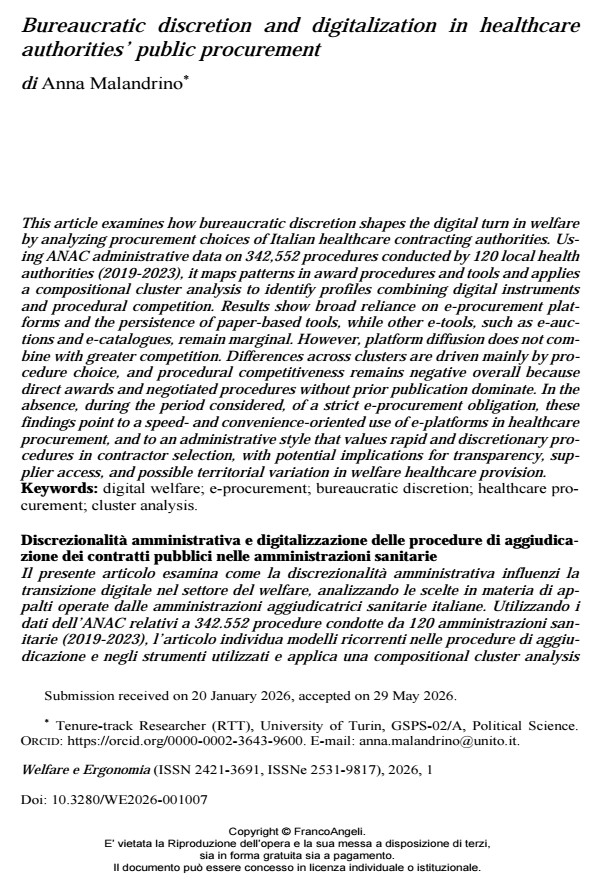
This article examines how bureaucratic discretion shapes the digital turn in welfare by analyzing procurement choices of Italian healthcare contracting authorities. Using ANAC administrative data on 342,552 procedures conducted by 120 local health authorities (2019-2023), it maps patterns in award procedures and tools and applies a compositional cluster analysis to identify profiles combining digital instruments and procedural competition. Results show broad reliance on e-procurement platforms and the persistence of paper-based tools, while other e-tools, such as e-auctions and e-catalogues, remain marginal. However, platform diffusion does not combine with greater competition. Differences across clusters are driven mainly by procedure choice, and procedural competitiveness remains negative overall because direct awards and negotiated procedures without prior publication dominate. In the absence, during the period considered, of a strict e-procurement obligation, these findings point to a speed- and convenience-oriented use of e-platforms in healthcare procurement, and to an administrative style that values rapid and discretionary procedures in contractor selection, with potential implications for transparency, supplier access, and possible territorial variation in welfare healthcare provision.
Keywords: digital welfare; e-procurement; bureaucratic discretion; healthcare procurement; cluster analysis.
- Casula M. and Malandrino A. (2023). Exploring the link between administrative styles and policy output: The case of the Italian Extraordinary Commissioner for the Covid-19 Emergency. European Policy Analysis, 9: 119-141.
- Decarolis F., Lotti C. and Spagnolo G. (2021). Emergency procurement and the Covid-19 crisis: Insights from Italian administrative data. In: Bandiera O., Bosio E., Spagnolo G., editors, Procurement in Focus: Rules, Discretion, and Emergencies. Paris: CEPR Press.
- Ege J., Gofen A., Hadorn S., Hakman I., Malandrino A., Ramseier L. and Sager F. (2024). Understanding street-level managers’ compliance: a comparative study of policy implementation in Switzerland, Italy, Germany, and Israel. Policy and Society, 43(3): 317-333.
- Frigo A. and Mocetti S. (2025). The Effects of Digitalization on the Functioning of the Public Sector: Evidence From E-Procurement. Bank of Italy Occasional Paper, 938: 5-25. DOI: 10.32057/0.QEF.2025.938
- Gaeta G.L., Malandrino A. and Di Mascio F. (2026). Transparency or Access? E-Procurement’s Two Paths to Integrity: Evidence From Italy. Regulation & Governance, pp. 1-19.
- García-Altés A., McKee M., Siciliani L., Pita Barros P., Lehtonen L., Rogers H., Kringos D., Zaletel J. and De Maeseneer J. (2023). Understanding public procurement within the health sector: a priority in a post-COVID-19 world. Health Economics, Policy and Law, 18(2): 172-185. DOI: 10.1017/S1744133122000184
- Geropoulos N., Voultsos P., Geropoulos M., Tsolaki F. and Tagarakis G. (2024). Hybrid model: a promising type of public procurement in the healthcare sector of the European Union. Frontiers in Public Health, 12, 1359155.
- Grandia J. and Warsen R. (2023). Procurement under pressure: shifting governance strategies in turbulent times. Public Management Review, online first. DOI: 10.1080/14719037.2023.2281973
- Hadorn S., Sager F., Mavrot C., Malandrino A. and Ege J. (2022). Evidence-based policymaking in times of acute crisis: Comparing the use of scientific knowledge in Germany, Switzerland, and Italy. Politische Vierteljahresschrift, 63(2): 359-382.
- Hudon P.A., Haren M.T., Gartner J.B., Bergeron F. and Côté A. (2025). Public healthcare procurement strategies in response to the COVID-19 pandemic: A scoping review. International Journal of Health Policy and Management, 14: 8556.
- Hupe P. and Hill M. (2007). Street-level bureaucracy and public accountability. Public Administration, 85: 279-299.
- Janssen W.A. (2023). Public Procurement Law in the European Union. In: Grandia J., Volker L., editors, Public Procurement. Cham: Palgrave Macmillan. DOI: 10.1007/978-3-031-18490-1_3
- Khorana S., Caram S. and Rana N.P. (2024). Measuring public procurement transparency with an index: exploring the role of e-GP systems and institutions. Government Information Quarterly, 41(3), 101952.
- Leijon K. and Moberg L. (2024). Limiting bureaucratic discretion? Analyzing the design and exercise of administrative judicial review in the welfare sector. Governance, 38, e12891.
- Lipsky M. (2010). Street-Level Bureaucracy: Dilemmas of the Individual in Public Services (30th Anniversary ed.). New York: Russell Sage Foundation.
- Malandrino A. (2016). Transnational Information Exchanges between EU Member States’ Contracting Authorities to Reduce Risks and Ensure Integrity in Cross-Border Public Procurement. In: Cantino V., De Vincentiis P. and Racca M.G., editors, Risk management: perspectives and open issues, pp. 872-886. McGraw-Hill Education.
- Malandrino A. (2013). Il diritto di accesso ai documenti nelle gare d’appalto e la tutela di interessi commerciali legittimi e della concorrenza. Il Foro Amministrativo CDS, 12: 1803-1833.
- Malandrino A. and Sager F. (2021). Can Teachers’ Discretion Enhance the Role of Professionalism in Times of Crisis? A Comparative Policy Analysis of Distance Teaching in Italy and Switzerland during the COVID-19 Pandemic. Journal of Comparative Policy Analysis: Research and Practice, 23(1): 74-84. DOI: 10.1080/13876988.2020.1844544
- Malandrino A. and Demichelis E. (2020). Conflict in decision making and variation in public administration outcomes in Italy during the COVID-19 crisis. European Policy Analysis, 6(2): 138-146.
- Pedersen K.Z. and Pors A.S. (2023). Discretionary responses in frontline encounters: Balancing standardization with the ethics of office. Journal of Public Administration Research and Theory, 33(1): 80-93.
- Plant J.F. (2011). Carl J. Friedrich on Responsibility and Authority. Public Administration Review, 71: 471-482.
- Thai K.V. (2001). Public procurement re-examined. Journal of Public Procurement, 1(1): 9-50. DOI: 10.1108/JOPP-01-01-2001-B001
- Tummers L. (2012). Policy Alienation of Public Professionals: The Construct and Its Measurement. Public Administration Review, 72: 516-525.
- Turner I.R. (2022). Reviewing procedure versus judging substance: How increasing bureaucratic oversight can reduce bureaucratic accountability. Journal of Political Institutions and Political Economy, 2(4): 569-596. DOI: 10.1561/113.00000049
- Vaidya K., Sajeev A.S.M. and Callender G. (2006). Critical factors that influence e-procurement implementation success in the public sector. Journal of Public Procurement, 6(1/2): 70-99. DOI: 10.1108/JOPP-06-01-02-2006-B004
- Van den Boogaart K.G. and Tolosana-Delgado R. (2013). Analyzing compositional data with R. Berlin: Springer
Anna Malandrino, Bureaucratic discretion and digitalization in healthcare authorities’ public procurement in "WELFARE E ERGONOMIA" 1/2026, pp 81-100, DOI: 10.3280/WE2026-0001007