Ergonomics of Control: Bureaucracy and Socio-Technical Risks in Digital Welfare
Journal title WELFARE E ERGONOMIA
Author/s Umberto Pagano
Publishing Year 2026 Issue 2026/1
Language Italian Pages 12 P. 129-140 File size 80 KB
DOI 10.3280/WE2026-0001010
DOI is like a bar code for intellectual property: to have more infomation
click here
Below, you can see the article first page
If you want to buy this article in PDF format, you can do it, following the instructions to buy download credits
FrancoAngeli is member of Publishers International Linking Association, Inc (PILA), a not-for-profit association which run the CrossRef service enabling links to and from online scholarly content.
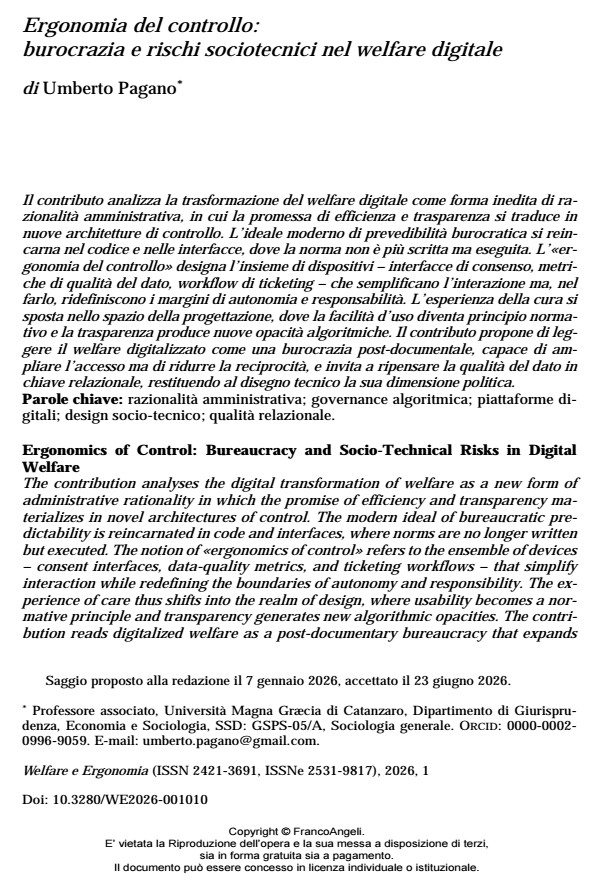
The contribution analyses the digital transformation of welfare as a new form of administrative rationality in which the promise of efficiency and transparency materializes in novel architectures of control. The modern ideal of bureaucratic predictability is reincarnated in code and interfaces, where norms are no longer written but executed. The notion of «ergonomics of control» refers to the ensemble of devices – consent interfaces, data-quality metrics, and ticketing workflows – that simplify interaction while redefining the boundaries of autonomy and responsibility. The experience of care thus shifts into the realm of design, where usability becomes a normative principle and transparency generates new algorithmic opacities. The contribution reads digitalized welfare as a post-documentary bureaucracy that expands access yet limits reciprocity, calling for a relational conception of data quality and for a political reorientation of technical design.
Keywords: administrative rationality; algorithmic governance; digital platforms; socio-technical design; relational quality.
- Henman P. (2022). Digital Social Policy: Past, Present, Future. Journal of Social Policy, 51(3): 535-550. DOI: 10.1017/S0047279422000162
- Bovens M. and Zouridis S. (2002). From Street-Level to System-Level Bureaucracies: How Information and Communication Technology Is Transforming Administrative Discretion and Constitutional Control. Public Administration Review, 62(2): 174-184. DOI: 10.1111/0033-3352.00168
- Campedelli G.M. e Vesan P. (2023). Welfare digitalizzato, welfare digitale e i nuovi rischi sociali digitali. Social Policies, 10(2): 169-192. DOI: 10.7389/108019
- Deleuze G. (1990). Post-scriptum sur les sociétés de contrôle. In: Pourparlers 1972-1990, Paris: Les Éditions de Minuit, pp. 240-247.
- Dencik L. (2022). The Datafied Welfare State: A Perspective from the UK. In: Hepp A., Jarke J., Kramp L., editors, New Perspectives in Critical Data Studies: The Ambivalences of Data Power. Cham: Palgrave Macmillan, pp. 145-165. DOI: 10.1007/978-3-030-96180-0_7
- Dul J., Bruder R., Buckle P., Carayon P., Falzon P., Marras W.S., Wilson J.R. and van der Doelen B. (2012). A strategy for human factors/ergonomics: developing the discipline and profession. Ergonomics, 55(4): 377-395. DOI: 10.1080/00140139.2012.661087.
- Eubanks V. (2018). Automating Inequality: How High-Tech Tools Profile, Police, and Punish the Poor. New York: St. Martin’s Press.
- Han B.C. (2014). Psychopolitik: Neoliberalismus und die neuen Machttechniken. Frankfurt am Main: S. Fischer Verlag.
- Heidegger M. (1954). Die Frage nach der Technik. In: Vorträge und Aufsätze. Pfullingen: Neske, pp. 9-40.
- ISO (2019). ISO 9241-210:2019. Ergonomics of human-system interaction - Part 210: Human-centred design for interactive systems. Geneva: International Organization for Standardization.
- Lessig L. (1999). Code and Other Laws of Cyberspace. New York: Basic Books.
- Longo F. e Maino F., a cura di (2021). Platform Welfare. Nuove logiche per innovare i servizi sociali. Milano: Egea.
- Morozov E. (2013). To Save Everything, Click Here: The Folly of Technological Solutionism. New York: PublicAffairs.
- Norman D.A., Draper S.W., editors (1986). User Centered System Design: New Perspectives on Human-Computer Interaction. Hillsdale, NJ: Lawrence Erlbaum Associates.
- Pasquale F. (2015). The Black Box Society: The Secret Algorithms That Control Money and Information. Cambridge, MA: Harvard University Press.
- Ruppert E., Isin E. and Bigo D. (2017). Data Politics. Big Data & Society, 4(2): 1-7. DOI: 10.1177/2053951717717749
- Weber M. (1922). Wirtschaft und Gesellschaft. Grundriss der verstehenden Soziologie. Tübingen: Mohr (J.C.B. Siebeck).
- Zuboff S. (2019). The Age of Surveillance Capitalism. New York: PublicAffairs.
Umberto Pagano, Ergonomia del controllo: burocrazia e rischi sociotecnici nel welfare digitale in "WELFARE E ERGONOMIA" 1/2026, pp 129-140, DOI: 10.3280/WE2026-0001010