Liminal Spaces in Digital Welfare: Sociotechnical Practices of Online Peer Support
Journal title WELFARE E ERGONOMIA
Author/s Maria Alessandra Molè, Eleonora Melchiorre, Urban Nothdurfter
Publishing Year 2026 Issue 2026/1
Language Italian Pages 13 P. 141-153 File size 105 KB
DOI 10.3280/WE2026-0001011
DOI is like a bar code for intellectual property: to have more infomation
click here
Below, you can see the article first page
If you want to buy this article in PDF format, you can do it, following the instructions to buy download credits
FrancoAngeli is member of Publishers International Linking Association, Inc (PILA), a not-for-profit association which run the CrossRef service enabling links to and from online scholarly content.
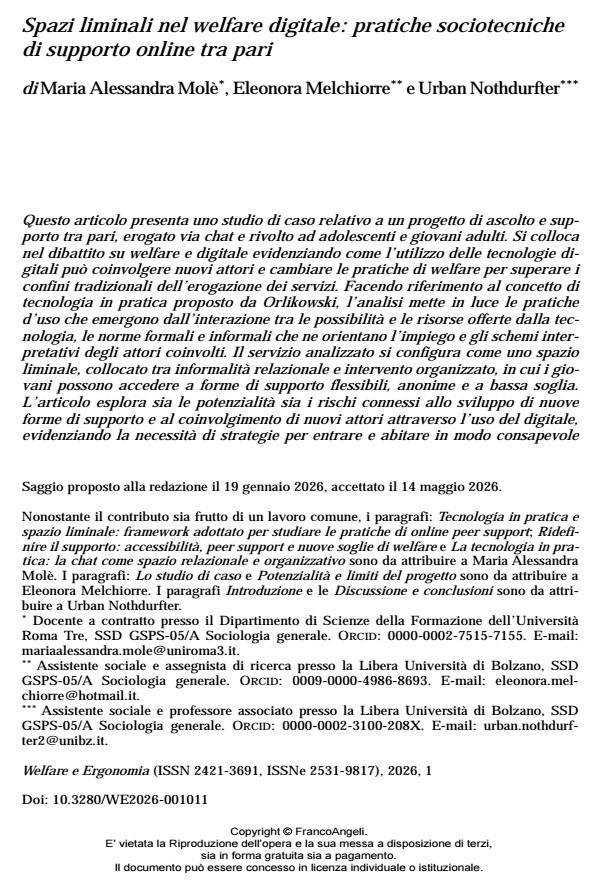
This article presents a case study of a peer listening and support project delivered via chat and addressed to adolescents and young adults. It contributes to the debate on welfare and digitalization, highlighting how the use of digital technologies can involve new actors and transform welfare practices overcoming the traditional boundaries of service provision. Drawing on Orlikowski’s concept of technology in practice, the analysis highlights practices which emerge from the interaction between what is offered by the technology, the formal and informal norms shaping its use, and the interpretive schemes of the actors involved. The service can be understood as a liminal space, situated between relational informality and organized intervention, in which young people can access flexible, anonymous, and low-threshold forms of support. The article examines both potentials and risks associated with the development of new forms of support and the involvement of new actors through digital technologies, emphasising the need for strategies to consciously enter and inhabit digital and hybrid spaces. When strategically governed, these spaces can enhance the inclusivity and proximity of welfare services.
Keywords: digital technologies, digital welfare, peer support, adolescents.
- Bovaird T. (2007). Beyond Engagement and Participation: User and Community Coproduction of Public Services. Public Administration Review, 67: 846-860.
- Caltabiano C., Vitale T. e Zucca G. (2024). La prospettiva civica. L’Italia vista da chi si mette insieme per cambiarla. Milano: Feltrinelli.
- Campedelli M. e Vesan P. (2023). Welfare digitalizzato, welfare digitale e i nuovi rischi sociali digitali: un’introduzione. Social Policies, 10(2): 169-192. DOI: 10.7389/108019
- Dencik L. (2022). The Datafied welfare state: a perspective from the UK. In: Hepp A., Jarke J. and Kramp L., editors, New perspectives in critical data studies: The ambivalences of data power. Cham: Springer International Publishing, pp. 145-165. DOI: 10.1007/978-3-030-96180-0_7
- Faraj S. and Azad B. (2012). The materiality of technology: An affordance perspective. In: Leonardi P.M., Nardi B.A and Kallinikos J., editors, Materiality and organizing: Social interaction in a technological world. Oxford: Oxford University Press, pp. 237-258.
- Fiore-Gartland B. and Neff G. (2015). Communication, mediation and the expectations of data: Data valences across health and wellness communities. International Journal of Communication, 9, 1466-1484.
- Henman P. (2020). Governing by algorithms and algorithmic governmentality: Towards machinic judgement. In: Schuilenburg M. and Peeters R., editors, The algorithmic society. London: Routledge.
- Larasati Z.W., Yuda T.K. and Syafa’at A.R. (2023). Digital welfare state and problem arising: An exploration and future research agenda. International Journal of Sociology and Social Policy, 43(5/6): 537-549. DOI: 10.1108/IJSSP-05-2022-0122
- Lipsky M. (1980). Street-Level Bureaucracy: Dilemmas of the Individual in Public Services. New York: Russell Sage Foundation.
- Nothdurfter U. e Sanfelici M. (2026). Assistere a distanza. Usi delle tecnologie nei servizi per la salute. Roma: Carocci.
- Orlikowski W.J. (2000). Using technology and constituting structures: A practice lens for studying technology in organizations. Organization Science, 11(4): 404-428.
- Orlikowski W.J. (2007). Sociomaterial practices: Exploring technology at work. Organization Studies, 28(9): 1435-1448. DOI: 10.1177/0170840607081138
- Ottman G. and Noble C. (2025). AI and the Disruption of Welfare. Challenges for Social Work Education and Practice. London: Routledge.
- Rouvroy A. and Stiegler B. (2016). The digital regime of truth: From the algorithmic governmentality to a new rule of law. La Deleuziana, 3: 6-29.
- Scott S.V. and Orlikowski W.J. (2014). Entanglements in practice: Performing anonymity through social media. MIS Quarterly, 38(3): 873-893. DOI: 10.25300/MISQ/2014/38.3.1
- Turner V. (1969). The Ritual Process: Structure and Anti-Structure. Chicago: Aldine Publishing Company.
- Van Gennep A. (1960). The Rites of Passage. London: Routledge and Kegan Paul.
- van Toorn G., Henman P. and Soldatic K. (2024). Introduction to the digital welfare state: Contestations, considerations and entanglements. Journal of Sociology, 60: 507-522. DOI: 10.1177/14407833241260890
- Vitale T. (2005). Attivazione e contrattualizzazione nel welfare locale: cambia la posizione dei destinatari?. La Rivista delle Politiche Sociali, 1: 291-323.
- Yoo Y., Henfridsson O. and Lyytinen K. (2010). Research commentary: The new organizing logic of digital innovation. Information Systems Research, 21(4): 724-735.
Maria Alessandra Molè, Eleonora Melchiorre, Urban Nothdurfter, Spazi liminali nel welfare digitale: pratiche sociotecniche di supporto online tra pari in "WELFARE E ERGONOMIA" 1/2026, pp 141-153, DOI: 10.3280/WE2026-0001011