On the psychoanalytic training system
Journal title PSICOTERAPIA E SCIENZE UMANE
Author/s Michael Balint
Publishing Year 2026 Issue 2026/3
Language Italian Pages 20 P. 373-392 File size 340 KB
DOI 10.3280/PU2026-003003
DOI is like a bar code for intellectual property: to have more infomation
click here
Below, you can see the article first page
If you want to buy this article in PDF format, you can do it, following the instructions to buy download credits
FrancoAngeli is member of Publishers International Linking Association, Inc (PILA), a not-for-profit association which run the CrossRef service enabling links to and from online scholarly content.
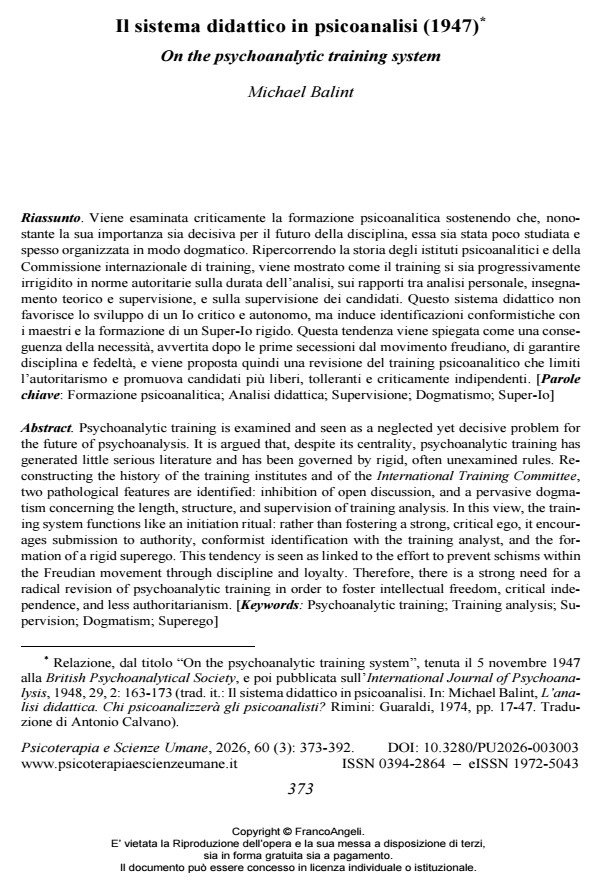
Psychoanalytic training is examined and seen as a neglected yet decisive problem for the future of psychoanalysis. It is argued that, despite its centrality, psychoanalytic training has generated little serious literature and has been governed by rigid, often unexamined rules. Reconstructing the history of the training institutes and of the International Training Committee, two pathological features are identified: inhibition of open discussion, and a pervasive dogmatism concerning the length, structure, and supervision of training analysis. In this view, the training system functions like an initiation ritual: rather than fostering a strong, critical ego, it encourages submission to authority, conformist identification with the training analyst, and the formation of a rigid superego. This tendency is seen as linked to the effort to prevent schisms within the Freudian movement through discipline and loyalty. Therefore, there is a strong need for a radical revision of psychoanalytic training in order to foster intellectual freedom, critical independence, and less authoritarianism.
Keywords: Psychoanalytic training; Training analysis; Supervision; Dogmatism; Superego
- Berliner Psychoanalytisches Institut (1930). Zehn Jahre Berliner Psychoanalytisches Institut. Wien: Internationaler Psychoanalytischer Verlag.
- Bibring E. (1937). III: Report of the International Training Commission. International Journal of Psychoanalysis, 18, 4: 369372.
- Ferenczi S. & Rank O. (1924). Entwicklungsziele der Psychoanalyse (1923). Wien: Internationaler Psychoanalytischer Verlag, 1924 (trad. it. dei capitoli 1, 3 e 5 dalla trad. francese: Prospettive di sviluppo della psicoanalisi. In: Fondamenti di psicoanalisi, Vol. III. Rimini: Guaraldi, 1974, pp. 175193. Riedizione in: Opere, vol. III: 19191926. Milano: Raffaello Cortina, 1992, pp. 201216. Nuova traduzione italiana completa dall’originale tedesco, con una Postfazione di Michael Turnheim: Psicoterapia e Scienze Umane, 2012, 46, 4: 487538. DOI: 10.3280/PU2012004001)
- Ferenczi S. (1932). Notes and fragments (19201932). In: Final Contributions to the Problems and Methods of PsychoAnalysis. Edited by Michael Balint. London: Hogarth, 1955 (trad. it.: Note e frammenti, 19201932. In: Opere, vol. IV: 19271933. Milano: Raffaello Cortina, 2004).
- Freud A. (1928). I. Report of the Tenth International PsychoAnalytical Congress. International Journal of Psychoanalysis, 9, 2: 132156.
- Freud S. (1914). Per la storia del movimento psicoanalitico. Opere, 7: 377438. Torino: Boringhieri, 1975.
- Freud S. (191517 [191617]). Introduzione alla psicoanalisi. Opere, 8: 191611. Torino: Borin ghieri, 1976.
- Freud S. (1918 [1919]). Vie della terapia psicoanalitica. Opere, 9: 1928. Torino: Boringhieri, 1977.
- Freud S. (1937). Analisi terminabile e interminabile. Opere, 11: 497535. Torino: Boringhieri, 1979.
- Glover E. (1935). FourCountries Conference. International Journal of Psychoanalysis, 16, 4: 505509.
- Glover E. (1939). Report of the International Training Commission (Edited by Edward Bibring). International Journal of Psychoanalysis, 20, 2: 212221.
- Jones E. (1936). The future of psychoanalysis. International Journal of Psychoanalysis, 17, 3: 269277.
- Kovács V. (1936). Training and control analysis. International Journal of Psychoanalysis, 17, 3: 346354.
- Sachs H. (1947). Observations of a training analyst. Psychoanalytic Quarterly, 16, 2: 157168.
Michael Balint, Il sistema didattico in psicoanalisi (1947) in "PSICOTERAPIA E SCIENZE UMANE" 3/2026, pp 373-392, DOI: 10.3280/PU2026-003003