When we psychoanalysts organize psychoanalytic training, we must do it psychoanalytically!
Journal title PSICOTERAPIA E SCIENZE UMANE
Author/s Johannes Cremerius
Publishing Year 2026 Issue 2026/3
Language Italian Pages 32 P. 485-514 File size 451 KB
DOI 10.3280/PU2026-003009
DOI is like a bar code for intellectual property: to have more infomation
click here
Below, you can see the article first page
If you want to buy this article in PDF format, you can do it, following the instructions to buy download credits
FrancoAngeli is member of Publishers International Linking Association, Inc (PILA), a not-for-profit association which run the CrossRef service enabling links to and from online scholarly content.
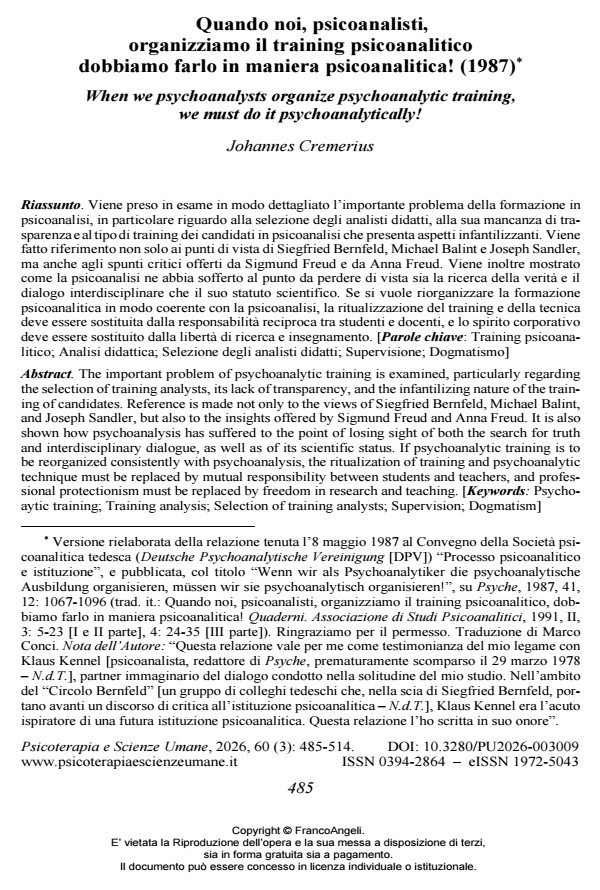
The important problem of psychoanalytic training is examined, particularly regarding the selection of training analysts, its lack of transparency, and the infantilizing nature of the training of candidates. Reference is made not only to the views of Siegfried Bernfeld, Michael Balint, and Joseph Sandler, but also to the insights offered by Sigmund Freud and Anna Freud. It is also shown how psychoanalysis has suffered to the point of losing sight of both the search for truth and interdisciplinary dialogue, as well as of its scientific status. If psychoanalytic training is to be reorganized consistently with psychoanalysis, the ritualization of training and psychoanalytic technique must be replaced by mutual responsibility between students and teachers, and professional protectionism must be replaced by freedom in research and teaching.
Keywords: Psychoaytic training; Training analysis; Selection of training analysts; Supervision; Dogmatism
- Strupp H.H. (1960). Psychotherapists in Action: Explorations of the Therapist’s Contribution to the Treatment Process. New York: Grune & Stratton.
- Thomä H., Grünzig J., Böckenförde H. & Kächele H. (1976). Das Konsensusproblem in der Psychoanalyse. Psyche, 30, 11: 9781027.
- Van der Leeuw (1968). The psychoanalyic society (Presidential Address). International Journal of Psychoanalysis, 49, 2/3: 160164.
- Arbeitsgruppe Ausbildung des Psychoanalytischen Seminars Freiburg (1987). Thesen zur Ausbildung (25. Februar 1987). Werkblatt. Zeitschrift für Psychoanalyse und Gesellschaftskritik, 14, 2: 5458.
- Balint M. (1947). On the psychoanalytic training system. International Journal of Psychoanalysis, 1948, 29, 2: 163173 (trad. tedesca: Über das psychoanalytische Ausbildungssystem. In: Die Urformen der Liebe und die Technik der Psychoanalyse. Stuttgart: Ernst Klett, 1966, pp. 307333; trad. it.: Il sistema didattico in psicoanalisi. In: L’analisi didattica. Chi psicoanalizzerà gli psicoanalisti? Rimini: Guaraldi, 1974, pp. 1747. Anche in: Psicoterapia e Scienze Umane, 2026, 60, 3: 373392. DOI: 10.3280/PU2026003003)
- Balint M. (1949). On the termination of analysis. International Journal of Psychoanalysis, 1950, 31, 3/4: 196199 (trad. it.: La conclusione dell’analisi. In: L’amore primario. Rimini: Guaraldi, 1973; Milano: Raffaello Cortina, 1991, pp. 201207).
- Balint M. (1953). Analytic training and training analysis. International Journal of Psychoanalysis, 1954, 35, 2: 157162 (trad. it.: Formazione analitica e analisi didattica. In: L’analisi didattica. Chi psicoanalizzerà gli psicoanalisti? Rimini: Guaraldi, 1974, pp. 4964. Anche in: Psicoterapia e Scienze Umane, 2026, 60, 3: 417428. DOI: 10.3280/PU2026003005)
- Beland H. (1981). Was ist und wozu entsteht psychoanalytische Identität? Jahrbuch der Psychoanalyse, 1983, 15: 3667 (relazione al Convegno della DPV, maggio 1981).
- Beland H. (1985). Das Problem der Vorhersehbarkeit von Eignung und Nichteignung bei Psychoanalysen. In: Friedrich F. & Ferstl H., editors, Bruchestellen in der Psychoanalyse. Eschborn: Fachbuchhandlung für Psychologie, 1986, pp. 2135.
- Bernfeld S. (1952). On psychoanalytic training. Psychoanalytic Quarterly, 1962, 31, 4: 453482.
- Bird B. (1968). On candidate selection and its relation to analysis. International Journal of Psychoanalysis, 49, 4: 513526.
- Brecht B. (193855 [1961]). Diari di lavoro 19381955. Torino: Einaudi, 1961. Nuova edizione: Diario di lavoro. Torino: Einaudi, 1976, due volumi (ediz. tedesca: Arbeitsjournal 19381955. Frankfurt a.M.: Suhrkamp, 1973).
- Breuer J. & Freud S. (189295 [189395]). Studi sull’isteria. Opere, 1: 162439. Torino: Boringhieri, 1967.
- Bruzzone M., Casaula E., Jimenez J.P. & Jordan J.F. (1985). Regression and persecution in analytic training. Reflections on experience. Int. Review of Psychoanalysis, 12, 4: 411415.
- Cramer B. & Flournoy O. (1975). Panel on “The changing expectations of patients and psychoanalysts today” (29th International Psychoanalytic Association Congress, London, July 27August 1, 1975). International Journal of Psychoanalysis, 1976, 57, 4: 419427.
- Cremerius J. (1981a). Die Präsenz des Dritten in der Psychoanalyse. Psyche, 35, 1: 141.
- Cremerius J. (1981b). Freud bei der Arbeit über die Schulter geschaut. Seine Technik im Spiegel von Schülern und Patienten. Jahrbuch der Psychoanalyse, 22, Suppl. 6: 123158 (trad. it.: Freud al lavoro: uno sguardo al di sopra delle sue spalle. La sua tecnica nel resoconto di allievi e pazienti. In: Il mestiere dell’analista. Torino: Boringhieri, 1985, pp. 184215).
- Cremerius J. (1985). Krankheitswandel oder Verlagerung und Umschichtung der Neurosen im medizinischen Versorgungsbereich. Praxis der Psychotherapie und Psychosomatik, 30, 2: 6071.
- Cremerius J. (1986). Spurensicherung. Die “Psychoanalytische Bewegung” und das Elend der psychoanalytischen Institution. Psyche, 40, 12: 10631091 (trad. it.: Alla ricerca di tracce perdute. Il “Movimento psicoanalitico” e la miseria della istituzione psicoanalitica. Psicoterapia e Scienze Umane, 1987, 21, 3: 334).
- Cremerius J. (1987). Die Einrichtung des Zulassungsverfahrens 19231926 als machtpolitisches Instrument der Psychoanalytischen Bewegung. In: Brede K., Fehlhaber H., Lohmann H.M., Michaelis D., Zeul M., editors, Befreiung zum Widerstand. Aufsätze zu Feminismus, Psychoanalyse und Politik. Margarete Mitscherlich zum 70. Geburtstag. Frankfurt a.M.: Fischer, 1987, pp. 135158 (trad. it.: L’istituzione, tra il 1923 e il 1926, del sistema di selezione come strumento della politica di potere del “movimento psicoanalitico”. Psicoterapia e Scienze Umane, 1990, 24, 4: 2844)
- Deutsche Psychoanalytische Vereinigung (1978). Die Einflüsse der Kassenregelung auf die psychoanalytische Behandlung. Referate und Protokolle der Arbeitstagung der DPV in Berlin vom 16.18. November 1978. Berlin: DPVEigenverlag.
- Eissler K.R. (1953). The effect of the structure of the ego on psychoanalytic technique. Journal of the American Psychoanalytic Association, 1, 1: 104143.
- Eissler K.R. (1969). Irreverent remarks about the present and the future of psychoanalysis. International Journal of Psychoanalysis, 50, 4: 461 471.
- Federn E. (1967). How Freudian are the Freudians? Some remarks of an unpublished letter. Journal of the History of the Behavioral Sciences, III, 3: 269281.
- Federn E. (1972). A cooperation through life. In: Federn E., Urbach A., Meng H. & Weiss E., editors, “ThirtyFive Years with Freud. In Honour of the Hundredth Anniversary of Paul Federn, M.D.”. Journal of the History of the Behavioral Sciences, 8 (Special Monograph Supplement): 1833.
- Ferenczi S. (1928a). Das Problem der Beendigung der Analysen. Internationale Zeitschrift für Psychoanalyse, 14, 1: 110 (trad. inglese: The problem of the termination of the analysis. In: Balint M., editor, Final Contributions to the Problems and Methods of Psychoanalysis. London: Hogarth, 1955, pp. 7786; trad. it.: Il problema del termine dell’analisi. In: Opere, Vol. IV: 19271933. Milano: Raffaello Cortina, 1991, pp. 4149).
- Ferenczi S. (1928b). Die Elastizität der psychoanalytischen Technik. Internationale Zeitschrift für Psychoanalyse, 14, 2: 197209 (trad. inglese: The elasticity of psychoanalytic technique. In: Balint M., editor, Final Contributions to the Problems and Methods of Psychoanalysis. London: Hogarth, 1955, pp. 87101; trad. it.: L’elasticità della tecnica psicoanalitica. In: Opere. Vol. IV: 19271933. Milano: Raffaello Cortina, 1990, pp. 2334).
- Franzen S. (1982). Editorial. Council for the Advancement of Psychoanalytic Education, 2, 2: 2. Freud A. (1938). Probleme der Lehranalyse. In: Max Eitingon in Memoriam. Jerusalem: Israel Psychoanalytic Society, 1950, pp. 8094 (trad. it.: Problemi dell’analisi didattica. In: Opere
- di Anna Freud. Vol. 1: 19221943. Torino: Boringhieri, 1978, pp. 267280. Psicoterapia e Scienze Umane, 2026, 60, 3: 363372. DOI: 10.3280/PU2026003002)
- Freud A. (1966). The ideal psychoanalytic institute: A utopia. Bulletin of the Menninger Clinic, 1971, 35, 4: 225239 (trad. it.: L’istituto psicoanalitico ideale: un’utopia. Opere. Vol. 3: 19651975. Torino: Boringhieri, 1979, pp. 963980. Anche in: Psicoterapia e Scienze Umane, 2026, 60, 3: 429442. DOI: 10.3280/PU2026003006)
- Freud A. (1969). Schwierigkeiten der Psychoanalyse in Vergangenheit und Gegenwart. Frankfurt a.M.: Fischer, 1972 (trad. it.: Le difficoltà della psicoanalisi: confronto fra punti di vista passati e presenti. Opere, Vol. 3: 19651975. Torino: Boringhieri, 1979, pp. 10411064. Anche in: La formazione psicoanalitica, 19381968. Prefazione di Giovanni Sias. Torino: Bollati Boringhieri, 2012, pp. 83114).
- Freud A. (1970). Childanalysis as a subspeciality of psychoanalysis. International Journal of Psychoanalysis, 1972, 53, 2: 151156 (trad. it.: L’analisi infantile come sottospecialità della psicoanalisi. Opere, Vol. 3: 19651975. Torino: Boringhieri, 1979, pp. 11051116).
- Freud S. (1901 [1905]). Frammento di un’analisi di isteria (Caso clinico di Dora). Opere, 4: 301 402. Torino: Boringhieri, 1970.
- Freud S. (190708). Appendice: Appunti di lavoro del 19071908. Opere, 6: 76124. Torino: Boringhieri, 1974 (edizione tedesca: Originalaufzeichnungen zum Fall der Zwangsneurose [“Rattenmann”]. In: Nachtragsband. Texte aus den Jahren 18851938. Frankfurt a.M.: Fischer, 1987, pp. 509569).
- Freud S. (1909). Osservazioni su un caso di nevrosi ossessiva (Caso clinico dell’Uomo dei topi). Opere, 6: 1124. Torino: Boringhieri, 1974.
- Freud S. (1920). Al di là del principio di piacere. Opere, 9: 189249. Torino: Boringhieri, 1977. Freud S. (1932 [1933]). Introduzione alla psicoanalisi (nuova serie di lezioni). Opere, 11: 117 284. Torino: Boringhieri, 1979.
- Freud S. (1937). Analisi terminabile e interminabile. Opere, 11: 497535. Torino: Boringhieri, 1979.
- Freud S. (191517 [191617]). Introduzione alla psicoanalisi. Opere, 8: 191611. Torino: Borin ghieri, 1976.
- Freud S. (1918 [1919]). Vie della terapia psicoanalitica. Opere, 9: 1928. Torino: Boringhieri, 1977.
- Freud S. (1924 [1925]). Autobiografia. Opere, 10: 71141. Torino: Boringhieri, 1978.
- Freud S. (1926). Il problema dell’analisi condotta da non medici. Conversazione con un interlocutore imparziale. Opere, 10: 347415 (Poscritto del 1927. Opere, 10: 416423). Torino: Boringhieri, 1978.
- Freud S. (1932 [1933]). Introduzione alla psicoanalisi (nuova serie di lezioni). Opere, 11: 117 284. Torino: Boringhieri, 1979.
- Freud S. (1937). Analisi terminabile e interminabile. Opere, 11: 497535. Torino: Boringhieri, 1979.
- Freud S. & Andreas Salomé L. (191236 [1966]). Briefwechse. Frankfurt a.M.: Fischer, 1966 (trad. it.: Eros e conoscenza. Lettere 19121936. A cura di Ernst Pfeiffer. Torino: Boringhieri, 1980).
- Gaddini E. (1984). Changes in psychoanalytic patients up to the present day. In: Wallerstein, 1984, pp. 619 (trad. it.: Se e come sono cambiati i nostri pazienti fino ai nostri giorni. Rivista di Psicoanalisi, 1984, 30, 4: 560580. Anche in: Scritti 19531985. Milano: Raffaello Cortina, 1989, pp. 644662).
- Galli P.F. (con la redazione di Psicoterapia e Scienze Umane) (1973). Psicoanalisi e psicoanalisti.
- Psicoterapia e Scienze Umane, 1975, 9, 4: 2031. Ristampa (con un intervento del 1969 di Marianna Bolko, pp. 118119): Psicoterapia e Scienze Umane, 2016, 50, 1: 113120.
- Wallerstein R.S., editor (1984). Changes in Analysts and in Their Training (IPA Monograph 4). London: International Psychoanalytic Association.
- Gitelson M. (1954). Therapeutic problems in the analysis of the “normal” candidate. International Journal of Psychoanalysis, 35, 2: 174183. Anche in: Psychoanalysis: Science and Profession. New York: International Universities Press, 1973 pp. 211238 (trad. it.: Problemi terapeutici nell’analisi del candidato “normale”. In: Psicoanalisi: scienza e professione. Torino: Boringhieri, 1980, cap. 11, pp. 171190).
- Glover E. (1937). Die Grundlagen der therapeutischen Resultate. Internationale Zeitschrift für Psychoanalyse, 23, 1: 4250.
- Jones E. (195357). The Life and Work of Sigmund Freud (3 volumes). New York: Basic Books, 1953 (vol. I), 1955 (vol. II), 1957 (vol. III) (trad. it.: Vita e opere di Sigmund Freud. Milano: Il Saggiatore, 1962, 3 volumi; Garzanti, Milano, 1977, 3 volumi).
- Kernberg O.F. (1984a). Institutional problems of psychoanalytic education. Journal of the American Psychoanalytic Associaton, 1986, 34, 4: 799834.
- Kernberg O.F. (1984b). Changes in the nature of psychoanalytic training, its structure and its standards. In: Wallerstein, 1984, pp. 5965.
- Klüwer R. (1973). Anmerkungen zum Selbstverständnis des Psychoanalytikers. Psyche, 27, 12: 10771089.
- Kuhn T. (1962). The Structure of Scientific Revolutions (2nd Edition: 1970). Chicago, IL: University of Chicago Press (trad. it.: La struttura delle rivoluzioni scientifiche. Torino: Einaudi, 1969).
- Lipton S.D. (1977). The advantages of Freud’s technique and the Rat Man. International Journal of Psychoanalysis, 58, 3: 255273.
- Marx K. (186274). Lettere a Kugelmann. Prefazione di V.I. Lenin. Roma: Editori Riuniti, 1976. Mitscherlich A. (1969). Über Feindseligkeit und hergestellte Dummheit. In: Unseld S. & Hildebrandt D., editors, Deutsches Mosaik. Ein Lesebuch für Zeitgenossen. Frankfurt a.M.: Suhrkamp, 1969, pp. 147156.
- MitscherlichNielsen M. (1970). Was macht einen guten Analytiker aus? Literaturübersicht und kritische Erwägungen. Psyche, 24, 8: 577599.
- Pollmann A. (1985). Die Zulassung zur psychoanalytischen Ausbildung: Eine historische und empirische Studie. Göttingen: Vandenhoeck & Ruprecht.
- Poster M.F. (2021). L’analisi didattica come incidente della storia diventato un rito tribale. Psicoterapia e Scienze Umane, 55, 3: 413414. DOI: 10.3280/PU2021003001
- Richards A.D. (1984). Summary of group discussion. In: Wallerstein, 1984, pp. 5361.
- Richter H.E. (1986). Die Chance des Gewissens. Erinnerungen und Assoziationen. Hamburg: Hoffmann und Campe.
- Sachs H. (1930). Die Lehranalyse. In: Zehn Jahre Berliner Psychoanalytisches Institut (Poliklinik und Lehranstalt). Wien: Internationaler Psychoanalytischer Verlag, 1930, pp. 5354.
- Sachs H. (1947). Observations of a training analyst. Psychoanalytic Quarterly, 16, 2: 157168. Sandler A.M (1982). The selection and function of the training analyst in Europe. International Review of Psychoanalysis, 9, 4: 386392.
- Sandler J. (1983). Reflections on some relations between psychoanalytic concepts and psychoanalytic practice. International Journal of Psychoanalysis, 64, 1: 3545 (trad. tedesca: Die Beziehung zwischen psychoanalytischen Konzepten und psychoanalytischer Praxis. Psyche, 1983, 37, 7: 577595).
- Smirnoff V.N. (1980). Mindestformen oder maximale Erwartungen? Einleitung zur Diskussion über die Aufnahme neuer Mitglieder in eine psychoanalytische Gesellschaft. Bulletin de la Fédération Européenne de Psychanalyse, 14: 1723.
- Speier S. (1983). Gedanken zur Ausbildung oder wie man Analytiker wird. In: Lohmann H.M., editor, Das Unbehagen in der Psychoanalyse: Eine Streitschrift. Frankfurt a.M.: Fisher, 1983, pp. 104110.
- Wallerstein R. & Sampson H. (1971). Issues in research in the psychoanalytic process. International Journal of Psychoanalysis, 52, 2: 1150.
Johannes Cremerius, Quando noi, psicoanalisti, organizziamo il training psicoanalitico dobbiamo farlo in maniera psicoanalitica! (1987) in "PSICOTERAPIA E SCIENZE UMANE" 3/2026, pp 485-514, DOI: 10.3280/PU2026-003009