From Basle to Milan to Zurich: On psychoanalytic training
Journal title PSICOTERAPIA E SCIENZE UMANE
Author/s Pier Francesco Galli
Publishing Year 2026 Issue 2026/3
Language Italian Pages 8 P. 623-630 File size 254 KB
DOI 10.3280/PU2026-003017
DOI is like a bar code for intellectual property: to have more infomation
click here
Below, you can see the article first page
If you want to buy this article in PDF format, you can do it, following the instructions to buy download credits
FrancoAngeli is member of Publishers International Linking Association, Inc (PILA), a not-for-profit association which run the CrossRef service enabling links to and from online scholarly content.
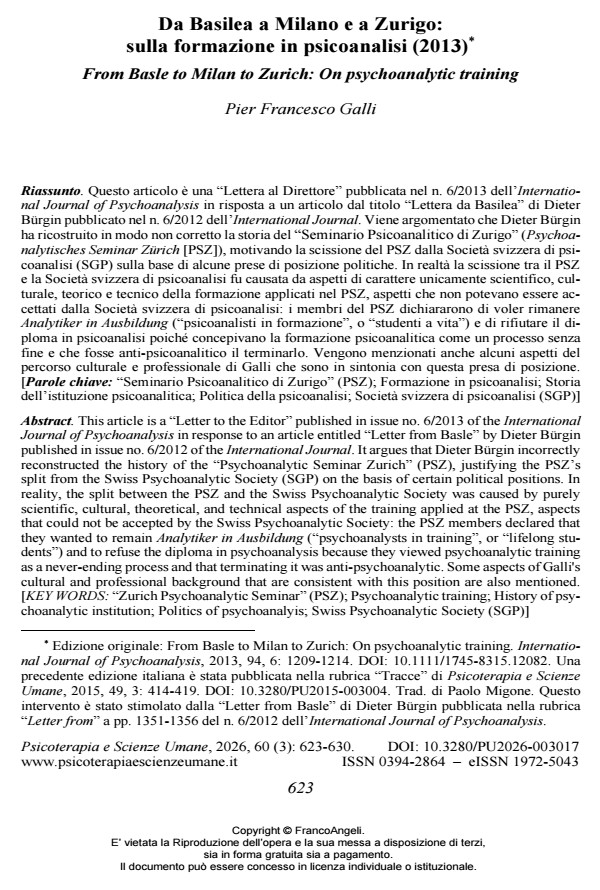
This article is a “Letter to the Editor” published in issue no. 6/2013 of the International Journal of Psychoanalysis in response to an article entitled “Letter from Basle” by Dieter Bürgin published in issue no. 6/2012 of the International Journal. It argues that Dieter Bürgin incorrectly reconstructed the history of the “Psychoanalytic Seminar Zurich” (PSZ), justifying the PSZ’s split from the Swiss Psychoanalytic Society (SGP) on the basis of certain political positions. In reality, the split between the PSZ and the Swiss Psychoanalytic Society was caused by purely scientific, cultural, theoretical, and technical aspects of the training applied at the PSZ, aspects that could not be accepted by the Swiss Psychoanalytic Society: the PSZ members declared that they wanted to remain Analytiker in Ausbildung (“psychoanalysts in training”, or “lifelong students”) and to refuse the diploma in psychoanalysis because they viewed psychoanalytic training as a neverending process and that terminating it was antipsychoanalytic. Some aspects of Galli's cultural and professional background that are consistent with this position are also mentioned.
Keywords: “Zurich Psychoanalytic Seminar” (PSZ); Psychoanalytic training; History of psychoanalytic institution; Politics of psychoanalyis; Swiss Psychoanalytic Society (SGP)
- Bolko M. & Rothschild B. (2006). Una “pulce nell’orecchio”. Cronaca del controcongresso dell’International Psychoanalytic Association di Roma del 1969. Psicoterapia e Scienze Umane, 40, 3: 703718. Ristampe: 2015, 49, 3: 431446 (
- Bürgin D. (2012). Letter from Basle. International Journal of Psychoanalysis, 93, 6: 13511356. DOI: 10.1111/17458315.12028
- GarzaGuerrero C. (2004). Reorganizational and educational demands of psychoanalitic training today: Our long and marasmic night of one century. International Journal of Psychoanalysis, 85, 1: 313. DOI: 10.1516/218TE85E7RA803UX
- Kernberg O.F. (1996). Thirty methods to destroy the creativity of psychoanalytic candidates. International Journal of Psychoanalysis, 77, 5: 10311040 (trad. it.: Trenta modi per distruggere la creatività dei candidati in psicoanalisi. Gli Argonauti, 1998, 76: 114. Anche in: Psicoterapia e Scienze Umane, 2026, 60, 3: 543556. DOI: 10.3280/PU2026003012)
- Kernberg O.F. (2011). La formazione in psicoanalisi e psicoterapia dinamica oggi: conflitti e sfide. Psicoterapia e Scienze Umane, 45, 4: 457471. DOI: 10.3280/PU2011004002
- Kernberg O.F. (2012). Suicide prevention for psychoanalytic institutes and societies. Journal of the American Psychoanalytic Association, 60, 4: 707719.
- Parin P. (1984). Anpassung oder Widerstand. Bemerkungen zu dem Aufsatz von Hans Füchtner “Traurige Psychotropen” (2011984) [Adeguamento od opposizione. Nota sul saggio di Hans Füchtner “Tristi psicotropici”. Psyche, 1984, 38, 7: 605626]. Psyche, 38, 7: 627635. Galli P.F. (con la redazione di Psicoterapia e Scienze Umane) (1973). Psicoanalisi e psicoanalisti. Psicoterapia e Scienze Umane, 1975, 9, 4: 2031. Ristampa (con un intervento del 1969 di
- Marianna Bolko, pp. 118119): Psicoterapia e Scienze Umane, 2016, 50, 1: 113120.
- Rodrigué E. (2007). Freud, le siècle de la psychanalyse. Paris: Payot (trad. it.: Freud: il secolo della psicoanalisi. Roma: Borla, 2010).
Pier Francesco Galli, Da Basilea a Milano e a Zurigo: sulla formazione in psicoanalisi (2013) in "PSICOTERAPIA E SCIENZE UMANE" 3/2026, pp 623-630, DOI: 10.3280/PU2026-003017