La trasformazione digitale e il controllo di gestione negli ecosistemi di business: verso una nuova prospettiva
Titolo Rivista MANAGEMENT CONTROL
Autori/Curatori Alessandro Marelli, Enrico Di Berardino
Anno di pubblicazione 2026 Fascicolo 2026/1 Suppl.
Lingua Italiano Numero pagine 22 P. 163-184 Dimensione file 248 KB
DOI 10.3280/MACO2026-001-S1008
Il DOI è il codice a barre della proprietà intellettuale: per saperne di più
clicca qui
FrancoAngeli è membro della Publishers International Linking Association, Inc (PILA), associazione indipendente e non profit per facilitare (attraverso i servizi tecnologici implementati da CrossRef.org) l’accesso degli studiosi ai contenuti digitali nelle pubblicazioni professionali e scientifiche.
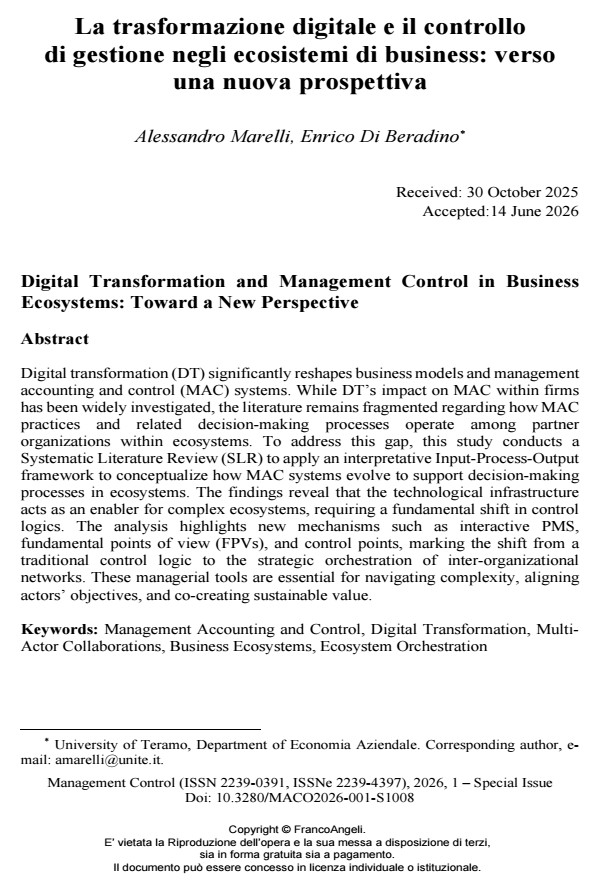
Digital transformation (DT) significantly reshapes business models and management accounting and control (MAC) systems. While DT’s impact on MAC within firms has been widely investigated, the literature remains fragmented regarding how MAC practices and related decision-making processes operate among partner organizations within ecosystems. To address this gap, this study conducts a Systematic Literature Review (SLR) to apply an interpretative Input-Process-Output framework to conceptualize how MAC systems evolve to support decision-making processes in ecosystems. The findings reveal that the technological infrastructure acts as an enabler for complex ecosystems, requiring a fundamental shift in control logics. The analysis highlights new mechanisms such as interactive PMS, fundamental points of view (FPVs), and control points, marking the shift from a traditional control logic to the strategic orchestration of inter-organizational networks. These managerial tools are essential for navigating complexity, aligning actors’ objectives, and co-creating sustainable value.
Parole chiave:Management Accounting and Control, Digital Transformation, Multi-Actor Collaborations, Business Ecosystems, Ecosystem Orchestration
- Bohnsack R., Rennings M., Block C., Bröring S. (2024). Profiting from innovation when digital business ecosystems emerge: A control point perspective. Research Policy, 53(3), 104961.
- Borlatto E., Ballesio E., Truant E., Broccardo L. (2026). Evolving Roles and Strategic Influence of CFOs within Modern Management Control Systems: A Systematic Literature Review. Management Control, 1, pp. 17-40, DOI: 10.3280/MACO2026-001002
- Buhalis D., Harwood T., Bogicevic V., Viglia G.; Beldona S., Hofacker C. (2019). Technological disruptions in services: lessons from tourism and hospitality. Journal of Service Management, 30(2), pp. 484-506. DOI: 10.1108/JOSM-12-2018-0398
- Burström T., Parida V., Lahti T., Wincent J. (2021). AI-enabled business-model innovation and transformation in industrial ecosystems: A framework, model and outline for further research. Journal of Service Management, 30(2), pp. 484-506.
- Caglio A. (2008). Il costing oltre i confini d’impresa. Metodologie e strumenti per la misurazione e la gestione dei costi nella supply chain. Milano: McGraw-Hill.
- Caglio A., Ditillo A. (2012a). Interdependence and Accounting Information Exchanges in Inter-Firm Relationships. Journal of Management and Governance, 23(1), pp. 57-80.
- Caglio A., Ditillo A. (2012b). Opening the black box of management accounting information exchanges in buyer-supplier relationships. Management Accounting Research, 23, pp. 61-78.
- Caputo A., Fiorentino R., Garzella S. (2018). From the boundaries of management to the management of boundaries: Business processes, capabilities and negotiations. Business Process Management Journal, 25(3), pp. 391-413. DOI: 10.1108/BPMJ-11-2017-0334
- Cavazza A., Dal Mas F., Campra M., Brescia V. (2025). Artificial intelligence and new business models in agriculture: the ZERO case study. Management Decision, 63(10), pp. 3244-3261. DOI: 10.1108/MD-06-2023-0980
- Chua W. F., Messner M. (2024). Algorithms, performance measurement, and management control, Anne M. Lillis and Jennifer Grafton (Ed.). Research Handbook on Performance Measurement for Management Control, Edward Elgar Publishing, pp. 29-47.
- Cinquini L., Tenucci A. and Campanale C. (2018). Performance Measurement in Servitization: results from a structured literature review. Manufacturing & Service Accounting Research Conference. Oslo, Norway, June 15-16, 2018.
- Colombo V. L. B.; Beuren I. M. (2023). Accountants robots in shared service centers: effects of the culture for innovation, work engagement and performance measurement system. Journal of Business and Industrial Marketing, 38(12), pp. 2760-2771. DOI: 10.1108/JBIM-09-2022-0436
- Corvino A., Intenza M. (2025). Le aziende nell’era della twin transition: i sistemi di management e controllo a supporto dell’agilità e della resilienza. Management Control, 3, pp. 5-14. DOI: 10.3280/MACO2025-003001
- Damavandi S., Berardi L. (2024). Exploring the Impact of Digitalization on the Social Economy: A Systematic Literature Review. Management Control, 3, pp. 61-85, DOI: 10.3280/MACO2024-003004
- Di Berardino E., Marelli A. (2024). Digitalizzazione e sostenibilità: i ruoli e le sfide del controller aziendale. In: Busetti S., Noto A., Romani R. (Eds). Diritti umani, giustizia sociale e principi di sostenibilità. Profili interdisciplinari per la complessità dei mutamenti epocali, Ricerche&Redazioni, pp. 303-318.
- Di Tullio P., La Torre M., Rea M., Guthrie J., Dumay J. (2023). Beyond the planetary boundaries: exploring pluralistic accountability in the new space age. Accounting Auditing & Accountability Journal, 37(5), pp. 1283-1311. DOI: 10.1108/AAAJ-08-2022-6003
- Fähndrich J. (2023). A literature review on the impact of digitalisation on management control. Journal of Management Control, 34, pp. 9-65.
- Graça P., Camarinha-Matos L. M. (2021). Assessment of Sustainable Collaboration in Collaborative Business Ecosystems. Computers, 10(12), 167.
- Haftor D. M., Climent R. C., Lundström E. (2021). How machine learning activates data network effects in business models: Theory advancement through an industrial case of promoting ecological sustainability. Journal of Business Research, 131, pp. 196-205.
- Hiebl M. R. W. (2023). Sample Selection in Systematic Literature Reviews of Management Research. Organizational Research Methods, 26(2), pp. 229-261. DOI: 10.1108/QRAM-12-2021-0222
- Jacobides M. G. (2022). How to Compete When Industries Digitize and Collide: An Ecosystem Development Framework. California Management Review, 64(3), pp. 99-123. DOI: 10.1177/00081256221083352
- Jacobides M. G., Cennamo C., Gawer A. (2018),. Towards a theory of ecosystems. Strategic Management Journal, 39(8), pp. 2255-2276.
- Knudsen D. R. (2020). Elusive boundaries, power relations, and knowledge production: A systematic review of the literature on digitalization in accounting. International Journal of Accounting Information Systems, 36(1), 100441.
- Kohtamäki M., Parida V., Oghazi P., Gebauer H., Baines T. (2019). Digital servitization business models in ecosystems. A Theory of the firm. Journal of Business Research, 104, pp. 380-392.
- Kolagar M., Parida V., Sjödin D. (2022). Ecosystem transformation for digital servitization: A systematic review, integrative framework, and future research agenda. Journal of Business Research, 146, pp. 176-200.
- Marelli A., Di Berardino E. (2014). Relazioni e dinamiche nello scambio di «informazioni contabili sensibili» per prodotti-servizi competitivi. Economia dei Servizi, Mercati, Istituzioni, Management, 1, pp. 19-42. DOI: 10.2382/80261
- Marelli A., Dello Sbarba A. (2025). Insights on the role of performance measurement systems in the digital servitization landscape: a longitudinal case study. Qualitative Research in Accounting and Management, 22(3), pp. 286-320. DOI: 10.1108/QRAM-11-2022-0185
- Massaro M., Dumay J., Guthrie J. (2016). On the shoulder of giants: undertaking a structured literature review in accounting. Accounting, Auditing & Accountability Journal, 29(5), pp. 767-801. DOI: 10.1108/AAAJ-01-2015-1939
- Möller K., Schäffer U., Verbeeten F. (2020). Digitalization in management accounting and control: an editorial. Journal of Management Control, 31, pp. 1-8.
- Mukhopadhyay S., Bouwman H. (2019). Orchestration and governance in digital platform ecosystems: a literature review and trends. Digital Policy, Regulation and Governance, 21(4), pp. 329-351. DOI: 10.1108/DPRG-11-2018-0067
- Palozzi G., Di Martino M., Chirico A., Antonucci G. (2025). La misurazione dell’impatto della digitalizzazione sulla performance delle organizzazioni di Long-Term Care. Una revisione sistematica della letteratura. Management Control, 3, pp. 111-135, DOI: 10.3280/MACO2025-003006
- Pham Q. H., Vu K. P. (2024a). Digitalization accounting information system and servitization in public sector organizations - moderating effect of recoverable slack. Cogent Business and Management, 11(1), 2420762. DOI: 10.1080/23311975.2024.2420762
- Pham Q. H., Vu K. P. (2024b). Insight into the impact of digital accounting information system on sustainable innovation ecosystem. Sustainable Futures, 8, 100377.
- Pham Q. H., Vu K. P. (2025a). Green Innovation Ecosystem Establishment Through Strategizing the Business Model in Public Sector. Public Works Management and Policy, 30(1), pp. 101-136.
- Pham Q. H., Vu K. P. (2025b). Does effectiveness of digital accounting system intensify sustainable business model innovation with mediating role of digital business ecosystem?. Journal of Innovation and Entrepreneurship, 14(1), 3.
- Rosa F. S., Compagnucci L., Lunkes R. J., Monteiro J. J. (2023). Green innovation ecosystem and water performance in the food service industry: The effects of environmental management controls and digitalization. Business Strategy and the Environment, 32(8), pp. 5459-5476.
- Rowan N. J. (2025). Embracing a Penta helix hub framework for co-creating sustaining and potentially disruptive sterilization innovation that enables artificial intelligence and sustainability: A scoping review. Science of the Total Environment, 972, 179018.
- Sandberg J., Holmström J., Lyytinen K. (2020). Digitization and phase transitions in platform organizing logics: Evidence from the process automation industry. MIS Quarterly: Management Information Systems, 44(1), pp. 129-153. 10.3390/fi12080128.
- Sayers A. (2008). Tips and tricks in performing a systematic review. British Journal of General Practice, 58(547), p. 136.
- Schaefer J. L., Siluk J. C. M., Carvalho P. S. D. (2021). An MCDM-based approach to evaluate the performance objectives for strategic management and development of Energy Cloud. Journal of Cleaner Production, 320, 128853. Technological Forecasting & Social Change, 166, 120647.
- Schneider M. H. G., Kanbach D. K., Kraus S., Dabic M. (2024). Transform me if you can: leveraging dynamic capabilities to manage digital transformation. IEEE Transactions on Engineering Management, 71, pp. 9094-9108. DOI: 10.1109/TEM.2023.3319406
- Shi J., Jiang S. (2025). Toward open-source foundation model ecosystem: Impact evaluation framework and promotion mechanism. Technological Forecasting and Social Change, 221, 124328.
- Sjödin D., Parida V., Palmié M., Wincent J. (2021). How AI capabilities enable business model innovation: Scaling AI through co-evolutionary processes and feedback loops, Journal of Service Management, 134, pp. 574-587.
- Vilkkumaa E., Liesiö J., Salo A., Ilmola-Sheppard L. (2018). Scenario-based portfolio model for building robust and proactive strategies. European Journal of Operational Research, 266(1), pp. 205-220.
- Wang J., Zhang K., Lin K. Y., Feng L. (2023). A systematic review for organizing servitization by multi-actor collaborations: lenses, factors and outcomes. Journal of Business and Industrial Marketing, 38(4), pp. 828-851. DOI: 10.1108/JBIM-07-2021-0355
- Yin D., Ming X., Zhang X. (2020). Sustainable and smart product innovation ecosystem: An integrative status review and future perspectives. Journal of Cleaner Production, 274, 123005.
- Yongzhang L. (2025). Digital transformation and pathways for promoting global value position: an empirical study in Chinese manufacturing industries. International Journal of Low-Carbon Technologies, 20, pp. 119-128.
- Zhang L., Kamasak R., Tang Y., Cai Y., Kucukaltan B. (2025). A Multilevel Examination of Performance in Innovation Ecosystems: Board, Asset Scale, Technology, and Government Support. IEEE Transactions on Engineering Management, 72, pp. 1714-1729. DOI: 10.1109/TEM.2025.3562907
Alessandro Marelli, Enrico Di Berardino, La trasformazione digitale e il controllo di gestione negli ecosistemi di business: verso una nuova prospettiva in "MANAGEMENT CONTROL" 1 Suppl./2026, pp 163-184, DOI: 10.3280/MACO2026-001-S1008