FinTech: Rethinking Financial Intermediation
Autori:

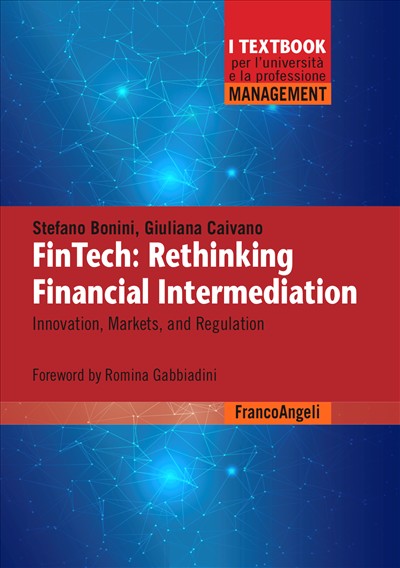
Stefano Bonini, Giuliana Caivano

FinTech: Rethinking Financial Intermediation

Innovation, Markets, and Regulation

This book aims to provide a rigorous and structured framework to understand FinTech, including its historical evolution, technological foundations, and core application areas. It seeks to offer a practical interpretative tool for students and professionals, helping them make sense of ongoing transformations and, potentially, design new solutions.

Pagine: 304

ISBN: 9788835196099

Edizione: in preparazione 1a edizione 2026

Codice editore: 1059.65

FinTech is often described as the application of technology to finance. This definition, while widespread, is misleading. FinTech is not about technology itself. FinTech is about rethinking financial services starting from users’ needs and using technology as an enabling tool to design more effective solutions. When we shift the focus from money to needs, we begin to dismantle many of the traditional assumptions of finance. This does not mean rejecting traditional finance, but rather reinterpreting it. From this perspective, technology is not the objective, but the enabler; financial services are not products, but solutions to needs; innovation is not incremental, but architectural. This idea represents the underlying thread of the entire book.
Across twelve chapters, the book examines digital payments, digital lending, credit risk modelling and decision systems, blockchain and crypto-assets, wealth management, supply chain finance, and sustainable finance, concluding with the governance of artificial intelligence under the AI Act and digital operational resilience under DORA. Case studies and evidence drawn from European banking portfolios show how these transformations affect risk, capital requirements, and regulation in practice.
The book offers students, practitioners, journalists, entrepreneurs, and investors a framework for rethinking financial intermediation and designing new solutions.

Stefano Bonini teaches FinTech at University of Bologna, Innovation in Banking and Financial Markets at University of Florence, and Risk Management at LUMSA University and School of Management of Politecnico di Milano. He has been invited to teach FinTech at University of Barcelona, Université Côte d’Azur, and Amsterdam University of Applied Sciences. He has over twenty years of consulting experience in the banking and financial sector, specialising in FinTech, credit risk, and climate risk modelling. He regularly publishes academic research and speaks at national and international conferences.

Giuliana Caivano teaches Business Statistics at University of Milan, Sustainability for Professionals at University of Bologna, and Credit Risk at School of Management of Politecnico di Milano. She has been invited to teach AI and Machine Learning for Banking Risk Management at Amsterdam University of Applied Sciences. She has over twenty years of experience in banking risk management. She regularly publishes academic research and speaks at national and international conferences.

Romina Gabbiadini, Foreword

Stefano Bonini, Preface

Part I. Foundations

Understanding FinTech: A Systemic Perspective

  • What Is FinTech
  • The Evolution of FinTech: From Infrastructure to Intelligence
  • The FinTech Ecosystem: A Systemic Framework
  • Key Takeaways

Data, Platforms, and Digital Business Models

  • Data as the Raw Material of Finance
  • Platform Economics and Network Effects
  • The DIVA Matrix: Understanding FinTech Business Models
  • Key Takeaways

Artificial Intelligence in Finance

  • A Short History of Artificial Intelligence
  • Machine Learning
  • Neural Networks and Deep Learning
  • Generative AI and Agents
  • The AI Infrastructure Stack
  • Key Takeaways

Part II. Applications

Digital Payments

  • The IPA Framework: Mapping the Payment System Stack
  • The European Payments Landscape
  • Frontier Models in Practice
  • The Changing Economics of Payments
  • Key Takeaways

Digital Lending

  • Economics of Digital Credit
  • Marketplace Lending
  • Buy Now, Pay Later
  • Key Takeaways

Credit Risk Modelling and Decision Systems

  • Credit Strategy
  • Underwriting and Origination
  • Portfolio Monitoring
  • Collection
  • Fraud Detection
  • AI Governance and Regulatory Challenges
  • Key Takeaways

Blockchain, DLT, and Crypto-Assets

  • Blockchain as a Trust Infrastructure
  • Programmable Finance
  • Crypto-Assets as an Investment Class
  • DLT in Traditional Financial Infrastructure
  • Key Takeaways

Wealth Management in the digital age

  • Evolution of Wealth Management
  • WealthTech Solutions
  • Governance Challenges and Future Directions
  • Key Takeaways

Supply Chain Finance

  • The Economics of Supply Chain Finance
  • Supply Chain Finance Techniques
  • Platforms, Data, and Risk
  • Key Takeaways

Sustainable Finance and Fintech

  • ESG Data Ecosystem
  • Sustainability Analytics
  • Sustainability Tech Platforms
  • Key Takeaways

Part III. Regulation, Governance and Resilience

AI Act: Govervance, Regulation, and Risk

  • The AI Act Risk Framework
  • AI Act and EU Digital Frameworks
  • Translating Compliance into Enterprise Control Systems
  • The Digital Omnibus Perspective
  • Strategic Implications and Roadmap
  • Key Takeaways

Digital Operational Resilience

  • From Digital Transformation to Digital Dependency
  • DORA: The European Framework and its Five Pillars
  • Supervising Financial Institutions and Critical ICT Providers
  • Limits and Future of Digital Operational Resilience
  • Key Takeaways

Giuliana Caivano, Afterword

References

List of tables

List of figures

List of boxes

About the Authors

Potrebbero interessarti anche